
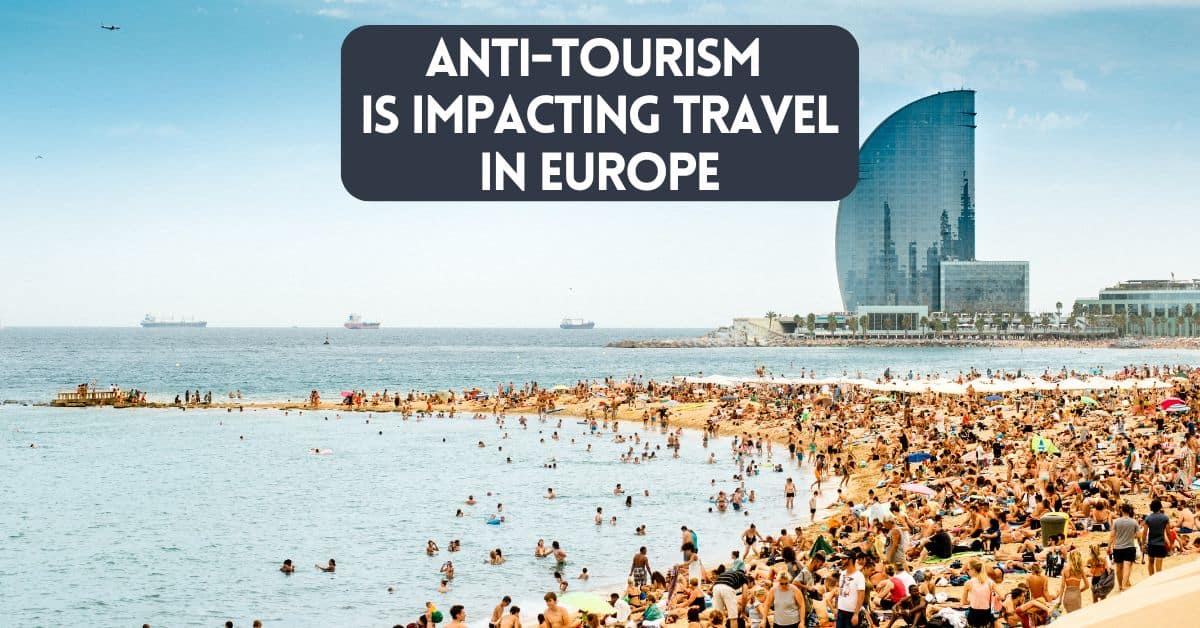
Anti-Tourism in Europe Can Impact Your Vacation
Tourism in Europe has reached a tipping point. With record-breaking visitor numbers, many of the continent’s beloved cities are overwhelmed, sparking the rise of anti-tourism protests in Europe and the implementation of strict measures to curb overtourism. For travelers planning their 2025 vacations, it’s essential to understand how these changes might impact your trip and how to travel more responsibly.
This guide will explore the overtourism crisis looming over Europe, the policies adopted to address it, and the steps you can take to ensure your travels remain enjoyable while respecting the local communities and environment.
The Places Where We Go contains affiliate links and is a member of the Amazon Services LLC Associates Program. As an Amazon Associate, we earn from qualifying purchases at no extra cost to you when you purchase using one of these Amazon links. Read our disclaimer and privacy policy for more information.

Joxemai, CC BY-SA 3.0 https://creativecommons.org/licenses/by-sa/3.0, via Wikimedia Commons
The Rise of Overtourism in Europe
Let’s look at the impact of anti-tourism protests in Europe. Take a stroll through Barcelona’s historic streets, Venice’s iconic canals, or Santorini’s white-washed alleys, and you’ll see more visitors than locals in many parts of these cities. With Spain welcoming over 30 million international visitors in the first five months of 2025 alone (an 8% increase from 2024), it’s no wonder many communities are pushing back against the influx.
This surge in tourism has disrupted local life, burdened infrastructure, and inflated the cost of living. The result? Cities, governments, and residents are taking a stand.
Get Free Weekly Travel Planning Guide
Destination Ideas – Practical Tips – Timely Travel News
Understanding Overtourism Measures
To help tourists stay informed, Hellotickets, a platform offering curated travel experiences, compiled a list of new overtourism measures that could impact your 2025 travel plans. From added taxes to capped daily visitor numbers, here’s how destinations across the globe are responding.
1. Tourist Taxes
Governments are leveraging increased taxes to regulate visitor numbers and generate funds to support local infrastructure.
- Barcelona, Spain: Visitors staying in 5-star hotels now pay an increased tourist tax of €6.75 per night, totaling €47.25 for a week.
- Venice, Italy: A €5 day-trip tax is now charged to discourage short-term visits and reduce congestion.
- Santorini and Mykonos, Greece: Cruise ship passengers must pay a €20 levy during peak summer.
- Kyoto, Japan: Lodging taxes have surged to a maximum of 10,000 yen (£52), incentivizing longer and more meaningful stays.
- Bali, Indonesia: A $10 (£7.70) tax is applied to each visitor, with a handbook on appropriate behavior handed out to promote respectful tourism.
| Destination | Country | Method |
| Barcelona | Spain | Barcelona’s tourist tax for five-star hotel guests increased to €6.75 per night, totalling €47.25 per week. |
| Venice | Italy | Venice has introduced a €5 day-trip tax to dissuade short-term tourists from overloading the city. |
| Santorini & Mykonos | Greece | The government announced a €20 levy for cruise ship visitors to Greece’s islands during peak summer. |
| Kyoto | Japan | Lodging tax for hotels will increase to a maximum of 10,000 yen (£52), ten times the current 1,000 yen cap. |
| Bhutan | The Himalayas | Visitors pay the world’s priciest entrance fee of US$100 daily to promote low-impact tourism, down from $200 in 2023. |
| Galapagos Islands | Ecuador | Tourists to the archipelago must now pay an entry tax of $200 (£155) for international visitors and $100 (£78) for those from neighboring countries. |
| Bali | Indonesia | Bali has introduced a $10 (£7.70) tourist tax to deter unruly visitors, with travelers required to pay the levy and potentially receive a handbook on acceptable behavior. |
| Seville | Spain | Seville plans to charge vacationers for Plaza de España entry to combat overtourism, with details still unclear. |
| Edinburgh | Scotland | Plans are set to introduce a 5% tourist tax on accommodation from 2026, aiming to raise £50 million annually. |
2. Access Restrictions
Some cities and regions are capping visitor numbers to alleviate pressure on hotspots.
- Amsterdam, Netherlands: River cruises are limited, hotel expansion is banned, and annual visitation is capped at 20 million overnight stays.
- Santorini, Greece: A daily cap of 8,000 cruise passengers has been introduced, easing crowds.
- Machu Picchu, Peru: Visitors are now required to book tickets with designated time slots when visiting Machu Picchu to prevent overcrowding.
| Destination | Country | Method |
| Santorini & Mykonos | Greece | Daily cap of 8,000 cruise visitors on Santorini and an organized berth system in Mykonos |
| Machu Picchu | Peru | Visitors face a strict ticketing system to arrive within designated time slots to prevent overcrowding. |
| Ibiza | Spain | Authorities have introduced new regulations limiting the simultaneous docking of cruise ships to no more than two at a time. |
| Amsterdam | Netherlands | There are plans to limit river cruises, ban new hotels, reduce visitors by 271,000 annually, and cap overnight stays at 20 million. |
| Menorca | Spain | Homeowners in Binibeca Vell have blocked access to private properties and asked tourists to visit only between 11am and 8pm to reduce noise. |
| Barcelona | Spain | The city cut cruise dockings to seven and removed the 116 bus route to Parc Güell to curb peak-season tourism. |
| Seoul | South Korea | Tourists can only visit between 10 am–5 pm in the “Red Zone” (Bukchon-ro 11-gil); violators risk a 100,000 KRW fine. Starting January 2026, chartered buses will be banned year-round in specified areas, with a trial beginning July 2025 |
| Athens | Greece | The Greek Acropolis capped visitors at 20,000 in September 2023 and introduced time slot bookings to reduce footfall. |
| Hallstatt | Austria | Measures were taken to discourage tourists by building wooden fences that block lakeside views. |
| Trentino Alto Adige | Italy | Overnight guests are capped at 2019 levels to tackle overtourism, with pre-registration for attractions like Alpe di Siusi. |
| French Polynesia | Annual tourist numbers are planned to be capped at 280,000, with local cruise lines taking priority over international cruise ships. | |
3. Tourist Behavior Regulations
Authorities are also cracking down on disruptive tourist behavior. New regulations are an impact of anti-tourism in europe.
- Amsterdam, Netherlands: A “stay away” campaign specifically discourages Brits from visiting for wild stag parties. Anti-social behavior such as excessive pub crawls is heavily monitored.
- Rome, Italy: Fines apply for shirtless visitors, installing “love padlocks” on bridges, or snacking near iconic landmarks like the Trevi Fountain.
- Portofino, Italy: Taking selfies in high-traffic zones could result in a €275 (£242) fine to combat congestion.
| Destination | Country | Method |
| Amsterdam | Netherlands | Authorities have urged Brits to “stay away” due to antisocial behavior during stag parties and pub crawls, with a warning video triggered by related search terms. |
| Sardinia | Italy | Tourists invading the pink sands of Spiaggia Rosa face fines ranging from €500 (£428) to €3,500 (£2,993). |
| Dubrovnik | Croatia | Visitors may face fines or charges for wearing swimwear, driving without permission, eating near monuments, or climbing city walls. |
| Prague | Czechia | City councilors have decided to ban outrageous stag and hen group costumes, as well as nighttime pub crawls. |
| Portofino | Italy | Tourists taking selfies in popular spots could face a €275 (£242) fine for causing congestion, with “no waiting” zones to prevent blockages. |
| Rome | Italy | Rome is cracking down on bans for shirtless men, “love padlocks” on bridges, and snacking near attractions like the Trevi Fountain. |
4. Sustainability-Focused Measures
Protecting ecosystems and heritage has become a priority with innovative new restrictions.
- Galapagos Islands, Ecuador: Walking is restricted to marked trails, and private yacht visits have been banned to minimize environmental disturbance.
- Ko Phi Phi Leh, Thailand: Swimming in Maya Bay is prohibited to protect coral reefs and reef sharks. Visitors are limited to one-hour stays.
| Destination | Country | Method |
| Capri | Italy | Capri plans to install a 40-buoy barrier 100m offshore to protect its coastline from boat damage. |
| Galapagos Islands | Ecuador | Tourism is regulated with rules like walking on marked trails, guided visits to protected areas, and no private yachts at key natural sites. |
| Okinawa | Japan | To protect endangered species and combat overtourism, visitor numbers to Iriomote Island are capped at 1,200 per day. |
| Ko Phi Phi Leh | Thailand | Swimming in Maya Bay is banned to protect coral and reef sharks, with visitors limited to one-hour stays and motorboats prohibited. |
5. General Planning and Management
| Destination | Country | Method |
| Cornwall | England | Cornish vacation lets may need registration to tackle overtourism and housing issues, with a £160m government crackdown on rentals. |
| Malaga | Spain | Malaga has set plans to prohibit vacation rental registrations across 43 districts. |
| Florence | Italy | Florence banned Airbnb and short-term rentals in its center to address the depletion of affordable housing. |
| Yorkshire Dales | England | Bans on the construction of second homes and vacation properties in villages have been introduced to curb tourism, allowing only permanent residents. |
| Marseille | France | Marseille banned key safes outside vacation lets, with agents authorized to remove them if hosts ignore warnings. |
| Penang | Malaysia | Short-term rentals like Airbnb are banned, allowing only commercial properties with resident approval and registration fees. |
Why These Changes Matter
The surge in travel poses serious consequences if left unchecked, including damage to natural resources, loss of cultural authenticity, and strained infrastructure that negatively impacts locals. Jorge Díaz Largo, CEO of Hellotickets, highlights the long-term importance of these measures:
“Protests and restrictions make it clear overtourism is at a breaking point. Travelers must adapt by seeking sustainable alternatives and avoiding overburdened destinations.”
By respecting these new protocols, tourists can meaningfully contribute to preserving the beauty and heritage of these destinations.
Responsible Travel Tips for Your 2025 Trips
Want to help tackle overtourism while still enjoying your adventures? Here are practical steps to take:
1. Choose Off-Season Travel Dates
Plan your vacations during less busy months to reduce pressure on popular destinations.
2. Explore Less Crowded Destinations
Instead of overbooked hotspots, consider less-traveled regions or towns nearby. For example, skip Venice and discover the charm of Bergamo or Treviso.
3. Support Local Business
Seek out locally owned accommodations, restaurants, and tour operators to directly benefit the community.
4. Follow the Guidelines
Be aware of restrictions and adhere to them. If an attraction limits group size, book in advance and respect the time slots.
5. Offset Your Carbon Footprint
Consider eco-friendly practices like purchasing carbon offsets, using public transportation, and carrying reusable water bottles to minimize waste.
Plan Smart and Travel Better
Travel is all about balancing discovery with respect for the people and places that make your journeys unforgettable. Anti-tourism protests in Europe are making an impact and affecting travelers. By learning about overtourism policies and making sustainable choices, you can still enjoy Europe without contributing to its challenges.
For more tips on planning, check out curated tours, activities, and lesser-known destinations on Hellotickets. Explore responsibly and make every trip meaningful!
Thanks for visiting this page. We hope to see you at the places where we go.
Julie & Art
