Saint Junipero Serra Pilgrimage – How We Survived 35 Miles – Hour by Hour
At 5 a.m. on August 8, 2026, our latest pilgrimage began in the dark.
Ahead of us were 35 miles of walking over two days, beginning at Old Mission Santa Barbara and ending at Mission Basilica San Buenaventura in Ventura. We would walk 18 miles on Saturday, sleep in a tent in Carpinteria, get up the next morning, and walk another 17 miles on Sunday.
This was our fifth consecutive year participating in the annual Saint Junipero Serra Walking Pilgrimage. By now, the experience has become something of a ritual for us. We know the route. We know our feet will eventually hurt. And we know that sometime late Sunday afternoon, we will probably question why we keep doing this voluntarily.
But we also know why we come back.
The 2026 pilgrimage was particularly special. A record 400 pilgrims registered, according to information provided to participants before the walk. We met first-time pilgrims who told us they discovered the event through videos we published in previous years. We renewed friendships with returning walkers from as far away as Washington State.
And we learned that this year’s pilgrimage represented something new: the journey from Santa Barbara to Ventura is now known as the Camino de San Buenaventura, part of the developing Camino de California and connected with the larger Camino de Santiago pilgrimage tradition in Spain.
And make no mistake about it:
This pilgrimage was hard.
We completed every mile, but walking 35 miles in roughly 36 hours tested our legs, feet, and determination—especially during the final hours on Sunday.
The Places Where We Go contains affiliate links and is a member of the Amazon Services LLC Associates Program. As an Amazon Associate, we earn from qualifying purchases at no extra cost to you when you purchase using one of these Amazon links. Read our disclaimer and privacy policy for more information.
Here is what our 2026 Saint Junipero Serra Pilgrimage was really like, hour by hour.
⬇️ Watch Our 36-Hour Camino de San Buenaventura Journey ⬇️
Our video follows the pilgrimage hour by hour, including our in-the-moment reactions as those 35 miles became increasingly difficult.
Saint Junipero Serra Pilgrimage 2026 at a Glance
| Detail | Our 2026 Pilgrimage |
|---|---|
| Dates | August 8–9, 2026 |
| Event | Sixth Annual Saint Junipero Serra Walking Pilgrimage |
| Camino route | Camino de San Buenaventura |
| Total distance | 35 miles |
| Saturday | 18 miles |
| Sunday | 17 miles |
| Starting point | Old Mission Santa Barbara |
| Overnight stop | St. Joseph Church, Carpinteria |
| Finish | Mission Basilica San Buenaventura, Ventura |
| 2026 registration | Record 400 registered pilgrims |
| Our experience | Fifth consecutive year completing the pilgrimage |
| Walking environment | City streets, coastal pathways, paved routes and beach |
| Support | Meals, refreshments, camping-gear transportation and support vehicles |
The Saint Junipero Serra Walking Pilgrimage is a supported two-day journey along a portion of California’s historic mission route. Pilgrims travel from Santa Barbara through Montecito, Summerland and Carpinteria before continuing along the coast toward Ventura.
You can find current event information at the official Saint Junipero Serra Pilgrimage website.
What Is the Saint Junipero Serra Walking Pilgrimage?
The annual Saint Junipero Serra Walking Pilgrimage travels approximately 35 miles between two of California’s historic missions.
The journey begins at Old Mission Santa Barbara.
Although Saint Junipero Serra played a central role in establishing California’s mission system, he did not found Mission Santa Barbara. The mission was established in 1786 by Father Fermín Francisco de Lasuén, two years after Serra’s death.
Thirty-five miles later, the pilgrimage reaches Mission Basilica San Buenaventura.
The relationship with Serra is much more direct here. Saint Junipero Serra founded Mission San Buenaventura in 1782. It was the ninth and final California mission he personally founded.
That gives the pilgrimage a wonderful historical bookend: beginning at one of California’s most recognizable missions and finishing at the last California mission established by Serra himself.
For us, however, this has never been simply a historical walk between old buildings.
Mass, prayer, singing, Eucharistic Adoration, conversations with fellow pilgrims, and the shared physical sacrifice of walking the route are all part of the experience.
And beginning in 2026, the journey took on another dimension through its connection to the Camino de California.
Day One: 18 Miles From Santa Barbara to Carpinteria
5 AM – Our Pilgrimage Begins Before Sunrise
Our Saturday began at 5 a.m. with a drive from our home in Simi Valley to Ventura.
We would leave our car in Ventura for the weekend and board one of the buses taking pilgrims north to Mission Santa Barbara.
There is something slightly surreal about beginning a 35-mile walking journey by getting into a car before dawn.
At that hour, however, our legs were still fresh.
We knew that wouldn’t last.
After 6 AM – A Bus Full of Pilgrims
Shortly after six, we boarded one of the buses for Santa Barbara.
It was full.
Before the pilgrimage, organizer Greg Wood had informed participants that a record 400 pilgrims had registered for 2026, including priests, religious sisters, missionaries, seminarians and participants traveling from seven other states.
Sitting on that bus surrounded by backpacks, camping gear and fellow pilgrims, the weekend suddenly felt very real.
There was excitement—but also anticipation because we knew exactly what lay ahead.
6:30 AM – Arriving at Mission Santa Barbara
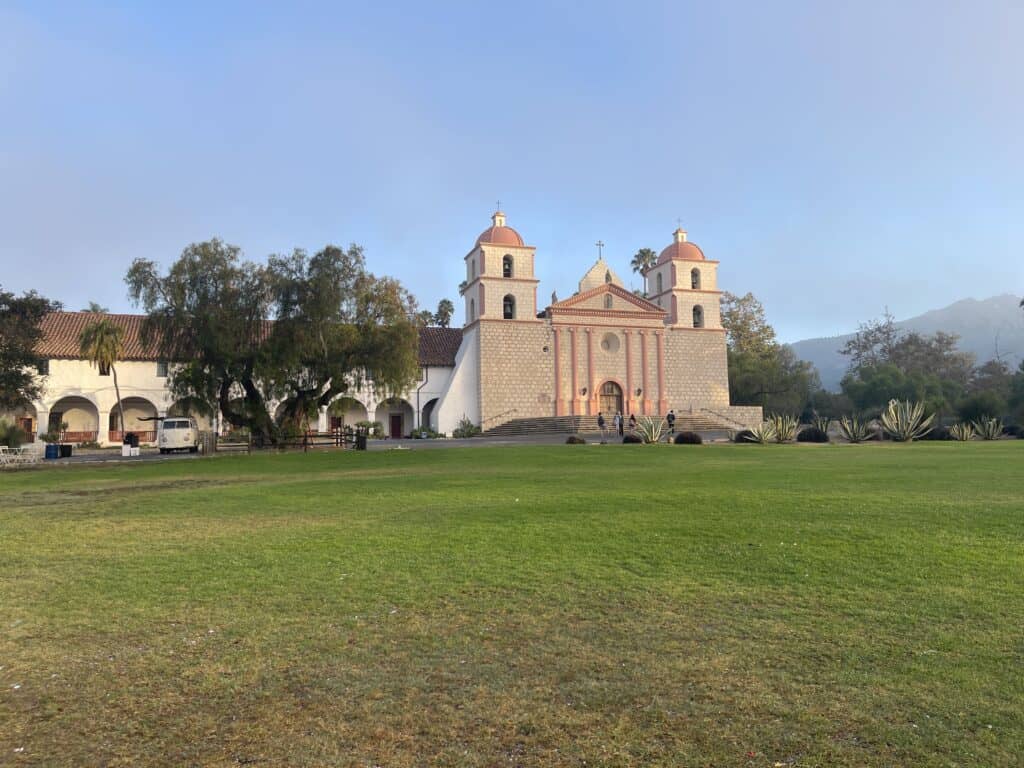
We arrived at Old Mission Santa Barbara as the early-morning light began to illuminate its familiar twin bell towers.
Even after visiting this mission many times, arriving as a pilgrim feels different from arriving as a tourist.
You’re not there simply to look at the building.
You’re there because you’re about to leave it on foot.
Our destination, Mission San Buenaventura, was 35 miles away.
7:30 AM – Beginning With Mass
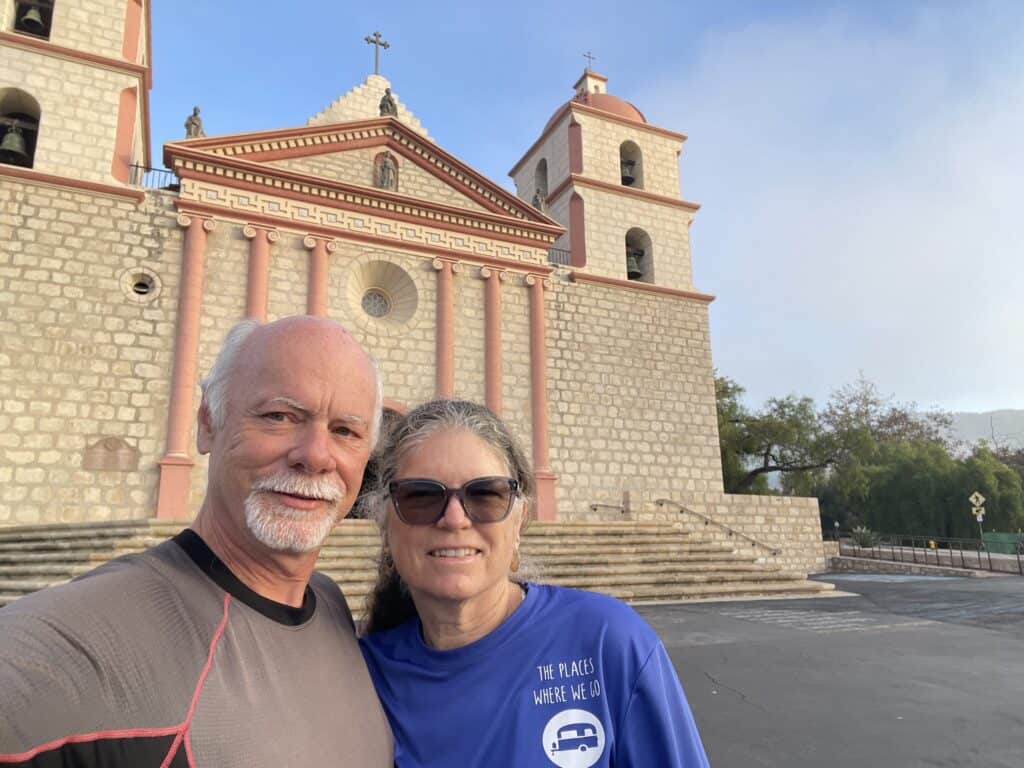
The pilgrimage officially began with Mass inside Mission Santa Barbara.
Hundreds of pilgrims filled the church, and the earnest singing created one of those moments when the size of the group became particularly apparent.
There was something fitting about beginning the weekend this way.
Whatever physical challenge awaited us outside, the purpose of the weekend was greater than accumulating mileage.
This was a pilgrimage.
8:30 AM – Coffee, Instructions and Saint Junipero Serra
After Mass, pilgrims gathered outside.
Considered Curbside Coffee provided some welcome caffeine before we began walking, while organizer Greg Wood offered encouragement and final instructions.
We were also introduced to a written icon of Saint Junipero Serra that would accompany the pilgrims along the route before being taken to its new home at Mission Basilica San Buenaventura.
Then came the moment everyone had been waiting for.
It was time to walk.
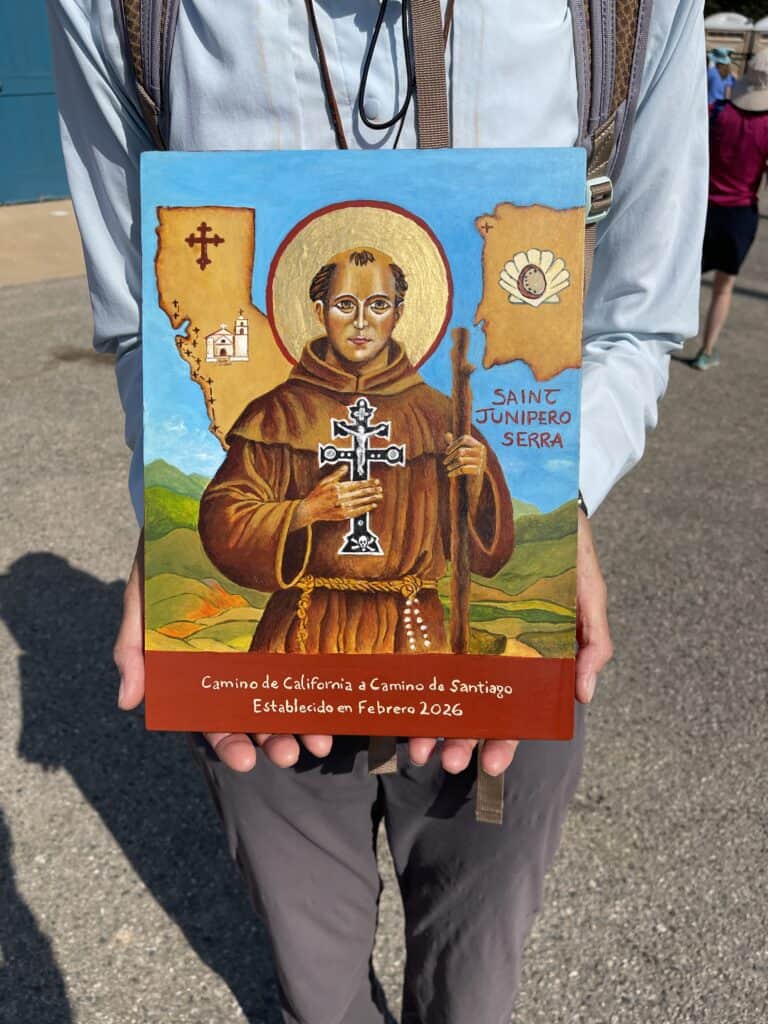
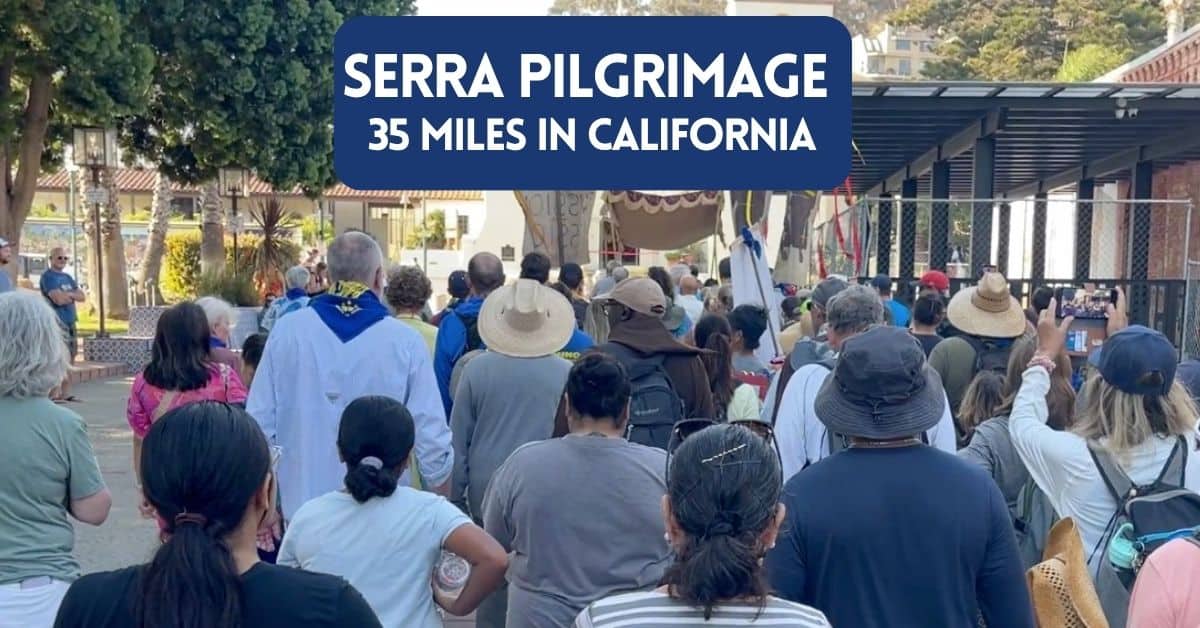
9 AM – Nearly 400 Pilgrims Start Moving
With drums and bagpipes accompanying us, our enormous group began leaving Mission Santa Barbara.
One of our first memorable stops came at the Monastery of the Poor Clares of Santa Barbara.
The Poor Clare sisters live a cloistered life. Rather than entering the monastery, hundreds of pilgrims gathered outside and sang to the sisters within.
We had barely begun walking, yet the weekend already felt special.
Only about 35 miles remained.
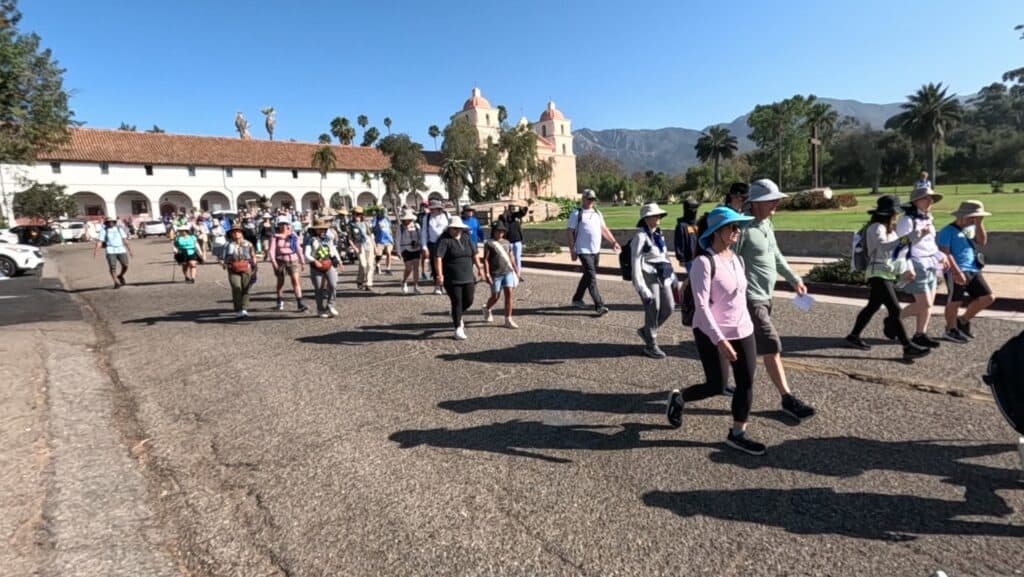
10 AM – Pilgrims Take Over State Street
By 10 a.m., our route had brought us onto Santa Barbara’s State Street.
Saturday morning activity was well underway, with the farmers market in full swing, while a long procession of singing pilgrims moved through downtown.
This is one of the characteristics we enjoy most about this pilgrimage. The scenery is constantly changing.
Within a relatively short span, we had gone from a historic California mission to a monastery and then directly through the heart of downtown Santa Barbara.
Soon we would reach the Pacific.
11 AM – We Were Ready for That First Rest Stop
The first portion of the walk felt longer than usual this year.
Because another city event was taking place along Cabrillo Boulevard, our normal rest area had to be relocated farther down the route.
That meant extra walking before the first substantial opportunity to stop.
By the time we reached refreshments near the beach, sitting down for a few minutes and grabbing something to drink felt wonderful.
A pilgrimage has a way of recalibrating what qualifies as luxury.
Sometimes it’s simply shade, a cold drink and the opportunity to get off your feet.
Noon – A Quieter Side of Montecito
Our route eventually left the activity of downtown and the waterfront behind and took us into quieter residential streets in Montecito.
The change in environment was welcome.
There was less traffic and fewer distractions, allowing us to settle into the rhythm that develops during a long walk:
Walk. Talk. Pray. Drink. Repeat.
By this stage, we were beginning to feel the miles.
Fortunately, lunch was getting closer.
1 PM – Lunch Overlooking the Pacific
Our lunch stop came at Lookout Park in Summerland, overlooking the Pacific Ocean.
The local Knights of Columbus provided lunch—and when you’ve spent the morning walking, food tastes particularly good.
One thing we have come to appreciate more after participating in this pilgrimage year after year is the volunteer effort required to support hundreds of walkers.
Water appears when we need it.
Food is waiting when we arrive.
Camping equipment moves from one destination to another.
Rest stops are staffed.
Support vehicles follow the pilgrims.
It allows those of us doing the walking to concentrate on the pilgrimage itself.
2 PM – The Problem With Resting
There is one unfortunate thing about a good lunch break during a long-distance walk:
Eventually, you have to stand up again.
Around 2 p.m., backpacks went back on and the pilgrimage resumed.
Our destination for the afternoon was Carpinteria, where St. Joseph Church would become our campground for the night.
Our legs knew we had already walked a long way.
Unfortunately, we weren’t there yet.
3 PM – We Reach Carpinteria
Just after 3 p.m., we entered Carpinteria.
Seeing the city name provided an immediate psychological boost.
Of course, reaching Carpinteria and reaching our campsite were not the same thing.
There were still more steps to take.
So we kept walking.
Around 4 PM – St. Joseph Church
Finally, we reached St. Joseph Church.
Almost immediately, the grounds began to transform into a temporary campground as pilgrims retrieved their camping equipment and set up tents.
Shoes came off.
Sleeping bags came out.
People sat down.
After 18 miles of walking, nobody needed much encouragement to stop moving.
Evening – Mexican Food, Adoration and New Friends
Dinner that evening was Mexican food prepared with help from the local church community.
It hit the spot.
The evening also gave us time for something that can sometimes be harder during the walking portions of the pilgrimage: longer conversations with the people around us.
One of the most meaningful parts of the 2026 pilgrimage was meeting several people who told us they had originally discovered this event because of videos we published about our previous walks.
We met a wonderful group from Long Beach making their first pilgrimage.
We also renewed connections with returning pilgrims, including people who had traveled from Washington State and had made this California pilgrimage several times.
That meant a great deal to us.
One reason we began documenting these walks was the hope that someone might watch one of our videos and think:
I would like to do that.
This year, we actually met some of those people.
Our evening concluded with Eucharistic Adoration before we retired to our tent.
After 18 miles, we expected to sleep well.
There was just one small problem.
We still had 17 miles to walk tomorrow.
Day Two: 17 Miles From Carpinteria to Ventura
7 AM – Breakfast and Stiff Legs
Sunday began with coffee, bagels and yogurt.
It also began with the unavoidable realization that our bodies remembered exactly what we had done the previous day.
We had slept on the ground and now had another long-distance walking day ahead of us.
This is one reason we think preparation for multi-day pilgrimages should include back-to-back training days.
Walking 17 or 18 miles when fresh is one challenge.
Walking another 17 miles after completing 18 the previous day is something else entirely.
9 AM – The Tents Disappear
By about 9 a.m., our temporary campground had disappeared.
Tents were packed.
Camping equipment was loaded onto a truck that would transport it to Ventura.
And once again, pilgrims assembled for the day’s walk.
The route would take us along the coast through Carpinteria, Rincon, Faria and Emma Wood before entering downtown Ventura.
We had 17 miles ahead of us.
10 AM – Back Beside the Pacific
After passing Carpinteria State Beach, we were once again walking with the Pacific Ocean nearby.
This is one of the things that makes the Saint Junipero Serra Pilgrimage particularly beautiful.
Despite the physical difficulty, much of the walk follows the Southern California coastline.
Ocean views and sea breezes certainly don’t eliminate tired legs.
But they help.
11 AM – Taking Off Our Shoes
Sunday also contains one of the most distinctive portions of the route.
Conditions allowed us to leave the paved pathway and walk directly on the beach.
Shoes came off.
Bare feet went into the sand and water.
And for a little while, after spending so many hours on pavement, walking along the edge of the Pacific felt wonderfully refreshing.
There was only one flaw in this plan.
Sand.
Lots of sand.
And some of it was going to accompany us for the rest of the day.
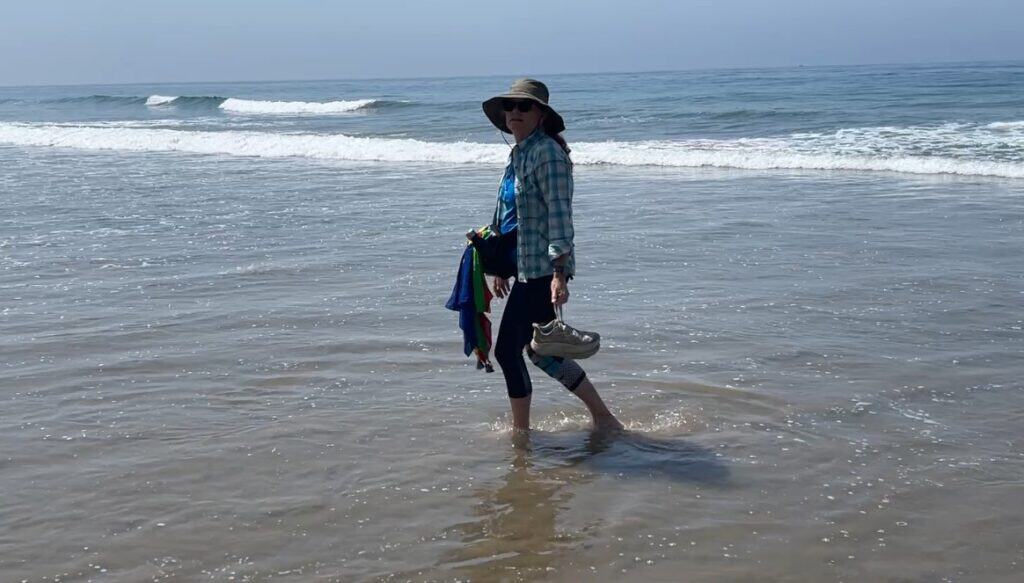
Noon – Getting the Sand Out…Mostly
When the beach portion ended, we attempted to clean our feet before putting our shoes back on.
Without a towel, the operation wasn’t entirely successful.
In hindsight, a small lightweight microfiber towel would have been an excellent addition to our daypacks.
We got most of the sand off.
Most.
Unfortunately, even a small amount of sand inside footwear can become considerably more noticeable after several additional miles.
That would become particularly relevant for Julie later in the afternoon.
1 PM – Lunch and Conversations About Spain
Lunch brought another welcome opportunity to sit down.
The Knights of Columbus again provided food and even some music.
But something else happened during this year’s pilgrimage that may ultimately have consequences well beyond California.
We started talking with people who had walked the Camino de Santiago.
The Camino has been on our travel bucket list for years, but the time commitment required for some of its best-known routes has made it difficult for us to schedule.
Thirty-five or forty days away simply hasn’t fit easily into our lives.
Several pilgrims, however, told us about their experiences walking the Camino Inglés, a considerably shorter Camino route.
Suddenly, an official pilgrimage to Santiago seemed considerably more achievable.
More on that shortly.
First, we had to finish this one.
2 PM – Faria Beach and the Hard Part Begins
By 2 p.m., we were passing Faria Beach.
This is approximately where the psychology of a long pilgrimage starts changing.
Early Saturday morning, you think:
We’re walking 35 miles.
Late Sunday afternoon, you think:
Let’s just get through the next two miles.
Then the next mile.
Then the next rest stop.
The enormity of the journey starts breaking itself into smaller objectives.
3 PM – Our Feet Had Opinions
By 3 p.m., the accumulated mileage was becoming increasingly apparent.
We stopped again to deal with sand in our shoes.
For Julie, foot discomfort and rubbing were becoming a significant issue.
She had begun the pilgrimage wearing HOKA sneakers. By Sunday afternoon, a combination of long mileage, rubbing and probably some lingering sand from the beach made continuing in the same shoes uncomfortable.
Fortunately, we had another option.
Julie switched to a walking sandal.
That change helped considerably.
It also reinforced one of our practical lessons from this pilgrimage:
Having an alternate footwear option can be extremely valuable on a multi-day walk.
Art completed all 35 miles wearing HOKA Bondi shoes.
4 PM – This Was Hard
This is the hour that probably best explains the phrase we chose for one of our YouTube thumbnails:
THIS WAS HARD.
By late Sunday afternoon, our bodies were tired.
Our feet hurt.
We were walking past motorhomes and trailers parked along the coast, and a comfortable chair suddenly looked extremely appealing.
Tylenol and Motrin also came in extremely handy for both of us during the weekend.
That was simply part of our personal experience. Anyone considering medication during strenuous activity should follow label directions and take into account their own health circumstances.
The Saint Junipero Serra Pilgrimage is supported.
It is beautiful.
There is tremendous camaraderie.
But none of those things eliminates the physical reality of walking 35 miles in two days.
For two walkers in our 60s, completing all 35 miles was a genuine physical test.
And we still weren’t finished.
5 PM – One Final Gathering at Emma Wood
Eventually, we reached Emma Wood State Beach.
This was our final major gathering point before the pilgrimage entered Ventura as a group.
Pilgrims who had become spread out along miles of coastline gradually came together again.
We had begun the pilgrimage together at Mission Santa Barbara.
Now we were going to finish it together.
The remaining distance suddenly felt manageable.
One more push.
6 PM – We Arrive at Mission Basilica San Buenaventura
And then, finally, we arrived.
Mission Basilica San Buenaventura.
Thirty-five miles.
Two days.
Five consecutive years.
And a lot of very tired feet.
Arriving at the mission on foot feels entirely different from simply driving there.
You’ve been moving toward this destination for two days. Every mile gradually gives the mission greater significance.
Then the bells, the procession and the arrival transform a historic building into the destination of a journey.
The pilgrimage concluded with Mass at the mission, followed by a celebratory dinner.
Our bodies were exhausted.
But we had finished.
Again.
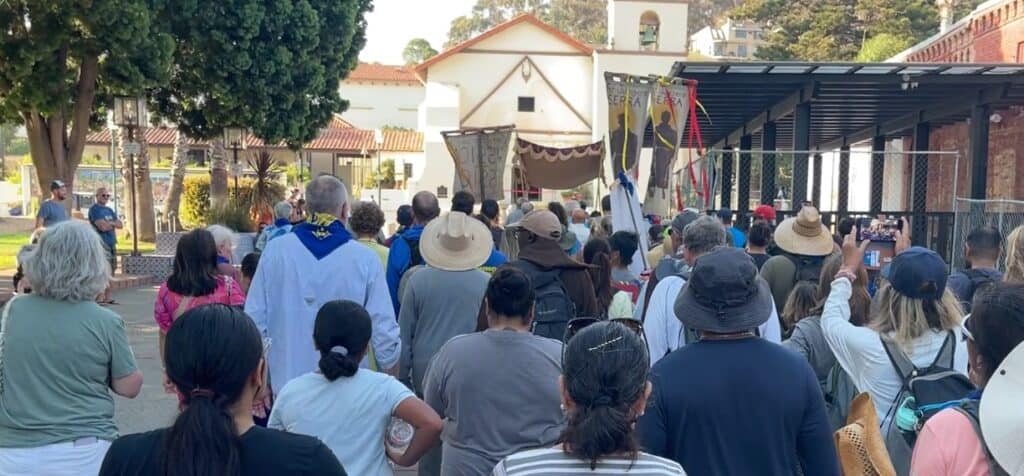
After 7 PM – Dinner, a Shower Ahead and One Familiar Thought
Dinner brought one final opportunity to gather with the pilgrims before everyone began heading home.
At this stage, two things sounded particularly appealing:
A shower.
And our own bed.
But something else happens to us almost every year.
During the most difficult miles, we wonder why we keep doing this.
Then we finish.
And almost immediately, we start thinking:
We’ll probably be back next year.
How Hard Is the Saint Junipero Serra Pilgrimage?
We don’t want to understate this.
Walking 35 miles over two consecutive days is hard.
The route isn’t technically difficult in the way a mountainous wilderness trail might be. Much of it follows streets, paved pedestrian routes, bike paths and relatively level coastal terrain.
The challenge is cumulative.
Eighteen miles on Saturday is a long walking day.
Sleeping in a tent and then walking another 17 miles Sunday makes it considerably harder.
By late Sunday afternoon, our legs and feet were hurting and every remaining mile seemed longer than it looked on a map.
We’ve completed this pilgrimage five consecutive years.
We knew what was coming.
We prepared for it.
It was still difficult.
That’s also part of what makes the arrival meaningful.
When you walk into Mission San Buenaventura after 35 miles, you haven’t simply visited the mission.
You’ve arrived there.
There’s a difference.
Our Firsthand Experience
We have completed the Saint Junipero Serra Pilgrimage five consecutive times and have also walked many miles along California’s historic Mission Trail. Even with that experience, we found the final hours of the 2026 pilgrimage physically difficult. The 35-mile distance should not be underestimated.
What Footwear Did We Use?
Art walked the entire 35 miles in HOKA Bondi shoes.
Julie began in HOKA sneakers but developed significant foot discomfort and rubbing late Sunday.
Sand remaining from the beach portion of the route may also have contributed.
Switching to a walking sandal for the final portion of the pilgrimage provided relief and allowed her to finish more comfortably.
Our experience reinforced an important lesson:
What feels perfect at mile five may not feel perfect at mile thirty.
For future multi-day pilgrimages, we like having an alternate footwear option available whenever logistics permit.
We would also add a small microfiber towel to our packing list for any route that includes beach walking.
Sand and long-distance walking are not particularly good companions.
What Made the 2026 Pilgrimage Different?
There were several reasons this year’s pilgrimage stood out.
Certainly, the record turnout was one.
But meeting pilgrims who had discovered the event through our previous videos may have been the most rewarding.
We create travel content because we enjoy documenting where we go, but there’s another purpose behind it.
We hope our experiences occasionally encourage someone else to visit a place, try an adventure or discover something they didn’t know existed.
Meeting first-time Serra pilgrims who had done exactly that made five years of documenting this event feel worthwhile.
But 2026 also brought a development with potentially much broader significance.
The Saint Junipero Serra Pilgrimage is now connected to something much larger.
The Camino de San Buenaventura and Camino de California
The 2026 pilgrimage introduced us to the growing Camino de San Buenaventura and its relationship with the Camino de California.
Camino de California is developing pilgrimage opportunities connecting California’s historic missions while also providing a way for qualifying California pilgrimage mileage to become part of a future Camino de Santiago journey.
We received a pilgrimage credential during the 2026 walk and learned more about how California pilgrims may document qualifying mileage before later continuing their pilgrimage in Spain.
For the latest details on how the program works, including current credential requirements, visit:
Starting a Camino de Santiago Pilgrimage in California
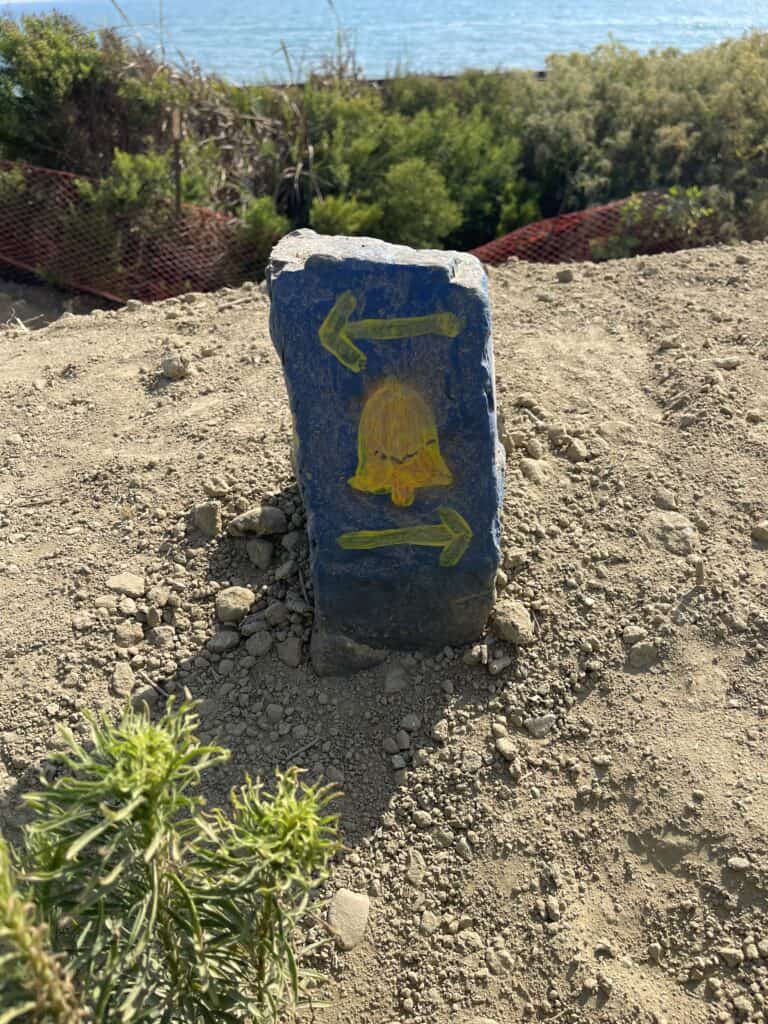
For us, the idea is fascinating.
A future pilgrimage to Santiago may not necessarily begin when we step onto a trail in Spain.
It may have already begun here in California.
Could Our Next Pilgrimage Be the Camino Inglés?
One of the unexpected benefits of walking with hundreds of pilgrims is meeting people who have already completed journeys you’re considering.
During this year’s Serra pilgrimage, we had several conversations with experienced Camino de Santiago pilgrims.
We have wanted to walk the Camino for years.
Our obstacle has always been time.
Some of the famous Camino routes can require a month or more, and finding 35 to 40 consecutive days has been difficult.
The Camino Inglés has therefore become particularly interesting to us.
It offers an official Camino de Santiago experience with a much shorter time commitment.
If everything falls into place, we hope our pilgrimage journey will continue in Spain.
And if it does, in a sense it will have begun here in California.
At Mission Santa Barbara.
What We Learned From Our Fifth Serra Pilgrimage
Five consecutive walks have taught us that experience doesn’t necessarily make the pilgrimage easy.
You simply understand the difficulty better.
A few lessons stood out to us in 2026:
- Train for consecutive days, not merely distance. Walking 18 miles once isn’t the same as doing it and then walking another 17 miles the following day.
- Test your footwear extensively. Feet can swell and pressure points may appear only after many hours.
- Consider backup footwear. Julie’s walking sandals became extremely useful Sunday afternoon.
- Carry spare socks and foot-care supplies. Address rubbing before it becomes a major problem.
- If the route includes sand, carry a small towel. We learned this one the sandy way.
- Take the rest stops seriously. Hydrate, eat and sit when the opportunity presents itself.
- Protect yourself from the sun. Hats were essential for us during long exposed portions of the route.
- Don’t obsess over the entire remaining distance. On Sunday afternoon, sometimes the best objective is simply reaching the next rest stop.
- Talk to the other pilgrims. Some of our favorite memories from 2026 came from conversations rather than landmarks.
- Remember why you’re walking. The destination matters, but pilgrimage is also about what happens along the way.
What Should You Bring on the Serra Pilgrimage?
The organizers provide substantial support, but that doesn’t mean you should arrive unprepared.
Items that proved important for us included:
- Comfortable, well-tested walking shoes
- Backup footwear when practical
- Spare socks
- Hat
- Sunscreen
- Water bottle
- Daypack
- Foot-care supplies
- Lightweight clothing layer
- Personal medications
- Portable battery or charging equipment
- Basic overnight camping gear
- Small microfiber towel
For the 2026 pilgrimage, pilgrims camped at St. Joseph Church in Carpinteria, and camping equipment was transported onward to Ventura on Sunday.
Logistics can change from year to year, so always review the current instructions provided by the pilgrimage organizers.
For much more about training, footwear, blister prevention and packing, see our complete guide:
How to Prepare for a Pilgrimage Walk
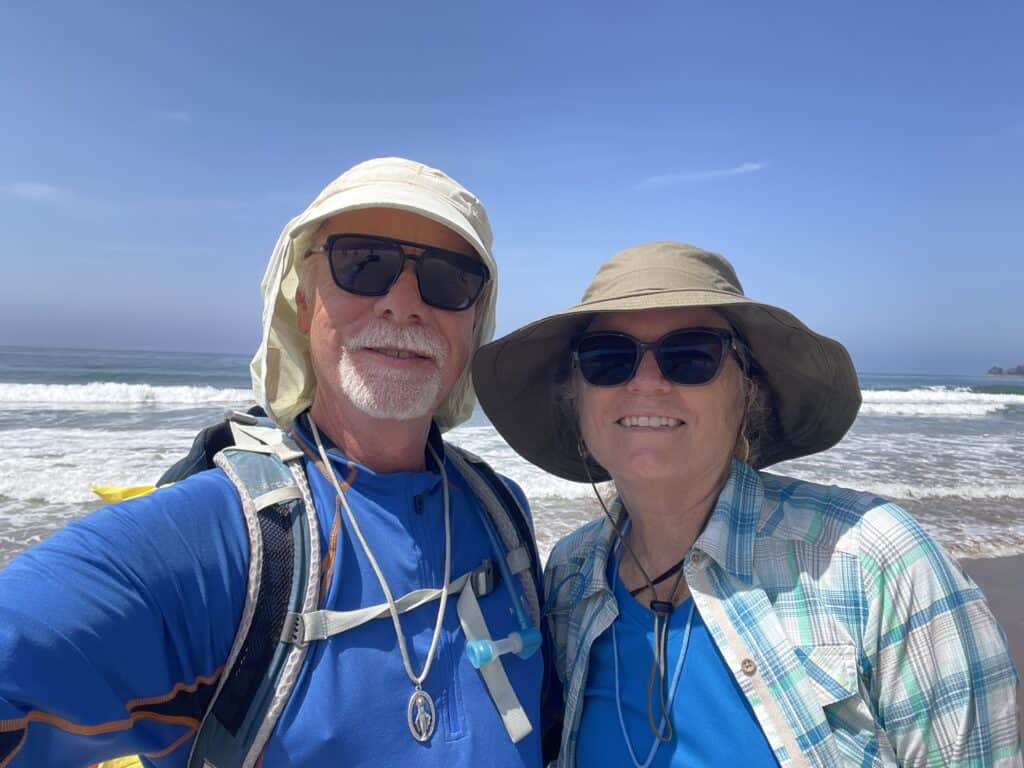
A Couples Tip for Walking a Pilgrimage Together
A long pilgrimage is not the place to compete with your partner.
Check in with each other.
Ask about feet before they become painful. Adjust your pace when necessary. Take advantage of rest stops. And if one person needs to change shoes, address a blister or simply sit for another five minutes, that matters more than maintaining a particular walking speed.
There were moments on Sunday when the objective wasn’t to make good time.
It was to make sure both of us reached Ventura.
We did.
Can You Walk Only Part of the Serra Pilgrimage?
You don’t necessarily have to complete all 35 miles to experience the event.
People may join selected portions of the pilgrimage, although meals, transportation and other organized services may be limited to registered participants.
Anyone considering participating for only part of the route should consult the current information on the official pilgrimage website before making plans.
Would We Walk the Serra Pilgrimage Again?
Ask us around 4 p.m. Sunday and you might get an interesting answer.
Ask us after we arrive at the mission and the answer is easier.
Yes.
This pilgrimage has become part of our year.
There is something satisfying about returning to the same journey while knowing that every year will produce different conversations, different challenges and different memories.
The pilgrimage itself has also grown dramatically since we first began participating.
And perhaps the most gratifying part of that growth is seeing new pilgrims discovering it.
Some of them now tell us they found the pilgrimage because of videos we created.
That’s exactly what we hoped those videos might accomplish.
So perhaps the best way to finish this recap is the same way our pilgrimage organizers often do:
¡Siempre adelante!
Always forward.
Saint Junipero Serra Pilgrimage FAQ
The 2026 Saint Junipero Serra Walking Pilgrimage covered approximately 35 miles over two days. We walked 18 miles from Santa Barbara to Carpinteria on Saturday and another 17 miles from Carpinteria to Ventura on Sunday.
The pilgrimage begins at Old Mission Santa Barbara and finishes at Mission Basilica San Buenaventura in Ventura, California.
During the 2026 pilgrimage, participants camped Saturday night at St. Joseph Church in Carpinteria.
No. During the supported 2026 pilgrimage, organizers transported overnight camping gear. Packed camping equipment was moved from Carpinteria to Ventura on Sunday.
We consider the 35-mile pilgrimage physically challenging. The terrain is generally less demanding than a mountainous hiking trail, but walking 18 miles one day and another 17 miles the next creates significant cumulative fatigue. Even after completing the pilgrimage five consecutive years, we found the final Sunday afternoon miles very difficult.
The Santa Barbara-to-Ventura pilgrimage is now associated with the Camino de San Buenaventura and the developing Camino de California pilgrimage network.
Camino de California has established a process through which qualifying pilgrimage mileage in California may be documented for pilgrims who later continue their Camino journey in Spain. Because credential requirements can change, we recommend reviewing the latest information directly from Camino de California.
No. It is possible to participate in only a portion of the pilgrimage, although access to meals, transportation and other support services may depend on registration.
We’ve compiled a guide to pilgrimage walks around the country, including organized Catholic pilgrimages, mission routes and other opportunities: Explore our Pilgrimage Walks in the USA guide
Planning Your Own Pilgrimage
If walking from Santa Barbara to Ventura has you thinking about trying a pilgrimage yourself, start with preparation rather than mileage.
Build your walking distance gradually.
Test your footwear.
Practice on consecutive days.
Learn how your feet react after several hours.
And understand that pilgrimage isn’t simply about covering miles.
Here are several resources to help you get started:
Pilgrimage Walks in the USA
Discover pilgrimage routes and organized events around the country.
Explore USA pilgrimage walks
How to Prepare for a Pilgrimage Walk
Our tips for training, packing, footwear and preparing for a multi-day pilgrimage.
Read our pilgrimage preparation guide
Camino de California
Learn about California pilgrimage routes and how a California walk can connect with a future Camino de Santiago.
Learn about beginning your Camino in California
Saint Junipero Serra Walking Pilgrimage
Check future dates, registration information, and current route details.
Visit the official Serra Pilgrimage website
Thanks for stopping by to read our article about walking the Serra Pilgrimage.
Julie and Art – The Places Where We Go
