
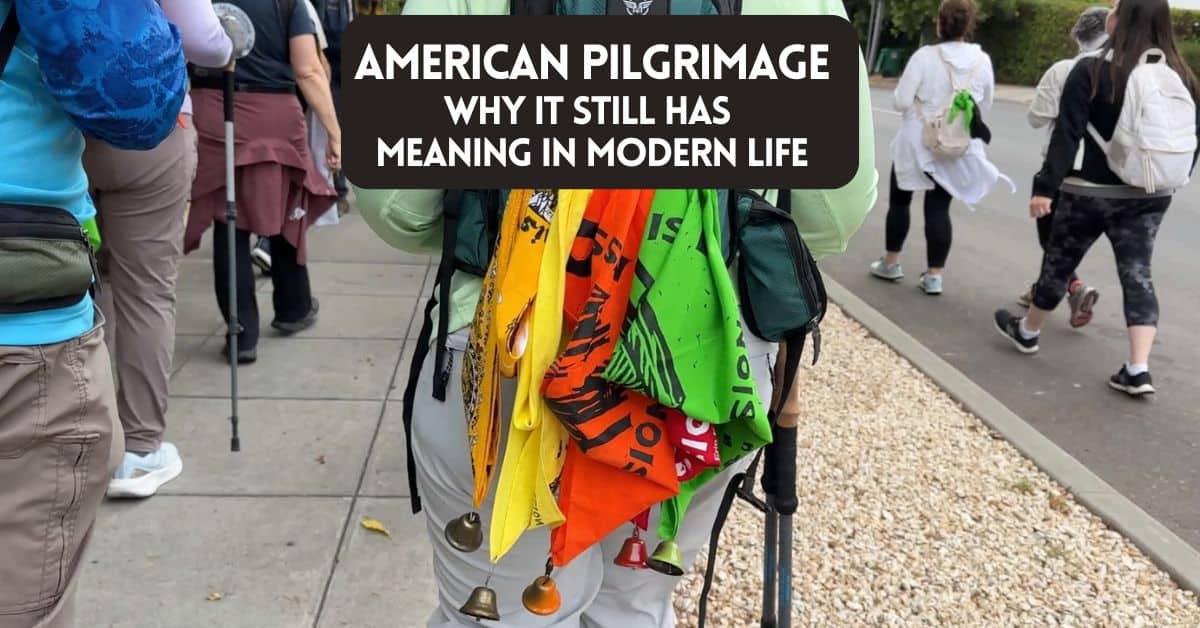
The American Pilgrimage – Why It Still Has Meaning in Modern Life
For centuries, people have set out on foot toward places they considered sacred. Some walked to great cathedrals, shrines, monasteries, or holy cities. Others followed routes associated with saints, historical events, or deeply held traditions.
Today, the idea of pilgrimage can seem almost out of place in a world built around speed, convenience, and digital connections. Yet the desire behind pilgrimage has hardly disappeared. If anything, stepping away from the routines of everyday life and walking toward something meaningful may have a particular appeal in the modern world.
Across the United States, pilgrimage is taking many forms. Some journeys remain firmly rooted in religious faith. Others are connected with history, remembrance, nature, or personal milestones. What they share is not necessarily a particular distance or destination, but a sense that the journey itself matters.
A pilgrimage asks us to do something increasingly unusual: slow down, move deliberately, and consider why we are traveling in the first place. We’ve been walking pilgrimage routes in America since 2022. The experience has changed us. It can transform you too.
The Places Where We Go contains affiliate links and is a member of the Amazon Services LLC Associates Program. As an Amazon Associate, we earn from qualifying purchases at no extra cost to you when you purchase using one of these Amazon links. Read our disclaimer and privacy policy for more information.
What Is a Modern Pilgrimage?
At its simplest, a pilgrimage is a journey undertaken with intention.
Traditionally, that intention has often been religious. A pilgrim might travel to a shrine to pray, seek healing, offer thanksgiving, fulfill a vow, or deepen their relationship with God.
Those motivations remain very much alive today. But the broader idea of pilgrimage can also encompass journeys of remembrance, reflection, personal transition, or cultural connection.
That does not mean that every meaningful walk is automatically a pilgrimage. Intent is important.
Two people might walk exactly the same trail. One may be there primarily for exercise and scenery. The other may be walking in memory of someone they lost, in prayer for a family member, or while considering a major change in life.
The physical journey may be identical, while the meaning attached to it is entirely different.
That extra layer of intention is one of the things that separates pilgrimage from ordinary travel.
Want to explore American pilgrimage walks?
Download our free one-page Pilgrimage Walks in the USA comparison guide and join our weekly travel newsletter.
Pilgrimage Hasn’t Disappeared — It Has Changed
When many travelers hear the word pilgrimage, they may picture the Camino de Santiago in Spain or other centuries-old routes across Europe and the Holy Land.
Those great pilgrimage traditions remain powerful. But pilgrimage does not belong only to the past, nor does it require crossing an ocean.
America has its own sacred places, historic routes, religious communities, memorials, missions, monasteries, landscapes, and destinations that invite reflection.
The United States also has an unusually diverse religious and cultural landscape. That means the modern American pilgrimage does not take one single form.
For some pilgrims, the journey may be explicitly Christian and centered on prayer, Mass, shrines, churches, or religious history.
Others may undertake a walk connected with national history, family heritage, remembrance, or an important personal milestone.
Still others may find that solitude in nature provides the setting they need to think deeply about where they have been and where they are going.
The routes may differ, but the underlying impulse is familiar: leave ordinary life for a time and travel toward something that carries meaning.
What Makes a Pilgrimage Different From a Hike?
Pilgrimages and hikes have plenty in common.
Both may involve trails, backpacks, weather, hills, sore feet, beautiful landscapes, and the simple challenge of continuing to put one foot in front of the other.
The distinction is often less about the path than about the purpose.
A hike generally centers on the outdoor experience itself. We may hike for exercise, scenery, recreation, challenge, or the satisfaction of reaching a summit or completing a trail.
A pilgrimage adds another question:
Why am I walking?
The destination may still matter, but so does everything that happens before arrival.
Hours of walking can create space for prayer, contemplation, conversation, silence, or simply paying closer attention to one’s surroundings.
Physical effort can also become part of the experience. A destination reached after hours or days on foot may feel quite different from the same place reached by car.
In that sense, the same path can be a hike for one person and a pilgrimage for another.
Why Pilgrimage May Matter Even More in Modern Life
Modern life is remarkably efficient.
We can cross a continent in a few hours, summon directions instantly, communicate across the world from our phones, and fill almost every idle moment with information or entertainment.
Pilgrimage moves in the opposite direction.
It is intentionally slow.
Miles that could be covered quickly by car may take hours on foot. The journey becomes repetitive. There may be long stretches when very little seems to happen.
And that may be part of its value.
Walking gives the mind time to wander. Thoughts that are easy to postpone during a busy day have a way of resurfacing after several miles.
A pilgrimage can also temporarily simplify life. Instead of juggling a long list of obligations, the immediate concerns become basic ones: Where am I going? How far do I have left? Do I have enough water? Where will I rest?
That simplicity can create room for reflection.
For some pilgrims, the result is spiritual insight. For others, it might be clarity about a decision, gratitude for something previously taken for granted, or simply a renewed appreciation for slowing down.
Not every pilgrimage produces a dramatic revelation. Sometimes the reward is simply the opportunity to pay attention.
What Does an American Pilgrimage Look Like?
There is no single model for pilgrimage in the United States.
A modern American pilgrimage might take many forms.
Religious Pilgrimage
For many people, pilgrimage remains first and foremost an expression of faith.
Routes may connect churches, missions, shrines, monasteries, or other sacred places. Some are organized journeys with prayer, worship, and fellowship built into the experience. Others are undertaken individually.
The physical act of walking can become part of the prayer itself.
Historical Pilgrimage
Some journeys are centered on places where events of lasting importance occurred.
Walking through a historical landscape can create a very different connection with the past than simply arriving at a monument or visitor center.
Distance, terrain, and time can provide a physical sense of geography that is difficult to experience from a vehicle.
Memorial Pilgrimage
A journey may also be undertaken in remembrance.
People walk in memory of loved ones, communities, historical events, or causes that have personal significance.
In these cases, the destination may matter less than the act of carrying someone’s memory along the road.
Nature-Based Pilgrimage
For many people, wilderness naturally encourages reflection.
Mountains, deserts, forests, coastlines, and open spaces can provide distance from ordinary routines and distractions.
A journey through nature may be explicitly religious, quietly spiritual, or simply an opportunity to think and reconnect with what matters.
Personal Pilgrimage
Not every pilgrimage requires an officially recognized route.
A place can carry profound significance because of something that happened there in one’s own life.
Returning to a childhood home, walking to a family grave, revisiting a place connected with an important relationship, or traveling toward a destination associated with a major life transition can all take on the character of pilgrimage when approached intentionally.
The Rewards of Pilgrimage
People begin pilgrimages for many reasons, and what they discover along the way can be equally varied.
One of the simplest rewards is accomplishment.
Walking a meaningful distance under your own power changes your relationship with a destination. Arrival is no longer merely the moment when transportation ends. It becomes something earned mile by mile.
Pilgrimage can also change our sense of time.
Instead of measuring a day through appointments and notifications, we begin measuring it in distance, daylight, rest stops, meals, and conversations.
There is also a surprising social dimension to many pilgrimage routes.
Shared effort has a way of encouraging conversation. People who might never interact in ordinary life can quickly become companions when traveling toward the same destination.
For religious pilgrims, those experiences may deepen faith and prayer.
For others, the journey may offer perspective, gratitude, or the chance to process an important transition.
And sometimes pilgrimage provides something much simpler: a few hours or days in which there is finally enough quiet to think.
You Don’t Have to Be Religious to Understand Pilgrimage
Religion remains inseparable from the history of pilgrimage, and for millions of pilgrims around the world faith continues to be the central reason for undertaking these journeys.
That tradition deserves to be recognized rather than stripped away from the concept.
At the same time, the human impulse behind pilgrimage can resonate beyond a particular religious tradition.
Leaving ordinary surroundings, accepting some degree of difficulty, and traveling deliberately toward a place or purpose of significance are experiences people have sought for centuries.
Someone may walk in prayer.
Another may walk in remembrance.
Another may walk because they have reached a crossroads in life and need time to think.
Their beliefs may differ, but each has chosen to turn travel into something more intentional.
Can You Create Your Own Pilgrimage?
One of the most interesting possibilities of pilgrimage in America is that the journey does not necessarily have to follow an established route.
You can create a pilgrimage of your own.
Start with a destination that carries meaning. It might be a church, mission, monastery, memorial, grave, historical site, or natural landmark.
Then consider your intention.
Why are you going?
Perhaps the journey is an act of thanksgiving. Maybe you want time for prayer, remembrance, discernment, or reflection. You may be marking an anniversary, retirement, birthday, recovery, loss, or other turning point.
Next, consider what would make the journey feel different from an ordinary outing.
That might mean walking all or part of the route rather than driving. You might spend portions of the journey in silence, carry a journal, pray along the way, or simply make a deliberate effort to remain present.
A pilgrimage does not have to cover hundreds of miles to be meaningful.
What matters most may be the intention you bring to those miles.
Planning a pilgrimage?
Download our free one-page guide comparing pilgrimage walks across the USA
You Don’t Have to Travel Across the World to Become a Pilgrim
Some of the world’s great pilgrimage routes deserve their legendary reputations. Walking the Camino de Santiago, traveling to Rome, or journeying through the Holy Land can be extraordinary experiences.
But pilgrimage does not begin when an airplane lands overseas.
It begins when a journey takes on meaning.
A pilgrimage might last several weeks, several days, or only a few hours. It might follow a route walked by thousands of people before you, or a path that matters only to you.
America may not have Europe’s vast network of medieval pilgrimage roads, but it has no shortage of places worth approaching slowly and intentionally.
Perhaps that is part of what makes the modern American pilgrimage so interesting.
It is both ancient and new.
The paths may change. The destinations may change. The reasons for walking may change.
But the fundamental invitation remains remarkably similar:
Leave the ordinary behind for a little while. Walk toward something meaningful. And pay attention to what happens along the way.
Ready to plan an American pilgrimage? Read our articles about the Best Pilgrimage Walks in the USA and How to Prepare for a Pilgrimage.
Thanks for stopping by to read this article. We hope we’ve inspired you to consider embarking on a pilgrimage journey.
Art & Julie – The Places Where We Go
