
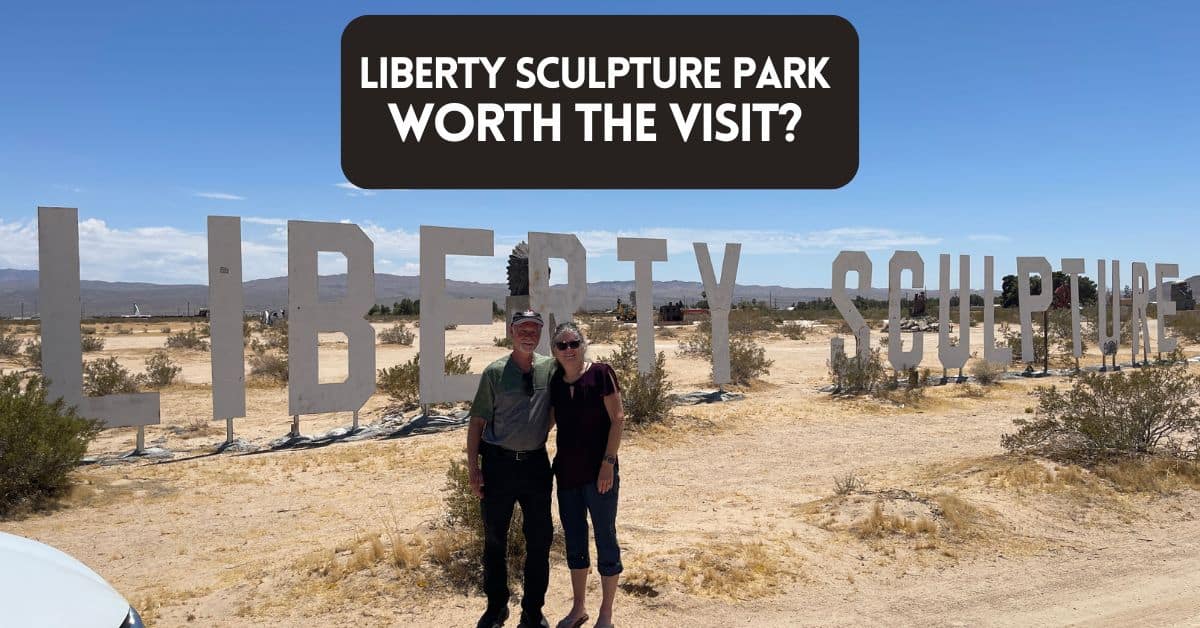
Is Liberty Sculpture Park Worth the Trip? Here Is What to Know
Like thousands of travelers, we’ve driven on Interstate 15 between Southern California and Las Vegas many times. Gazing to our right-hand side during our drive into Yermo, California, we’ve noticed a collection of enormous sculptures right in the midst of the Mojave Desert. We’ve often wondered, what is this place? Well, during our recent drive to Las Vegas, we pulled off the highway to find out.
We surmised there was a collection of sculptures to view. However, exactly what they represented, we had no idea until we entered the park. Upon arrival, we learned that Liberty Sculpture Park holds a collection of one of the most unusual—and politically direct—roadside attractions you’ll encounter perhaps anywhere.
What we found was not a conventional sculpture collection. Liberty Sculpture Park is part outdoor art exhibition, part memorial and part protest site. The artwork we encountered addresses democracy, political repression, human trafficking, the Tiananmen Square crackdown, Hong Kong’s democracy movement, the war in Ukraine and other struggles associated with freedom and human rights. Yes, it’s a heavy experience that took us by surprise.
If you’ve ever wondered if it’s worth pulling off the highway to see this place, you can learn from our experience. Based on our visit, here is what you should know before visiting Liberty Sculpture Park in Yermo, California.
The Places Where We Go contains affiliate links and is a member of the Amazon Services LLC Associates Program. As an Amazon Associate, we earn from qualifying purchases at no extra cost to you when you purchase using one of these Amazon links. Read our disclaimer and privacy policy for more information.
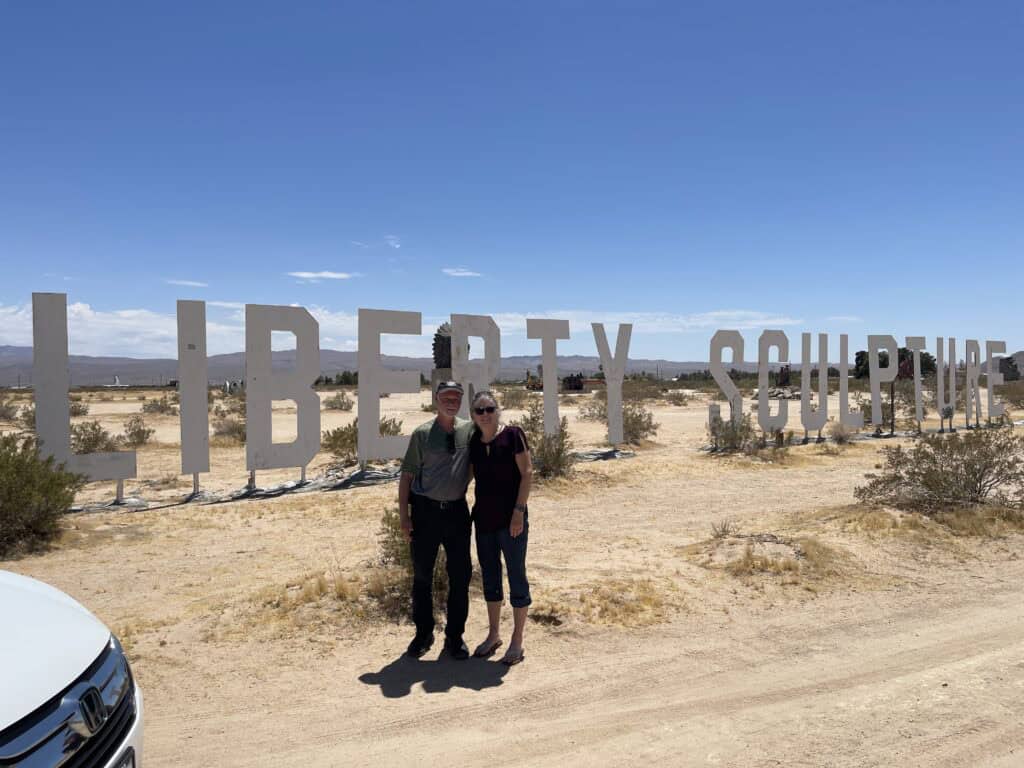
⬇️ Want To See Our Visit to Liberty Sculpture Park? ⬇️
Watch our Liberty Sculpture Park highlights video on YouTube for a closer look at what you can experience at this roadside stop in Yermo, California.
What Is Liberty Sculpture Park?
Liberty Sculpture Park is an open-air collection of monumental artwork located in the Mojave Desert near Interstate 15. We’ve previously encountered an open air museum when we visited Rhyolite Ghost Town, not too far from Death Valley National Park.
This park was established by sculptor Chen Weiming along with other supporters of the Chinese democracy movement. According to the Liberty Sculpture Park Foundation, the organization’s mission is to advocate for democracy and freedom, oppose communist tyranny,and commemorate victims of communism.
The foundation describes the park as a physical gathering place for the Chinese democracy movement outside China and as a memorial site for people affected by political oppression.
While the park focuses very heavily on Chinese political issues and the Chinese Communist Party, its themes extend beyond a single country. We encountered works associated with Native American resistance, civil-rights leaders such as Martin Luther King Jr., international democracy advocates, and the defense of Ukraine.
The park’s artwork expresses a strong political perspective. This is not a neutral history museum by any means. The sculptures and accompanying plaques present the viewpoints of their creators, many of whom are activists and outspoken critics of the Chinese government. We took a bit of time moving about from one exhibit to another, taking time to read the descriptions about the art work in front of us.
Get Free Weekly Travel Planning Guide
Destination Ideas – Practical Tips – Timely Travel News

Where Is Liberty Sculpture Park?
Liberty Sculpture Park is located at:
37570 Yermo Road
Yermo, California 92398
The park is right off Interstate 15 in Yermo, between Barstow and Baker. If you’re making a stop at Eddie World on your way to Las Vegas (you really should if you have not been there before), you’ll find this sculpture park right on the other side of the road. This makes it a convenient stop when driving between Southern California and Las Vegas.
Just leave Interstate 15 near Yermo, follow Calico Road south, and then turn onto Yermo Road. The entrance is marked, although the desert roads and setting may feel informal compared with a developed museum or state park.
You can use a navigation app to help locate the property, but we suggest that you also download the route before arriving in case cellular service becomes unreliable. It’s the desert after all.
How Much Does It Cost to Visit?
We didn’t encounter an entrance fee during our visit to Liberty Sculpture Park. Finding the main entrance, we just drove on in. Atlas Obscura also identifies it as a free outdoor attraction with interpretive signs in English and Chinese.
There wasn’t an attendant visible during our visit, nor did we see a formal visitor center upon arrival. We understand that donations may help support the foundation’s sculptures, construction and maintenance projects.
Because access conditions can change, you’ll want to verify current information through the park’s official website or contact the foundation before making a special trip.
When Is Liberty Sculpture Park Open?
The park’s official website provides its address and contact information, but we didn’t find clearly published daily visiting hours.
Because the grounds are outdoors and relatively informal, some travel websites and visitor reports describe the park as readily accessible. However, don’t assume that access is guaranteed at every hour or on every day.
Before visiting, check the official Liberty Sculpture Park website for announcements or contact the foundation at the email address listed on its website.
This is especially important when:
- You are making a special trip solely to see the park.
- You plan to visit early in the morning or near sunset.
- Construction or a special event may be taking place.
- Weather conditions could affect access.
- You are traveling with a large group.
How Much Time Should You Allow?
Allow approximately 30 to 60 minutes for a typical visit.
If your interest is primarily in seeing and photographing the major sculptures, you may be able to walk or drive through the park in about half an hour. This was close to our experience. We would have spent more time, but our visit took place in the midday of summer. That’s code for “it was blazing hot.”
Plan closer to an hour if you want to:
- Read the interpretive plaques.
- Examine the artwork from several angles.
- Photograph individual sculptures.
- Discuss the historical and political subjects.
- Record video or create travel content.
This is a place that will resonate particularly with people who have a strong interest in public art, political history, or human-rights issues. If that describes you, you’ll likely want to stay longer and take it all in.
What Will You See at Liberty Sculpture Park?
The park includes more than a dozen sculptures, murals, memorials and architectural projects. The collection continues to evolve as new works are completed.
The official foundation identifies major installations including the 64 Monument, the Tiananmen Massacre relief, Tank Man, Chief Crazy Horse, Li Wangyang, Liu Xiaobo in a Cage, the Goddess of Democracy, Hong Kong democracy memorials and the CCP Virus sculpture.
Several additional works were present during our visit.
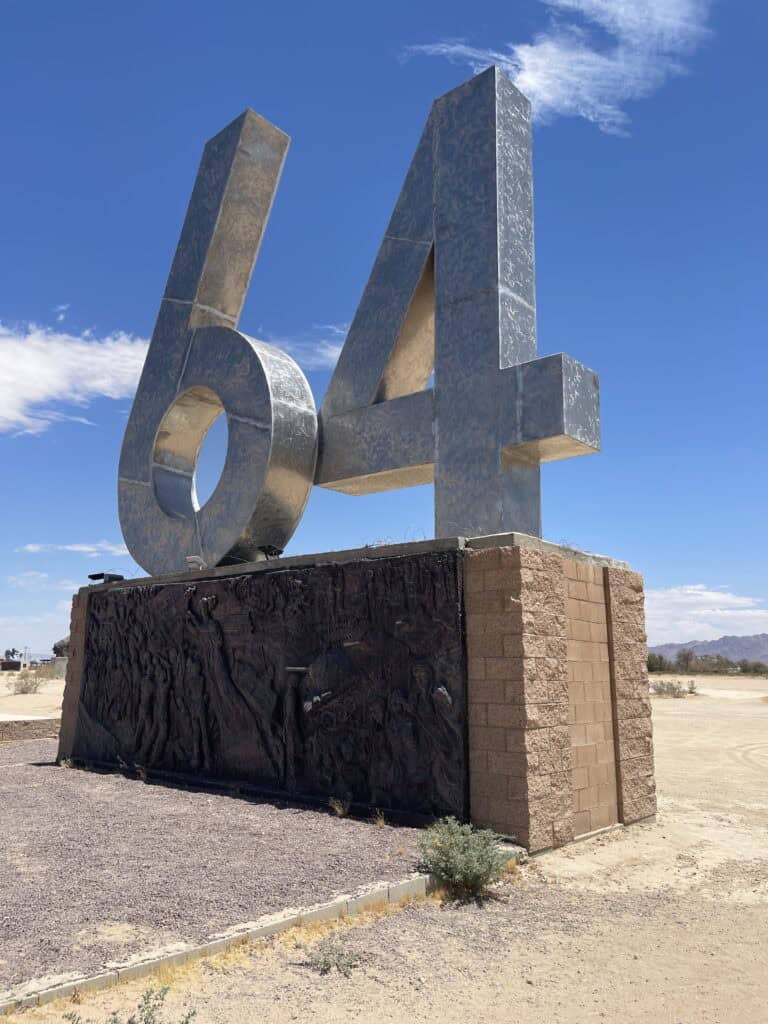
The 64 Monument
The enormous stainless-steel “64” is among the park’s most visible landmarks and can be seen from Interstate 15.
We learned that the numbers represent June 4, 1989. This is the date commonly associated with the Chinese government’s military crackdown on demonstrators in and around Beijing’s Tiananmen Square.
Atlas Obscura reports that the structure incorporates several references to the number 64, including its height, angle, and distance from Beijing.
Even without knowing the symbolism, the monument’s scale makes it one of the park’s most recognizable works.
Tank Man
Near the 64 Monument, we saw a three-dimensional interpretation of the unidentified man photographed standing in front of a column of tanks following the Tiananmen Square crackdown. This image is legendary.
The park’s official description says Chen Weiming based the installation on the famous photograph taken by Associated Press photographer Jeff Widener. The artwork positions the figure directly in the path of a tank moving toward the 64 Monument.
The sculpture transforms one of the twentieth century’s best-known protest images into a physical scene that you can walk around and examine.
The Tiananmen Massacre Relief
A large relief sculpture portrays the violence and confusion surrounding the 1989 crackdown.
Unlike a monument that uses abstract symbolism, this installation presents recognizable human figures, soldiers and scenes of confrontation. It is one of several pieces connecting the park directly with the history of China’s democracy movement.
The imagery may be disturbing for some visitors, particularly children. We had two small children in the car with us. They didn’t know quite what to make of the images they saw. In a word, they called the place “creepy”. So a bit of caution if you travel here with littles. Be prepared to answer lots of questions as they confront the artwork along with you.
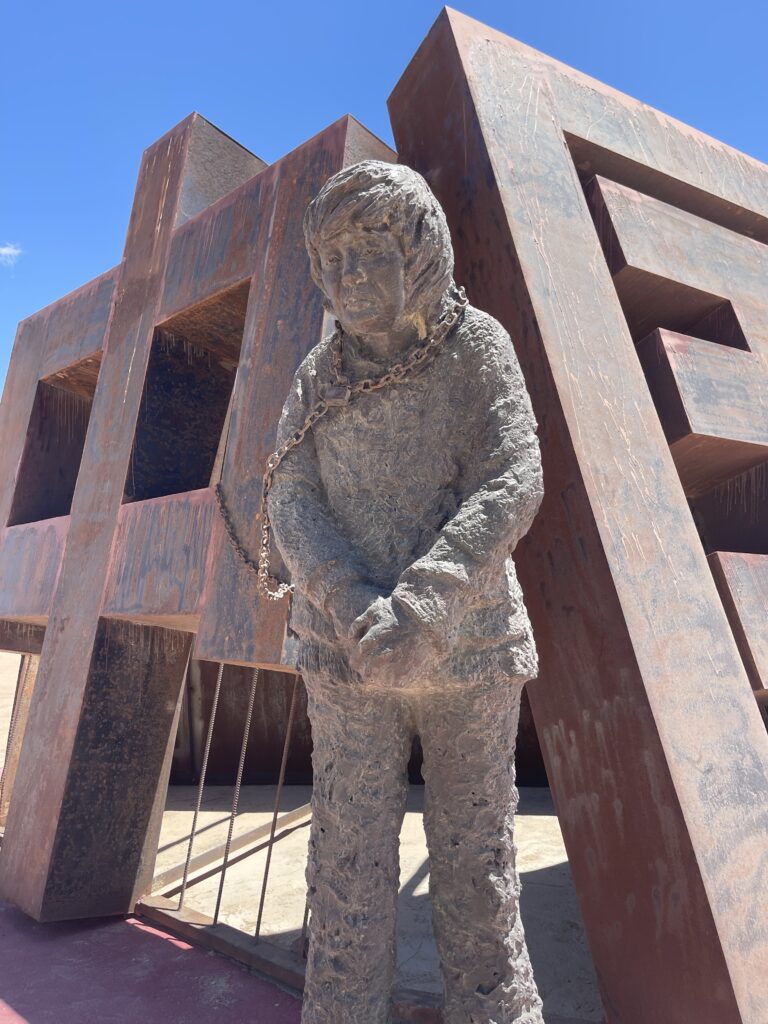
The Chained Woman
The Chained Woman memorial addresses the widely publicized case of a woman who was discovered confined with a chain around her neck in China’s Jiangsu Province.
According to the account presented on the park’s plaque, the woman had been trafficked, sold, and subjected to years of abuse. The sculpture was erected not only to recognize her individual experience but also to commemorate other women and girls affected by trafficking, forced marriage and enslavement.
The accompanying text contains descriptions of sexual violence, physical abuse and imprisonment. The sculpture is intentionally unsettling. It demonstrates that the park’s purpose is not merely to display beautiful objects but also to confront visitors with human suffering that its creators believe has been ignored or suppressed.
Victims of Communism Memorial
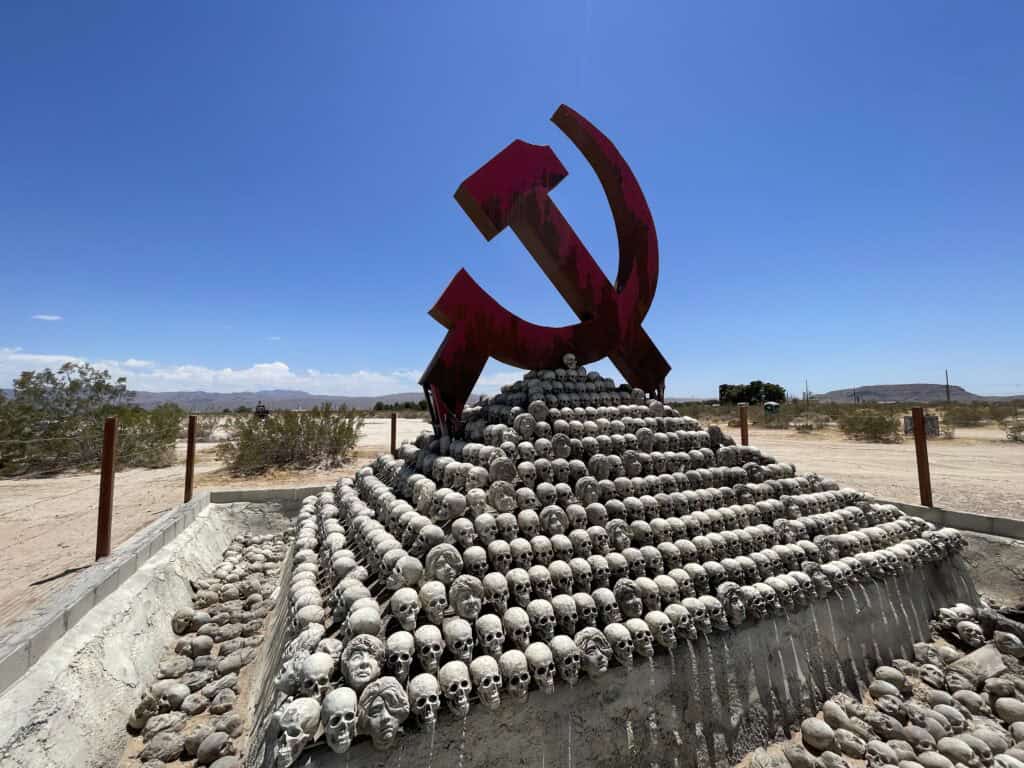
One of the park’s most visually dramatic installations is a pyramid of skulls topped with a hammer-and-sickle symbol.
The imagery is stark and unmistakable. The work represents people who, according to the artists, suffered or died under communist governments.
Whether you share the creators’ political conclusions or not, the sculpture communicates its message with enormous visual force.
Garbage of History
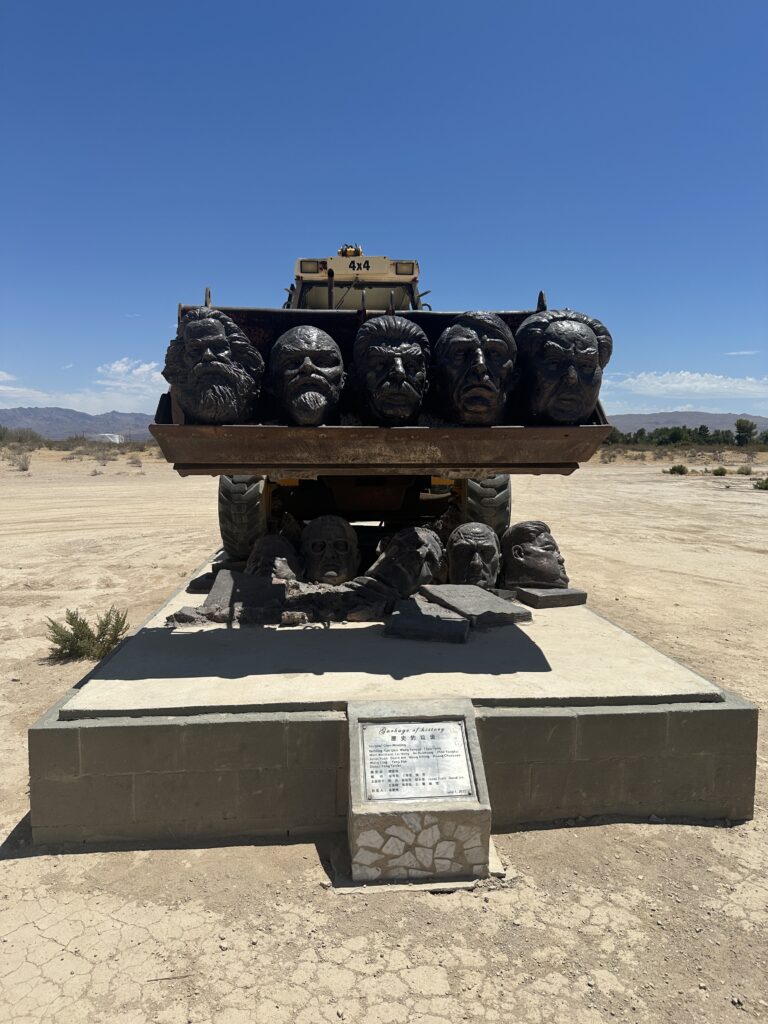
Garbage of History uses political symbolism to condemn leaders, institutions and ideologies that the artists believe should be discarded.
Like many works at Liberty Sculpture Park, it is confrontational rather than subtle. The sculpture is designed to provoke a reaction and leave little uncertainty about the artist’s position.
The Ruins of Culture—The Spirit of Freedom
This installation explores the relationship between political oppression, the destruction of culture and the persistence of human freedom.
Its presence helps broaden the park’s narrative beyond individual political figures. It invites visitors to consider what happens to traditions, art, education and collective memory when governments attempt to control ideas.
Wall of Democracy Movement Pioneers
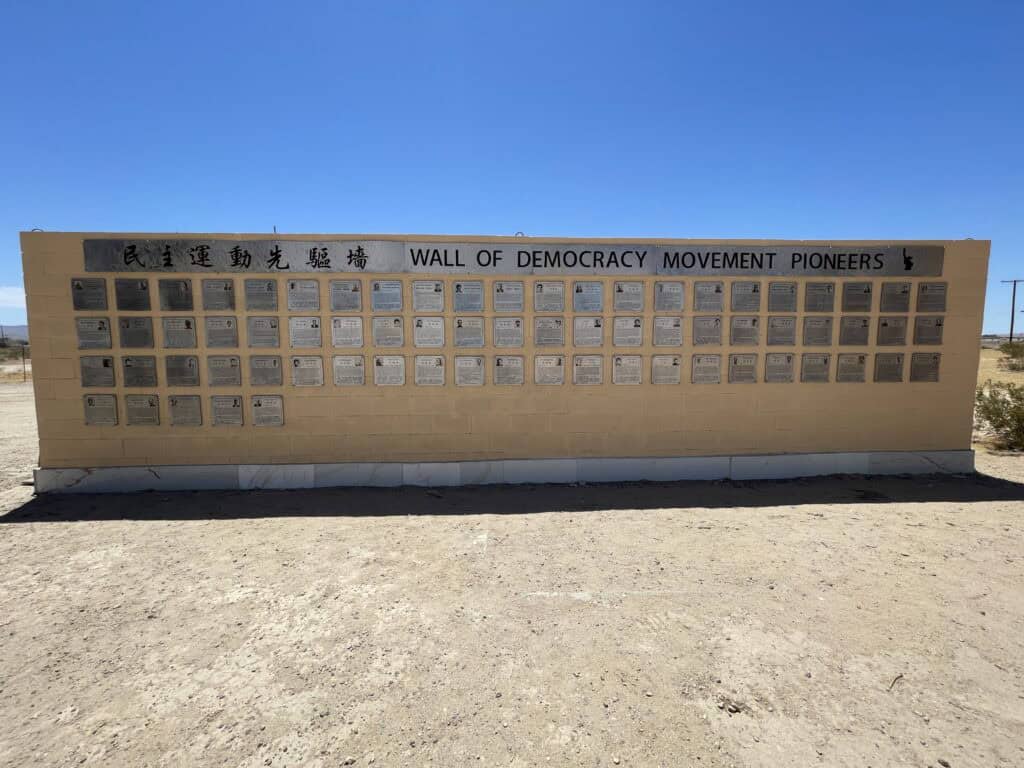
The Wall of Democracy Movement Pioneers displays photographs of people associated with civil rights, political resistance and democratic movements throughout the world.
During our visit, we noticed images of Nelson Mandela, Martin Luther King Jr., former Polish president Lech Wałęsa and Ukrainian president Volodymyr Zelenskyy.
The histories and political circumstances of these people differ considerably. Within the park, however, they are connected by the foundation’s broad themes of resistance, democracy and human freedom.
The wall reflects the park’s interpretation of these figures rather than an official or universally accepted list of democracy leaders.
Gazing at the Starry Sky
Gazing at the Starry Sky recognizes Gao Zhisheng, a Chinese human-rights lawyer known for representing religious minorities, activists and other clients involved in politically sensitive cases.
The sculpture is part of a recurring pattern throughout the park: an individual person is used to represent broader concerns involving political prisoners, dissidents, attorneys, journalists and activists.
Defending Free Ukraine
Defending Free Ukraine honors Ukrainian soldiers, international volunteer fighters and civilians who lost their lives during Russia’s war against Ukraine.
The accompanying inscription presents the sculpture as a tribute to people defending their homeland and expresses the artist’s belief that freedom must sometimes be protected through extraordinary sacrifice.
The work also shows that Liberty Sculpture Park continues to address present-day international events rather than focusing exclusively on China’s political history.
The Origin of Freedom—Number One: Chief Crazy Horse
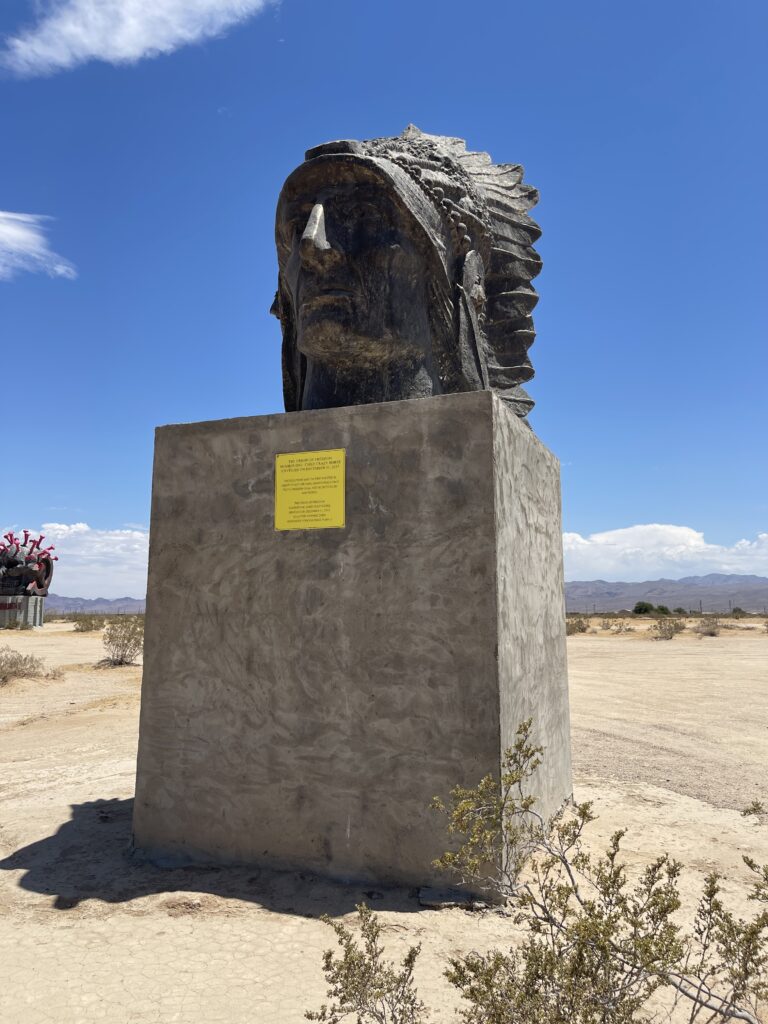
One of the park’s earliest major works depicts Lakota leader Crazy Horse.
The sculpture extends the park’s theme of resistance into American history. Roadside America reports that the large head was installed in recognition of the 140th anniversary of Crazy Horse’s death.
Its inclusion alongside Chinese dissidents and international political figures illustrates how broadly the park’s creators interpret the idea of fighting for freedom.
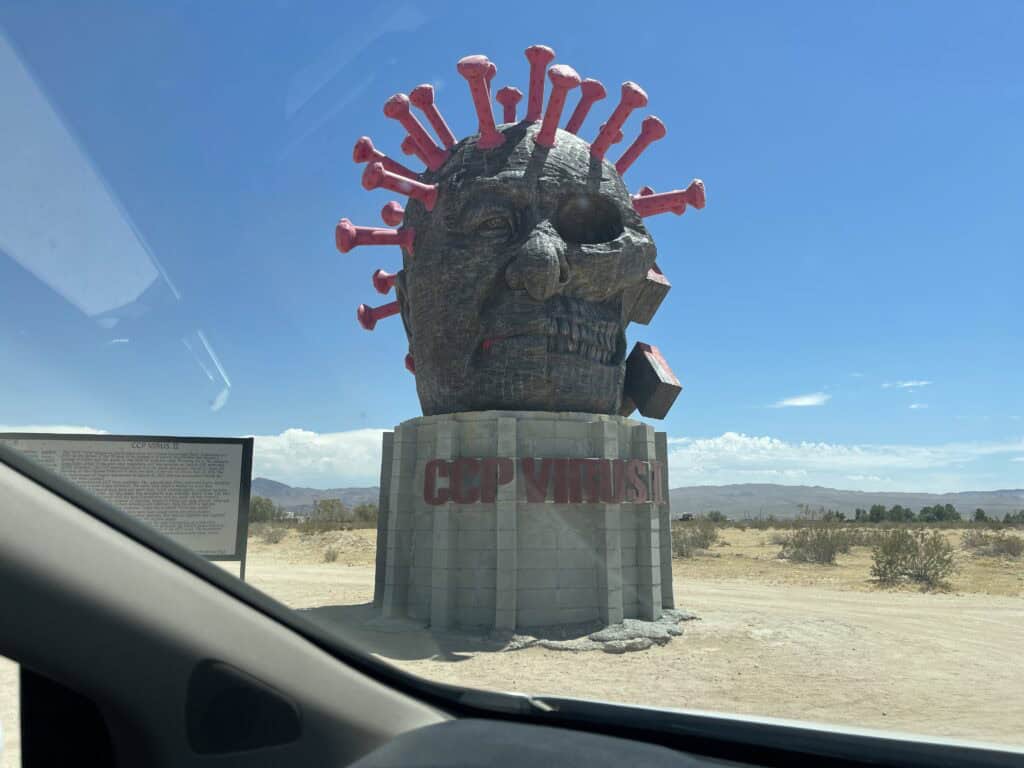
CCP Virus
CCP Virus is one of the park’s largest and most controversial sculptures. We viewed this one from our air-conditioned car as the summer heat was getting to us. We stopped for a bit in front of the artwork to read the signage and get a bit of an understanding about this very intriguing work of art.
The work resembles a giant coronavirus particle incorporating a skull, the face of Chinese leader Xi Jinping and communist political symbols. The park’s official description says the original sculpture was approximately 27 feet tall and constructed from steel and fiberglass.
The artwork expresses Chen Weiming’s condemnation of the Chinese government’s handling of the COVID-19 outbreak and later pandemic restrictions. Its title and imagery reflect the artist’s political argument; they should not be interpreted as neutral scientific terminology.
An earlier version of the sculpture was destroyed by fire in 2021. A reconstructed steel version now stands at the park.
The story surrounding its destruction has become part of the installation’s meaning, reinforcing the park’s recurring themes of censorship, political interference and the survival of protest art.
Is Liberty Sculpture Park Appropriate for Children?
Families can visit Liberty Sculpture Park, but adults should understand that several installations address mature and disturbing subjects.
The park includes representations or written descriptions involving:
- Mass death
- Human trafficking
- Sexual violence
- Imprisonment
- Torture
- War
- Political executions
- Skulls and other graphic symbolism
Older children and teenagers studying history, government, civil rights or public art may find the park thought-provoking.
For younger children, you’ll want to guide the visit carefully and decide which plaques are appropriate to read. The Chained Woman memorial and some Tiananmen-related works may require particular discretion.
The park is not designed primarily as a children’s attraction.
Is Liberty Sculpture Park Politically Neutral?
No.
Liberty Sculpture Park openly advocates for democracy and human rights while opposing the Chinese Communist Party and communist political systems more broadly. The foundation explicitly identifies those goals as part of its mission.
That does not mean travelers must agree with every plaque or interpretation to find the park worthwhile.
You can approach the site from several perspectives:
- As an outdoor art installation
- As a memorial
- As political protest
- As a site connected with the Chinese diaspora
- As an example of activist art
- As an unusual roadside attraction
- As a starting point for additional historical research
It is helpful to distinguish between three different types of information while visiting:
- Established historical events, such as the 1989 Tiananmen Square crackdown.
- Personal stories or allegations summarized by the park.
- Political interpretations and conclusions expressed by the artists.
Reading the plaques critically does not diminish the experience. In many ways, examining their perspective is part of understanding the park.
What Is the Walking Surface Like?
Liberty Sculpture Park is an outdoor desert property rather than a landscaped urban sculpture garden.
When you visit, you’ll encounter:
- Dirt and gravel roads
- Sandy or uneven ground
- Desert vegetation
- Limited shade
- Exposure to wind, dust and heat
- Significant distances between some installations
The roads and paths leading through the park are not paved but can generally be traveled on foot or by vehicle easily.
Conditions may be difficult for visitors using wheelchairs, walkers or other mobility devices. Contact the park directly for current accessibility information before visiting.
What Should You Bring?
Plenty of drinking water
Bring more water than you think you will need, particularly during late spring, summer and early fall.
The park is in the Mojave Desert, where heat can become dangerous quickly. Do not rely on finding a working drinking fountain, vending machine, or staffed visitor facility.
Keep additional water in your vehicle in case of delays or mechanical problems.
Sun protection
Bring:
- Sunscreen
- Sunglasses
- A broad-brimmed hat
- Lightweight protective clothing
There is little natural shade around many of the sculptures.
Closed-toe shoes
Wear sturdy, comfortable shoes suitable for dirt, gravel and uneven ground. Sandals may be uncomfortable and offer limited protection from rocks, thorns or hot surfaces.
A fully charged phone
A charged phone is helpful for navigation, photography and emergency communication. Consider carrying a portable battery pack.
A camera
The combination of monumental sculptures, open desert and dramatic skies makes the park an interesting photography location.
Wide-angle lenses are helpful for showing the scale of the artwork, while a moderate telephoto lens can isolate details and compress sculptures against the surrounding mountains.
Be mindful that several works function as memorials. Photograph them respectfully and avoid climbing or posing directly on the installations.
When Is the Best Time to Visit?
Best time of year
The most comfortable seasons will generally be:
- Late fall
- Winter
- Early spring
Summer temperatures in the Mojave Desert can be extreme.
Best time of day
Morning and late afternoon usually provide:
- More comfortable temperatures
- Softer light
- Better shadows and texture
- More dramatic photography
Avoid the hottest portion of a summer afternoon.
Even outside summer, check the forecast before leaving. Desert weather can include strong winds, blowing dust, sudden temperature changes and occasional flash-flood hazards.
Important Summer Safety Tips
A brief roadside stop can become hazardous when desert temperatures are high.
When visiting during summer:
- Carry plenty of water for every person.
- Bring additional emergency water in the vehicle.
- Avoid prolonged walking during the hottest hours.
- Wear sunscreen and protective clothing.
- Never leave children or pets unattended in a parked vehicle.
- Make sure your vehicle has adequate fuel.
- Check tire pressure and coolant before a long desert drive.
- Tell someone your route when traveling in extreme weather.
- Leave immediately if anyone becomes dizzy, confused, nauseated or unusually weak.
Do not underestimate the heat because the visit appears short or because the sculptures are close to the highway.
Can You Drive Through the Park?
We entered with our car and drove through the majority of the artworks with our vehicle. We also spent a bit of time stopping the car, and got out to walk for close up views of many of the exhibits.
Just keep in mind that road conditions may vary with construction, weather and maintenance. Drive slowly, and watch for other visitors.
Can You Bring a Large RV or Travel Trailer?
Travelers towing an RV should use caution.
Although the park is near Interstate 15, unpaved surfaces, narrow turning areas, and uncertain road conditions may not be appropriate for a long trailer or motorhome. We wouldn’t recommend this unless you have a Class B Van – maybe a Class C RV would also work, but we’re not 100% sure.
A better strategy may be to:
- Confirm current parking conditions before arriving.
- View recent satellite imagery.
- Contact the park for large-vehicle guidance.
- Leave the trailer at a campground or secure parking area.
- Visit with the tow vehicle alone.
Do not enter an unpaved area unless you are confident there is enough room to turn around without backing a long distance.
Nearby Places to Visit
Liberty Sculpture Park can be incorporated into a longer Yermo or Barstow-area itinerary.
Eddie World
Eddie World is a convenient food, fuel, and restroom stop near Interstate 15.
We stopped there for lunch before visiting the sculpture park. Its location makes it an easy pairing with Liberty Sculpture Park, especially during a longer drive to or from Las Vegas.
Calico Ghost Town
Calico Ghost Town is only a few miles from Yermo and can turn a short roadside break into a half-day excursion.
The former silver-mining town includes restored and reconstructed buildings, shops, exhibits and family-oriented attractions. You can catch our YouTube video to understand what a day at Calico Ghost Town is like.
Peggy Sue’s 50’s Diner
Peggy Sue’s is another recognizable Yermo roadside stop. The retro diner and its adjacent collection of dinosaur sculptures offer a considerably lighter experience after the serious subject matter at Liberty Sculpture Park. We recommend Peggy Sue’s for a memorable diner breakfast experience.
Barstow
Barstow offers Route 66 history, restaurants, fuel, and additional museums and attractions. It can serve as a practical overnight base or meal stop during a Southern California-to-Las Vegas road trip. Given it’s midpoint location on the way to Las Vegas, we can’t tell you how many times we’ve stopped in Barstow for a bite to eat.
A Suggested Half-Day Yermo Itinerary
Travelers who want more than a brief highway stop could use the following itinerary:
Morning: Visit Calico Ghost Town before temperatures rise.
Lunch: Stop at Eddie World or another Yermo restaurant.
Early afternoon: Spend 30 to 60 minutes at Liberty Sculpture Park.
Later afternoon: Continue toward Barstow, Baker or Las Vegas.
During hot weather, visit Liberty Sculpture Park earlier in the morning and move indoor activities to the afternoon.
Is Liberty Sculpture Park Worth Visiting?
Liberty Sculpture Park is worth considering if you are interested in:
- Unusual roadside attractions
- Monumental outdoor sculpture
- Contemporary political art
- Human-rights history
- The Chinese democracy movement
- Tiananmen Square memorials
- Desert photography
- Lesser-known California destinations
It may be less suitable for travelers looking for a polished museum, extensive visitor services, shade, entertainment, or a politically neutral presentation.
Our visit was more serious and thought-provoking than we expected. The sculptures are not arranged simply to decorate the landscape. They were created to communicate arguments, preserve memories and provoke emotional reactions.
Some visitors may agree strongly with those messages. Others may question or challenge them. Either way, the scale of the artwork and its unexpected Mojave Desert setting make Liberty Sculpture Park difficult to forget.
Final Tips for Visiting Liberty Sculpture Park
Before adding the park to your itinerary, remember these essential tips:
- Confirm current access information before traveling.
- Allow approximately 30 to 60 minutes.
- Bring plenty of water.
- Avoid summer’s hottest hours.
- Wear sunscreen, a hat and closed-toe shoes.
- Expect dirt roads and uneven surfaces.
- Prepare children for mature subject matter.
- Read the plaques with an awareness of the park’s advocacy mission.
- Do not climb on or damage the sculptures.
- Use caution before bringing a large RV or trailer onto the property.
- Combine the visit with Eddie World, Calico Ghost Town or another Yermo attraction.
Liberty Sculpture Park began for us as a place we had briefly noticed from Interstate 15.
Once we stopped, however, it became much more than an unusual roadside curiosity. It was a landscape filled with stories of political resistance, human suffering and the continuing struggle over how history is remembered.
For travelers willing to leave the freeway and engage with challenging subject matter, it offers one of the most distinctive stops on the road between Southern California and Las Vegas.
Thanks for stopping by to read about our experience at Liberty Sculpture Park.
Julie & Art – The Places Where We Go
