
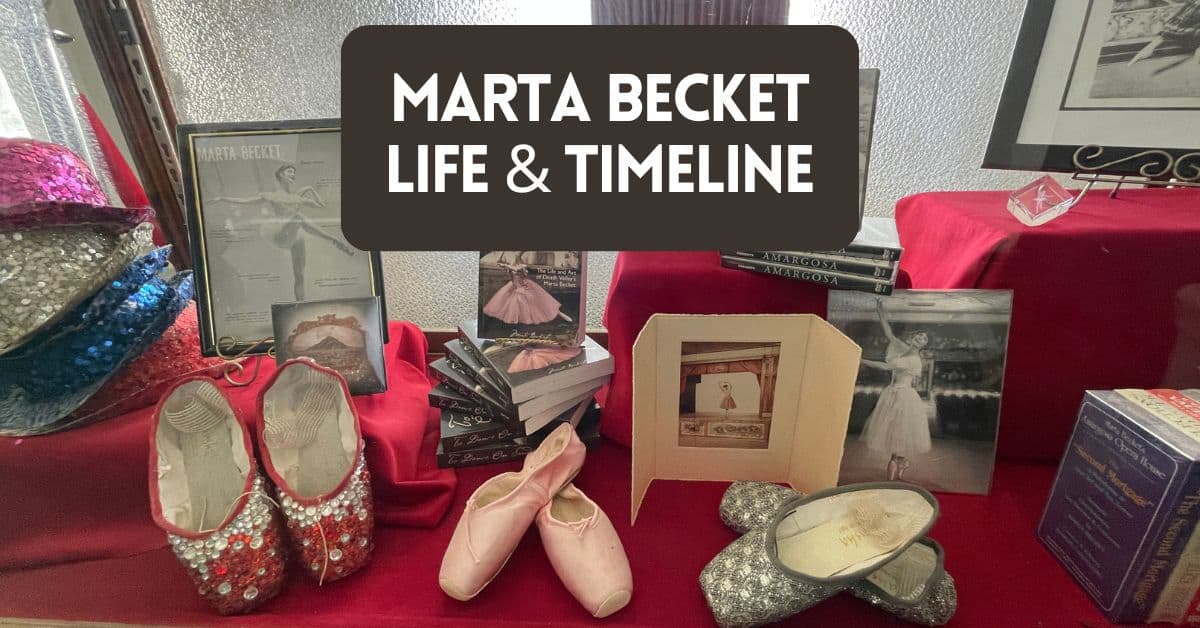
How Marta Becket Turned a Ghost Town into Her Personal Stage PLUS Her Life Timeline
We first encountered the story of Marta Becket on our visit to Death Valley, when we saw a book about her life in the gift shop. On a subsequent trip, we stopped outside the Amargosa Opera House to wander the place she made famous. You can see that stop captured in one of our early YouTube videos. We were excited to learn more about her life legacy. Some travel stories begin with careful planning. Others begin with a flat tire.
The story of Marta Becket and the Amargosa Opera House belongs to the second category. In 1967, Marta Becket, a dancer, painter, choreographer, and performer from New York, came across an abandoned social hall in Death Valley Junction, California. What most people might have seen as a ruined room in a nearly forgotten desert town, Marta saw as a stage.
That moment became the beginning of one of the most unusual artistic stories in the American desert: a woman who left behind the conventional path of a performing artist and created her own world in the middle of nowhere.
Today, the Amargosa Opera House remains one of the most memorable stops near Death Valley National Park. But to understand why this place matters, you first have to understand the remarkable woman who brought it back to life.
The Places Where We Go contains affiliate links and is a member of the Amazon Services LLC Associates Program. As an Amazon Associate, we earn from qualifying purchases at no extra cost to you when you purchase using one of these Amazon links. Read our disclaimer and privacy policy for more information.
A Desert Theater Unlike Any Other
The Amargosa Opera House is located in Death Valley Junction, a small desert community near the California-Nevada border. The building was originally part of a Pacific Coast Borax Company civic town center built in the 1920s. The complex included offices, lodging, and other facilities tied to the mining company’s operations in the area.
The section that became the Amargosa Opera House was once known as Corkill Hall, a social hall for the company town. Long before Marta Becket arrived, it served a practical community function. By the time she found it, however, the building had fallen into disrepair. The floors were damaged, the walls were stained, and the hall seemed to be waiting for someone with enough imagination to see what it could become.
That person was Marta.
Who Was Marta Becket?
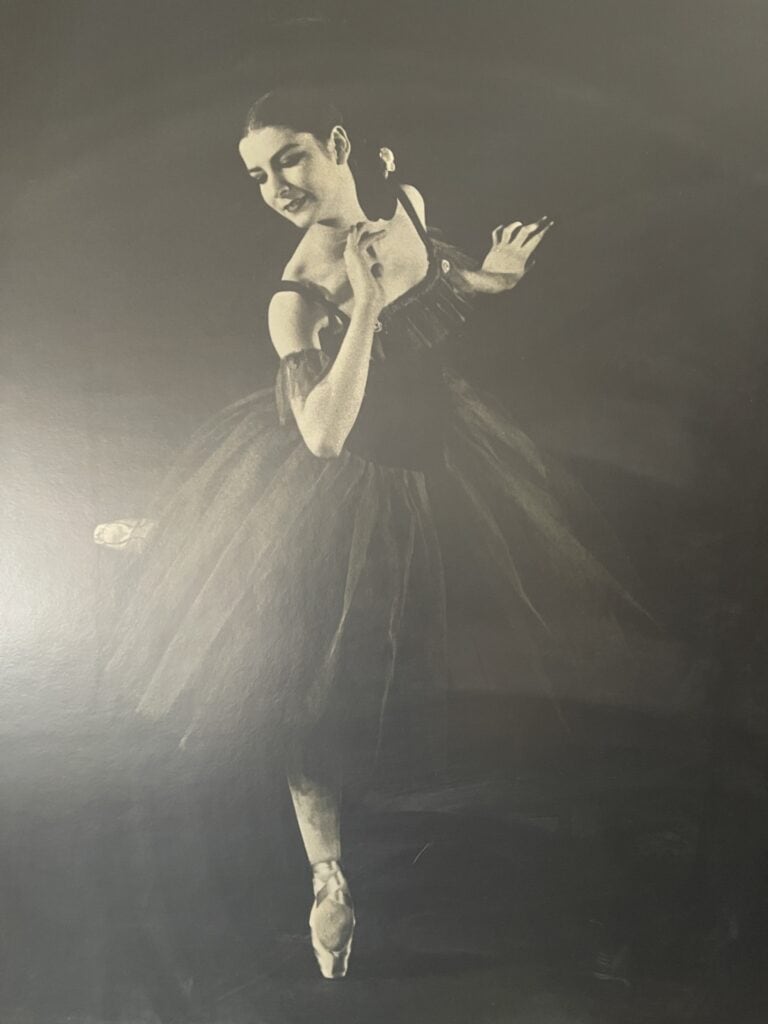
Marta Becket was born in New York City on August 9, 1924. She became a professional performer whose artistic life included dance, theater, choreography, painting, and illustration. The official Amargosa Opera House site describes her as an artist who discovered her creative life in the California desert, and her legacy remains central to the Opera House’s identity today.
Before Death Valley Junction, Marta lived as a working performer. She danced, toured, created solo works, and developed the kind of artistic discipline required to keep performing even when the path was uncertain. That background helps explain why the Amargosa story feels so powerful. Marta did not arrive in the desert seeking novelty. She arrived as an artist who had spent years searching for a place where her imagination could fully take shape.
Death Valley Junction gave her that place.
Get Free Weekly Travel Planning Guide
Destination Ideas – Practical Tips – Timely Travel News

How a Flat Tire Changed Her Life
In March 1967, Marta Becket and her husband were traveling near Death Valley while she was on hiatus from touring her one-woman show. Their vehicle had a flat tire, and they stopped in Death Valley Junction for repairs. While her husband worked on the tire, Marta explored the nearby old buildings.
She came across the abandoned social hall and looked inside. The room was in terrible condition, but Marta saw beyond the damage. She later recalled the building speaking to her in effect, offering her life if she would do something with it. Rather than dismissing the thought as impractical, she pursued it.
She found the property manager and asked about renting the space. The rent was reportedly $45 per month, with the understanding that she would be responsible for repairs. Marta and her husband returned to New York, packed their belongings, and came back to Death Valley Junction later that year.
For many people, a flat tire is simply an inconvenience. For Marta Becket, it became the turning point of her life.
From Corkill Hall to the Amargosa Opera House
Once Marta returned to Death Valley Junction, the work began immediately. She and her husband repaired the hall, leveled the floor, extended the stage, and painted the walls white. The old social hall became the Amargosa Opera House, a name that gave the modest desert theater a sense of grandeur and purpose.
Marta’s first performance took place on February 10, 1968. The audience numbered only twelve people, but that did not matter. She had found her stage.
In a traditional theater, the performer waits for an audience. Marta reversed that relationship. She decided that whether people came or not, she would perform. That commitment is one of the most inspiring parts of her story. She did not create the Amargosa Opera House for practical business reasons. She created it because she needed a place to make art.
Why Marta Painted an Audience on the Walls
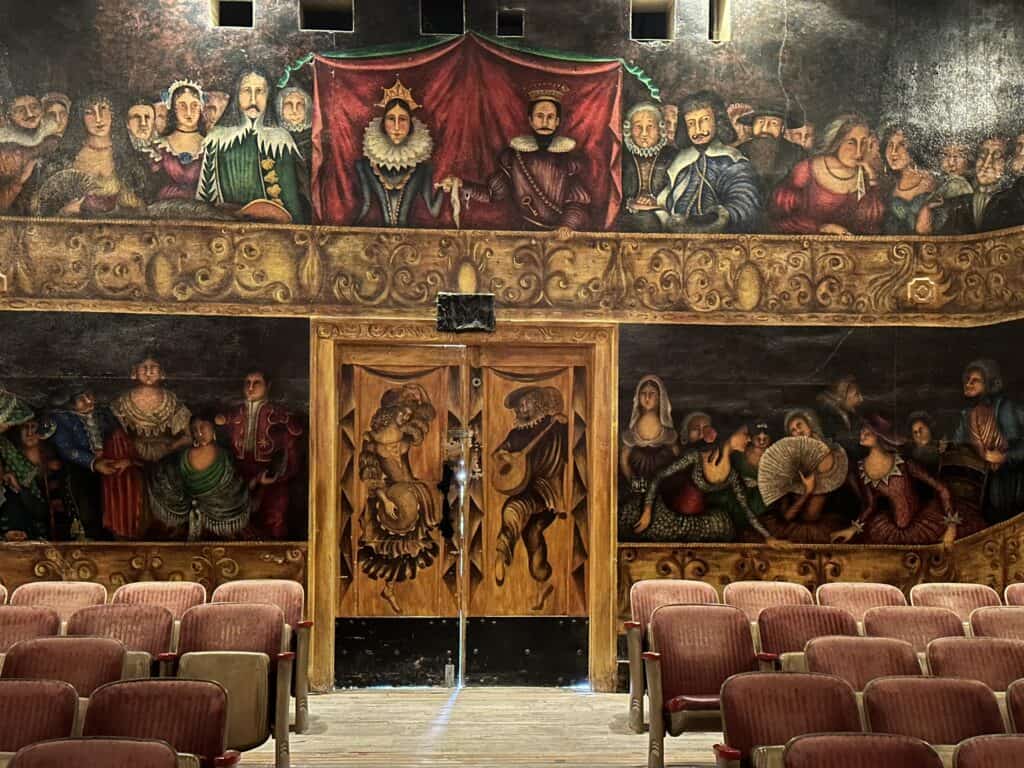
One of the most unforgettable features of the Amargosa Opera House is Marta Becket’s painted audience.
After a flood damaged the theater, Marta looked at the walls and imagined them filled with spectators from another time. She began painting a Renaissance-inspired audience seated in balconies, with royalty, musicians, performers, nobility, and other figures surrounding the room. The walls took four years to complete, and she then spent another two years painting the ceiling.
The result is extraordinary. The murals are more than decoration. They create the illusion that the performer is never alone. Even if only a few visitors were sitting in the real seats, Marta was surrounded by the audience she had created with her own hands.
Her painted world also reflected the kind of performance she loved: classical dance, pantomime, courtly traditions, theatrical storytelling, and music. The official Opera House history notes that her 16th-century audience was inspired in part by the building’s Spanish Colonial Revival architecture.
For visitors today, the murals are often the emotional center of the visit. They reveal Marta’s imagination, humor, loneliness, resilience, and theatrical instinct all at once.
Marta Becket’s Life as a Desert Artist
Marta Becket did not merely restore a theater. She built a life around it.
For decades, she performed at the Amargosa Opera House, created costumes, painted, wrote, choreographed, and maintained a theatrical presence in one of the most unlikely places imaginable. Her story attracted attention because it seemed almost impossible: a New York performer creating an opera house in a remote desert town and continuing to perform whether the audience was large, small, or nearly absent.
That is also why the story continues to resonate. Marta’s life asks a question many artists, travelers, and dreamers understand: What would you create if you stopped waiting for the perfect circumstances?
Her answer was clear. She would create anyway.
In a letter displayed at the Amargosa Hotel, Marta Becket looked back on the discovery of Death Valley Junction as the place where her childhood dreams could be reborn. She also reminded readers that the past cannot preserve itself. Places like the Amargosa Opera House survive only when people choose to care for them.
“There is only one Amargosa Opera House”
Marta Becket
Preserving Marta’s Legacy Today
Marta Becket died on January 30, 2017, at the age of 92. Her official Amargosa biography lists her dates as August 9, 1924, to January 30, 2017.
Her final performance took place in February 2012, closing a career at the Opera House that spanned more than four decades.
But the story did not end with Marta’s final bow. The nonprofit she created continues the work of preserving the Opera House and the surrounding historic property. The official site notes that Marta’s legacy continues through performances, maintenance, restoration, and efforts to care for the adobe buildings and murals.
Visitors can still experience the Amargosa Opera House today. The official site currently lists Opera House tours daily at 9 a.m. and 6 p.m., with payment at the front desk, though travelers should always confirm current tour times before making a special trip.
For anyone visiting Death Valley National Park, the Amargosa Opera House offers something different from scenic overlooks and desert hikes. It offers a human story: one artist, one abandoned room, and one lifetime of creative devotion.

Marta Becket Timeline
Here is a brief timeline of Marta Becket’s life and connection to the Amargosa Opera House:
1924 – Marta Becket is born in New York City.
1967 – Marta discovers the abandoned Corkill Hall in Death Valley Junction after a flat tire.
1968 – She gives her first performance at the newly named Amargosa Opera House.
Late 1960s-1970s – Marta paints the Opera House walls and ceiling, creating her famous painted audience.
1970 – National media attention helps introduce her desert theater to a wider audience.
1981 – Death Valley Junction is listed on the National Register of Historic Places.
2012 – Marta gives her final performance.
2017 – Marta Becket dies in Death Valley Junction at age 92.
Today – The Amargosa Opera House continues as a historic arts destination near Death Valley.
You can also download our printable Marta Becket timeline below:
Download Marta Becket Timeline
Frequently Asked Questions About Marta Becket
Marta Becket was a dancer, choreographer, painter, performer, and visual artist best known for creating and performing at the Amargosa Opera House in Death Valley Junction, California.
She discovered the old Corkill Hall in 1967 after stopping in Death Valley Junction because of a flat tire. She saw the damaged building as a theater and decided to transform it into a home for her artistic work.
Yes. Marta painted a Renaissance-inspired audience on the walls of the Opera House so that the theater would always feel filled with spectators. The walls took four years to complete, and the ceiling took another two years.
Marta Becket’s final performance at the Amargosa Opera House took place in February 2012.
Yes. The Amargosa Opera House currently offers tours, and the official site lists daily tour times. Because this is a remote destination and schedules can change, confirm directly with the Opera House before visiting.
Marta died in Death Valley Junction in 2017. She was cremated, and her ashes were spread over the property with wildflower seeds.
Marta became famous for transforming an abandoned desert social hall into the Amargosa Opera House, painting its walls with an elaborate audience, and performing there for more than four decades.
Visit, Stay & Learn More
Check Rates & Availability at the Amargosa Hotel
Final Thoughts: Why Marta Becket’s Story Still Matters
Marta Becket’s story endures because it is about more than an unusual theater near Death Valley. It is about the courage to recognize a calling when it appears in an unexpected place.
She found a ruined hall and imagined a stage. She found isolation and created an audience. She found a forgotten desert junction and turned it into a destination for art, memory, and wonder.
That is why the Amargosa Opera House still matters. It reminds us that remarkable places do not always begin as remarkable places. Sometimes they become remarkable because one person refuses to let a dream disappear.
Thanks for stopping by to read this article about Marta Becket!
Julie & Art – The Places Where We Go
