
The Ultimate Campground Comparison AI Prompt To Find Your Perfect Campsite
A campground may have beautiful photographs, a convenient location, and hundreds of positive reviews. But, will the campground work for you? None of those things guarantees that the campground—or the individual site you select will work for your camping equipment and travel priorities.
For RV travelers, the trailer may technically meet the campground’s published length limit while the individual parking pad remains too short for both the trailer and tow vehicle. Trees, posts, slopes, and tight turns can also affect whether you can open an awning or safely maneuver into the site.
Tent campers face a similar problem. A reservation platform might identify a campsite as suitable for tents without telling you whether the designated tent pad is large enough for your tent, vestibule, and guylines.
In this post, we present our Campground Comparison Tool. It’s an AI travel prompt that we designed, tested, and refined to improve campground selection.
The Campground Comparison Tool is a free copy-and-paste AI prompt that helps RV and tent campers compare two campgrounds based on equipment fit, campsite dimensions, hookups, reservation rules, driving time, shade, privacy, noise and nearby activities. It also identifies facts that must be verified before booking.
The Places Where We Go contains affiliate links and is a member of the Amazon Services LLC Associates Program. As an Amazon Associate, we earn from qualifying purchases at no extra cost to you when you purchase using one of these Amazon links. Read our disclaimer and privacy policy for more information.

The complete prompt is free to copy and customize
The Campground Comparison Prompt
CAMP-01: The Campground Comparison Tool is an AI travel prompt designed to investigate these practical details before you reserve.
It can help you:
- Compare two campgrounds you are already considering
- Find two campground options near a destination
- Find campgrounds within a specified drive from home
- Evaluate whether an RV, tow vehicle, or tent should fit
- Compare hookups, facilities, shade, privacy, and noise
- Determine when reservations become available
- Identify important facts that still require verification
Important: Artificial intelligence can assist with campground research, but it should not replace the official reservation listing or direct confirmation from campground staff. Individual campsite dimensions, road conditions, closures and reservation policies can change.
The Problem This AI Prompt Solves
Most basic campground searches focus on broad information:
- Location
- Price
- Photographs
- Overall review score
- General amenities
Those factors are useful, but they may not answer the questions most likely to affect your stay.
For example:
- Does the campground’s maximum RV length apply to every campsite?
- Is the parking pad long enough for the trailer and tow vehicle?
- Can the truck park separately within the campsite?
- Is there clearance for slide-outs and an awning?
- Does the electrical pedestal provide the amperage you require?
- Is the tent pad large enough for the actual tent footprint?
- Will highway, train, or campground noise affect the experience?
- When does reservation inventory open?
- Can the entire stay be reserved when the arrival date is entered in the booking window?
- Are any campground loops closed for construction?
The Campground Comparison Tool asks AI to research these questions systematically rather than simply recommending the campground with the best rating. As users of ChatGPT and Perplexity, we developed this ChatGPT prompt for finding campgrounds that meet our specifications.
Who Should Use the Campground Comparison Tool?
This prompt is especially useful for:
RV and Travel-Trailer Owners
RV travelers can use the prompt to compare:
- Campground-wide length limits
- Individual campsite dimensions
- Tow-vehicle parking
- Back-in and pull-through access
- Slide-out and awning clearance
- Electrical, water, and sewer connections
- Dump-station availability
- Generator restrictions
- Road and entrance conditions
Tent Campers
Tent campers can use it to investigate:
- Tent-pad dimensions
- Pad surface and slope
- Space for multiple tents
- Vestibule and guyline clearance
- Distance from parking to the campsite
- Food-storage rules
- Shade and exposure
- Restrooms and potable water
Families and Groups
Families can compare playgrounds, swimming areas, interpretive programs, showers, campground stores, nearby activities, and the spacing between campsites.
Travelers With Pets
The prompt asks AI to research leash rules, areas where pets are prohibited, whether animals may be left unattended, and whether pet-friendly trails or off-leash areas are available.
Campers Choosing Between Location and Convenience
One campground may have a spectacular setting but no hookups. Another may have better facilities but require a longer or more difficult towing route.
The weighted-priority section helps determine which tradeoff is better for the particular trip.
Information to Gather Before Using the Prompt
You will receive a more useful comparison when you provide detailed and accurate information.
Trip Information
Gather:
- Your departure location
- Arrival date
- Departure date
- Number of campers
- Budget
- Preferred activities
- Pet information
- Accessibility requirements
Using actual arrival and departure dates allows AI to calculate the reservation-opening date and determine whether minimum-stay rules affect the trip.
RV Information
RV travelers should know:
- The true exterior length of the RV or trailer
- Tow-vehicle length
- Approximate combined length
- Required campsite parking capacity
- Slide-out locations
- Awning-clearance needs
- Electrical amperage
- Water and sewer preferences
- Whether the tow vehicle must remain at the campsite
Do not rely only on the model number printed on the RV. A trailer marketed as a “27-foot” model may measure closer to 30 feet from the rear bumper to the front of the hitch.
California State Parks, for example, defines trailer length from the bumper to the tip of the trailer hitch.
Tent Information
Tent campers should know:
- The number of tents
- The floor dimensions of each tent
- Vestibule dimensions
- Additional guyline clearance
- Preferred surface
- Whether a raised platform or dedicated pad is required
Get Free Weekly Travel Planning Guide
Destination Ideas – Practical Tips – Timely Travel News

⬇️ Copy-and-Paste AI Prompt ⬇️
Use the following prompt to use AI tools like ChatGPT for selecting among campground options. As everybody’s situation is different, feel free to modify the prompt to suit your needs best. The full prompt continues through the “Required Output” section below.
CAMP-01: The Campground Comparison Tool
You are a campground research and comparison assistant.
SELECT ONE OF THE FOLLOWING
A. Help me compare these two named campgrounds:
- Campground 1: [CAMPGROUND NAME]
- Campground 2: [CAMPGROUND NAME]
B. Find and compare two campgrounds:
- In or near: [DESTINATION]
OR
- Within: [SPECIFIED DRIVING TIME]
- Starting from: [IDENTIFIED STARTING POINT]
USE MY TRIP SPECIFICATIONS
- Location of departure: [DEPARTURE LOCATION]
- Arrival date: [ARRIVAL DATE]
- Departure date: [DEPARTURE DATE]
- Number of campers: [NUMBER OF CAMPERS]
- Camping style: [RV OR TENT]
- Equipment dimensions: [RV LENGTH OR TENT DIMENSIONS]
- Campsite parking-pad dimensions needed: [REQUIRED DIMENSIONS]
- Number of vehicles: [NUMBER]
- Budget: [MAXIMUM NIGHTLY OR TOTAL BUDGET]
- Preferred activities: [ACTIVITIES]
- Traveling with a pet: [YES, NO OR NOT APPLICABLE]
- Accessibility requirements: [REQUIREMENTS OR NONE]
- Additional requirements: [OTHER NEEDS]
RV SPECIFICATIONS FOR RV CAMPERS
- RV type: [TRAVEL TRAILER, FIFTH WHEEL, MOTORHOME, CAMPER VAN OR OTHER]
- RV length: [LENGTH]
- Tow-vehicle length, if applicable: [LENGTH]
- Combined tow-vehicle and trailer length: [TOTAL LENGTH]
- Must the tow vehicle remain parked at the campsite? [YES OR NO]
- Required campsite vehicle capacity: [COMBINED LENGTH OR SEPARATE PARKING REQUIREMENT]
- Preferred access: [BACK-IN, PULL-THROUGH OR EITHER]
- RV slide-outs: [NUMBER, LOCATION AND REQUIRED CLEARANCE]
- Awning clearance: [REQUIRED CLEARANCE]
- Hookup requirements: [NONE, ELECTRIC, WATER AND ELECTRIC OR FULL HOOKUPS]
- Electrical amperage: [20, 30 OR 50 AMP]
- Dump-station access: [REQUIRED OR NOT REQUIRED]
- Generator use: [REQUIRED, OPTIONAL OR NOT NEEDED]
- Combined tow-vehicle and trailer length for road and access considerations: [TOTAL LENGTH]
TENT SPECIFICATIONS FOR TENT CAMPERS
- Number of tents: [NUMBER]
- Dimensions of each tent: [DIMENSIONS]
- Vestibule or guyline space required: [DIMENSIONS OR DESCRIPTION]
- Minimum tent-pad size needed: [DIMENSIONS]
- Preferred tent-pad surface: [DIRT, SAND, GRASS, PLATFORM OR NO PREFERENCE]
- Additional space needed at the campsite: [DESCRIPTION]
MY PRIORITIES
Rate each relevant factor from 1 to 5, with 5 meaning extremely important:
- Equipment fit:
- Driving time:
- Hookups:
- Shade:
- Privacy:
- Quiet:
- Restrooms and showers:
- Campground facilities:
- Nearby activities:
- Scenic setting:
- Cell service:
- Price:
- Ease of obtaining a reservation:
- Other priority: [DESCRIPTION AND RATING]
CAMPGROUND RESEARCH
For both campgrounds, compare:
- Location
- Estimated driving time from my departure location
- Operating season
- Current closures, construction and access restrictions
- Campsite and equipment fit
- Individual parking-pad or tent-pad dimensions
- Back-in or pull-through access
- Hookups
- Shade
- Privacy
- Campsite spacing
- Road and campground noise
- Restrooms
- Showers
- Potable water
- Laundry
- Camp store
- Cell service
- Wi-Fi
- Generator rules
- Pet rules
- Campground facilities
- Recurring themes in recent reviews
- On-site and nearby activities
- Road restrictions or access concerns for my vehicle or RV combination
Determine:
- How far in advance reservations may be made
- The exact time and time zone when new inventory normally opens
- The calendar date and time when I should attempt to reserve my stated arrival date
- Whether the reservation window is rolling or uses another release system
- Whether reserving the arrival date allows the full stay through my departure date to be booked
- Minimum-stay requirements
- Check-in and check-out times
- Gate hours and late-arrival procedures
- Cancellation and modification policies
- First-come, first-served availability
- Possible strategies for finding cancellations
RESEARCH STANDARDS
Use current official sources first, including official campground websites, park agencies, county or state park systems, the National Park Service, Recreation.gov and official reservation platforms.
Supplement official information with recent camper reviews when evaluating subjective factors such as shade, privacy, noise, campsite condition, and restroom quality.
Do not assume that every campsite accommodates the campground’s stated maximum RV length. Distinguish clearly between:
- The campground-wide maximum RV length
- The dimensions of the individual campsite
- Whether the tow vehicle must also fit on the parking pad
- Whether slide-outs and awnings have sufficient clearance
For tent camping, do not assume that a campsite described as a tent site has a tent pad large enough for my equipment.
If an individual parking-pad dimension, tent-pad size, shade level, road restriction or other important fact cannot be confirmed, label it “Not confirmed.” Do not estimate or invent missing information. Explain how I can verify it.
Cite or link to the most important official sources and state the date on which the information was checked.
REQUIRED OUTPUT
- Quick Recommendation
Recommend the better campground for my particular trip and briefly explain why. - Comparison Table
Provide a side-by-side comparison of the campgrounds, including the factors most relevant to my specifications and priorities. - Equipment-Fit Warning
Identify any possibility that my RV, trailer, tow vehicle, slide-outs, awning, tents, vestibules, guylines, or additional vehicles may not fit. - Reservation Strategy
Explain the earliest date and time I can reserve, whether I should reserve immediately, which site types appear most suitable, alternatives if the campground is full, and how to look for cancellations. - Weighted Score
Score each campground out of 100 based on my stated priority ratings. Explain the major reasons and identify assumptions caused by missing information. - Best Choice by Camping Priority
State which campground is better for relevant camper types and priorities. - Final Verification Checklist
Provide a concise campground comparison checklist of details to confirm through the official reservation page or directly with the campground before booking.
How to Customize the Prompt
You do not need to complete every field. Remove any item that does not apply to your trip.
However, do not omit the measurements that determine whether your equipment fits.
For a Motorhome
Remove the tow-vehicle questions unless you will be towing a separate car. Include the motorhome’s complete exterior length and the dimensions of any towed vehicle.
You can also make different allowances for parking requirements. For example: minimum campsite parking requirement = RV or trailer length + required tow-vehicle parking space + a safety allowance for maneuvering and site obstructions.
For a Camper Van
Emphasize:
- Vehicle height
- Parking-space dimensions
- Restroom needs
- Generator or battery use
- Whether tent-only loops permit camper vans
For a Fifth Wheel
Include:
- Fifth-wheel length
- Tow-vehicle length
- Combined length
- Turning requirements
- Height
- Slide-out locations
- Whether the truck can park separately
For a Large Family Tent
Include both the advertised tent dimensions and the additional space required for:
- Vestibules
- Guylines
- Entry access
- Multiple tents
- A shade shelter or dining canopy
Campsite fit formula modification: You can update the prompt as a tent camper for a more refined tent area calculation using the following adjustment:
Minimum usable tent area = tent floor footprint + vestibule area + guyline clearance + entry access.
For Campgrounds Near Home
Choose option B and ask for two campgrounds within a specified driving time.
Example:
Find and compare two campgrounds within two hours of Ventura, California, that can accommodate a 30-foot travel trailer and Ford F-250.
For a Destination-Based Search
Ask for options near a national park, town or attraction.
Example:
Find and compare two campgrounds within 45 minutes of Sequoia National Park’s Giant Forest that can accommodate a 30-foot travel trailer.
For Accessibility
- Accessible campsite designation
- Surface firmness and slope
- Distance to accessible restroom
- Accessible picnic table and fire ring
- Transfer space beside the vehicle
- Accessible pathways to campground facilities
- Whether the campsite is truly usable for the traveler’s particular mobility equipment
For Environmental and Safety Considerations
- Wildfire restrictions
- Campfire and charcoal rules
- Heat and shade
- Bear or wildlife food-storage requirements
- Drinking-water availability
- Air-quality or smoke conditions
- Seasonal insects
- Swimming or water-contact restrictions
- Emergency cellular coverage
For Cancellation Options
- Official availability alerts
- Third-party cancellation-notification services
- Same-day reservation releases
- Campground telephone cancellations
- Flexible nearby alternatives
Our Methodology
We drafted the prompt, tested it with campgrounds we had personally visited, modified and refined it multiple times, compared its answers with current official sources, identified unsupported assumptions, and revised the instructions to require “Not confirmed” labels for missing information.
Real-World Test: Cachuma Lake vs. El Capitán State Beach
Our initial prompt drafts were good, but not great. Interested in developing a tool to answer how to compare campgrounds, we refined our prompt by looking at output on campgrounds we knew well. We tested the prompt by comparing two campgrounds in Santa Barbara County that we have visited frequently:
- Cachuma Lake Recreation Area
- El Capitán State Beach
Our example involved two people traveling with a 27-foot Airstream that measures approximately 30 feet in total length.
The tow vehicle was a 2018 Ford F-250. The truck and trailer measured approximately 50 feet when connected, and the truck needed to remain at the campsite.
We preferred:
- Water and electrical hookups
- 30-amp electrical service
- Dump-station access
- A pull-through site when possible
- Six feet of awning clearance
- Outdoor activities
- Reliable equipment fit
The departure point was California Classic Storage in Ventura.
What the AI Recommended
The test favored Cachuma Lake as the better practical match for this RV setup.
Cachuma Lake offers tent, trailer, and RV camping, and Santa Barbara County provides both basic and hookup options. The campground also offers access to activities such as hiking, boating, fishing, wildlife viewing, interpretive programs, and other recreational activities.
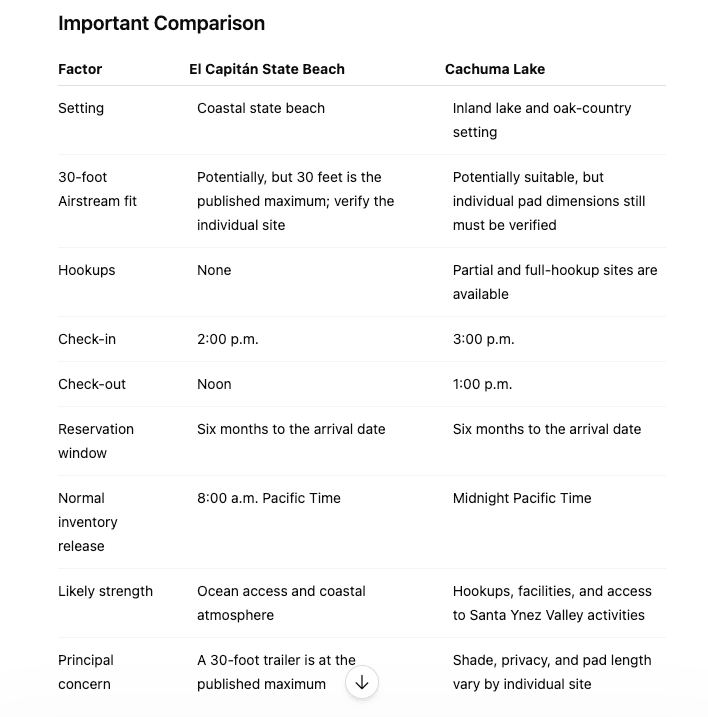
El Capitán offered the more distinctive coastal environment and a more direct towing route from Ventura. However, California State Parks publishes a maximum motorhome and trailer length of 30 feet for the campground. It also states that no hookups are available.
Because our Airstream measures approximately 30 feet from the rear bumper through the hitch, it sits directly at El Capitán’s published maximum.
That does not necessarily mean the trailer cannot camp there. We have stayed at El Capitán. It does mean that we should not assume every available campsite will work.
The specific site must provide:
- Enough parking length for the Airstream
- A legal place for the Ford F-250
- Adequate maneuvering room
- Awning clearance
- A site-specific RV allowance of at least 30 feet
Comparing Reservations at Cachuma Lake and El Capitán
Both campgrounds ordinarily allow reservations up to six months ahead, but they use different reservation systems.
Santa Barbara County says camping reservations may be made six months before the arrival date, beginning at midnight Pacific Time. It also has a two-night minimum.
California State Parks uses a rolling six-month reservation window. New inventory ordinarily opens at 8:00 a.m. Pacific Time, and a booking may extend from the arrival date through the desired departure date, subject to availability and maximum-stay rules. In our experience, getting a reservation through California State Parks is much more difficult.
Comparing Check-In and Check-Out Times
Cachuma Lake publishes a campground check-in time of 3:00 p.m. and a campsite checkout time of 1:00 p.m.
El Capitán publishes a 2:00 p.m. check-in and noon check-out.
For a short two-night camping trip, those differences affect how much usable time the traveler receives on arrival and departure days.
Why Current Operating Information Matters
Campground conditions may have changed since older reviews, articles, and AI training information were published.
El Capitán State Beach reopened in summer 2026, following an extended infrastructure project. At the time of this article’s research, the middle and upper loops had reopened, while lower-loop sites 1 through 28 remained closed because of active trail construction.
A research result based on outdated information might incorrectly claim that:
- The entire campground remained closed, or
- Every campground loop had reopened
This illustrates why the prompt requires AI to start with current official sources.
How to Evaluate the AI Response
Do not judge the result only by which campground receives the higher score.
Review the following parts carefully.
1. Check the Sources
The response should rely primarily on:
- Official park websites
- Official reservation systems
- County or state park agencies
- Recreation.gov
- National Park Service pages
Reviews can help assess shade, noise, and privacy, but they should not overrule current official policies.
2. Look for Site-Specific Information
A campground-wide RV maximum is not enough.
The response should distinguish:
- Maximum RV length for the campground
- Maximum length for the chosen campsite
- Usable parking-pad length
- Tow-vehicle parking
- Slide-out and awning clearance
We also recommend examining the campground map, photographs, and satellite imagery.
Consider the following definitions when using the tool and adding your personal specifications:
Campground maximum RV length: The largest equipment category that the campground may accept within the facility.
Site-specific maximum length: The maximum equipment length assigned to one particular campsite.
Usable parking-pad length: The actual unobstructed space available after accounting for curbs, posts, trees, slopes, and required vehicle positioning.
3. Watch for Invented Measurements
AI should not guess an individual parking pad or tent pad dimension.
A good response should say:
Not confirmed. Check the individual site listing, map or campground office.
That is more useful than a confident but unsupported number.
4. Review the Weighted Score
Make sure the result reflects your priorities.
In our test, equipment fit was rated five out of five. That strongly favored Cachuma Lake because El Capitán’s 30-foot campground limit created a greater fit risk.
A traveler who values beach access above hookups could receive a different recommendation.
5. Independently Check the Route
Driving-time estimates may not account adequately for:
- Towing speed
- Road grades
- Sharp curves
- Construction
- Vehicle-length restrictions
- Weather
- Traffic
Check the route with a current navigation service and, when appropriate, an RV-specific routing tool.
6. Complete the Final Verification Checklist
The prompt instructs the AI to finish by providing a list of details that still require confirmation.
Do not skip this section.
Before reserving, verify:
- Exact campsite dimensions
- RV or tent fit
- Tow-vehicle parking
- Hookup type
- Electrical amperage
- Current closures
- Reservation-opening time
- Cancellation terms
- Gate and late-arrival procedures
Optional Prompt Variations
Compare Individual Campsites
After choosing a campground, follow with:
Compare campsites [SITE NUMBER] and [SITE NUMBER] at [CAMPGROUND]. Focus on parking-pad dimensions, orientation, shade, privacy, restroom proximity, traffic, views, awning clearance and ease of backing in. Use official campsite listings and recent photographs. Label anything that cannot be confirmed.
Find a Campground Along a Road Trip
Find and compare two campgrounds located approximately halfway between [STARTING POINT] and [DESTINATION]. Both must accommodate my equipment and avoid adding more than [NUMBER] minutes to the route.
Compare Public and Private Campgrounds
Compare one public campground and one private RV park near [DESTINATION]. Evaluate cost, hookups, campsite spacing, atmosphere, reservation flexibility and proximity to activities.
Compare Campgrounds for Remote Work
Add these priorities:
- Reliable cellular service
- Wi-Fi
- Electrical hookup
- Generator policy
- Quiet during working hours
- Nearby cafés or libraries
Compare Campgrounds for Families
Add:
- Playground
- Swimming
- Junior ranger or nature programs
- Bicycle safety
- Restroom distance
- Camp store
- Family-oriented nearby attractions
What This Prompt Does Well
The Campground Comparison Tool is particularly effective at:
- Organizing a complicated research task
- Identifying equipment-fit risks
- Comparing reservation systems
- Applying traveler-specific priorities
- Distinguishing objective facts from subjective reviews
- Exposing missing or ambiguous trip requirements
- Producing a final verification list
What This Prompt Cannot Do Reliably
Even a well-designed prompt may not be able to confirm:
- The true usable length of every parking pad
- Current tree and vegetation clearance
- Whether a tow vehicle fits beside a trailer
- Precise cell reception at one campsite
- Current restroom cleanliness
- The subjective experience of noise and privacy
- Last-minute road or wildfire conditions
The prompt helps narrow the decision. It does not eliminate the need to inspect the reservation listing and verify critical details.
Frequently Asked Questions
Can AI tell me whether my RV will fit at a campsite?
AI can compare published length limits and campsite dimensions, but it cannot reliably confirm the fit when individual measurements are unavailable. Verify the exact site through the official reservation listing or the campground office.
Does the campground’s maximum RV length apply to every campsite?
Not necessarily. Individual sites may have shorter parking pads or different access constraints. The specific site listing should control your final decision.
Should the parking-pad length include my tow vehicle?
Yes, when the tow vehicle must remain within the campsite. Determine whether the truck can park in front of, beside, or separately from the trailer.
Can tent campers use this prompt?
Yes. Provide the number and dimensions of the tents, vestibule size, guyline requirements, and minimum tent-pad dimensions.
Can AI find two campgrounds near my home?
Yes. Choose option B and provide your starting location and maximum driving time.
Can the prompt calculate when campground reservations open?
Yes, when you provide an arrival date, the official source clearly explains the reservation window. Always confirm the calculated date and time with the reservation platform.
Should I trust campground reviews?
Use recent reviews to identify recurring themes about shade, privacy, noise, and facilities. Do not use reviews as the primary authority for policies, closures, or reservation rules.
What should AI do when a campsite dimension is unavailable?
It should label the information “Not confirmed” and explain how to verify it rather than inventing a measurement.
What is an AI campground comparison prompt?
An AI campground comparison prompt is a structured set of instructions that asks an AI tool to compare campgrounds using the traveler’s dates, equipment dimensions, reservation rules, priorities and campsite requirements.
Does a campground’s RV maximum apply to every campsite?
No. A campground-wide maximum does not prove that every campsite can accommodate an RV of that length. Campers must verify the individual site’s parking dimensions, access and tow-vehicle requirements.
What measurements should an RV camper provide?
Provide the RV’s complete exterior length, height and width; tow-vehicle length; connected length; slide-out and awning clearance; and the amount of parking space needed after unhitching.
Related Posts
What Every New Camper Needs to Know About Finding Great Campgrounds
How to Choose the Perfect Travel Destination
6 Amazing RV Campgrounds in Santa Barbara County
Final Thoughts
Selecting a campground is not simply a choice between two locations. It is a compatibility decision involving your equipment, vehicles, preferred activities, comfort needs, route, travel dates, and reservation strategy.
This AI prompt for campground research provides enough structure to investigate those factors and explain the trade-offs. Its most valuable function may not be choosing a winner. It may be identifying the questions you still need to answer before reserving.
We wanted a useful tool to use in ChatGPT to help us with comparing campgrounds. To start, we created an initial draft, we tested this prompt on areas and campgrounds we were familiar with. After examining the outputs, we refined the prompt multiple times to arrive at the version presented in this blog post. It’s likely a prompt that we’ll fine-tune in the future as our camping style evolves and we get even more experiences under our belts.
Use the prompt to conduct the initial comparison. Then verify the campsite-specific details through the official reservation system or campground office before completing the booking.
Thanks for stopping by to read our article about the campground comparison AI prompt. Happy travels.
Art & Julie – The Places Where We Go
