

Memoir of Stefan Arkadjusz Petrusewicz – Polish Apprentice of RAF Halton
During our exploration of the Polish Apprentices’ historical archives at RAF Halton in 2019, we found the following files of Stefan Arkadjusz Petrusewicz. We present the information here to further preserve the historical record.
The Places Where We Go contains affiliate links and is a member of the Amazon Services LLC Associates Program. As an Amazon Associate, we earn from qualifying purchases at no extra cost to you when you purchase using one of these Amazon links. Read our disclaimer and privacy policy for more information.
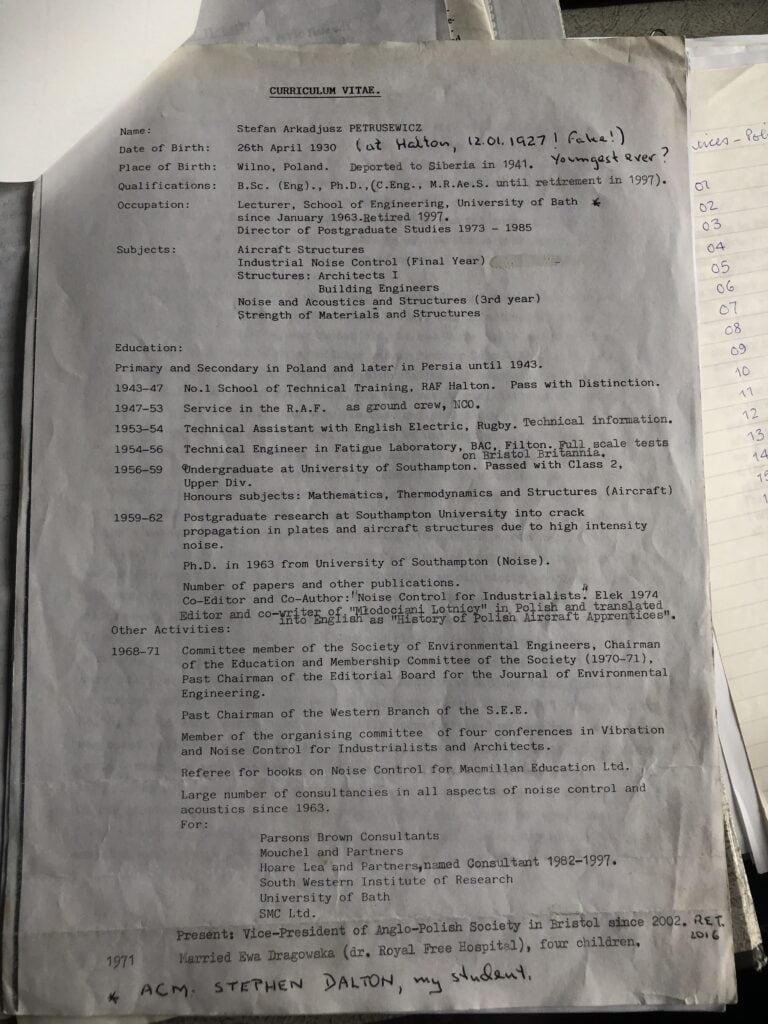
Curriculum Vitae – Stefan Arkadjusz Petrusewicz
Memoir – Stefan Arkadjusz Petrusewicz
We found the following four-page document among the Polish Apprentice historical archives at RAF Halton. We believe Stefan Arkadjusz Petrusewicz wrote this document.
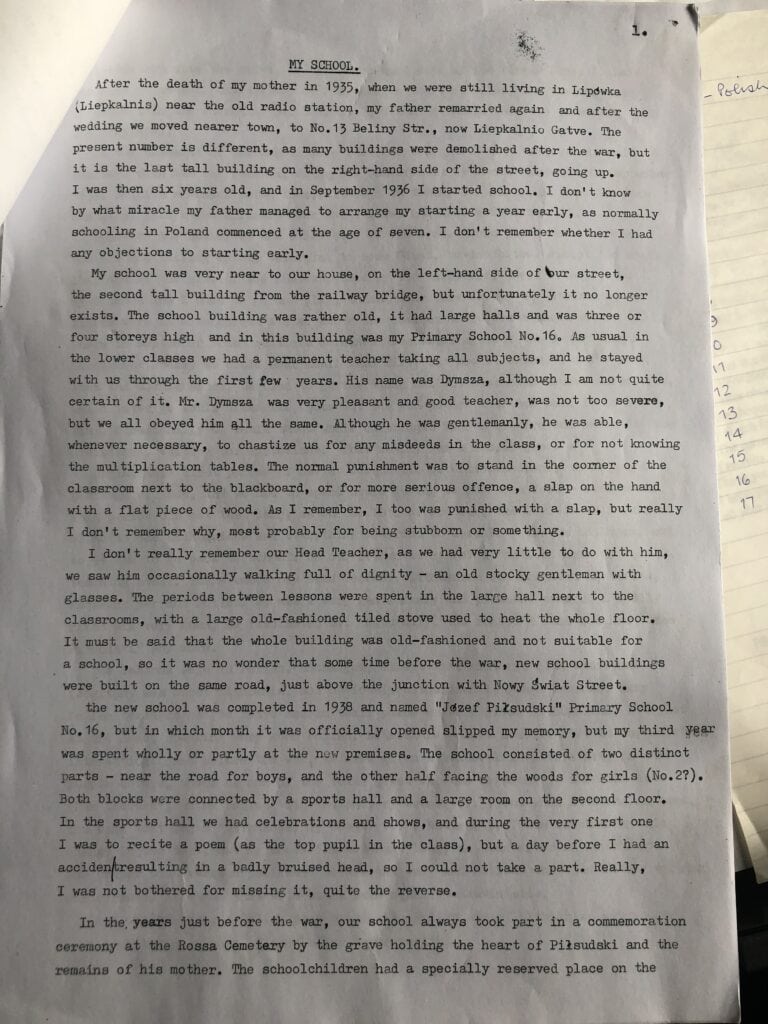
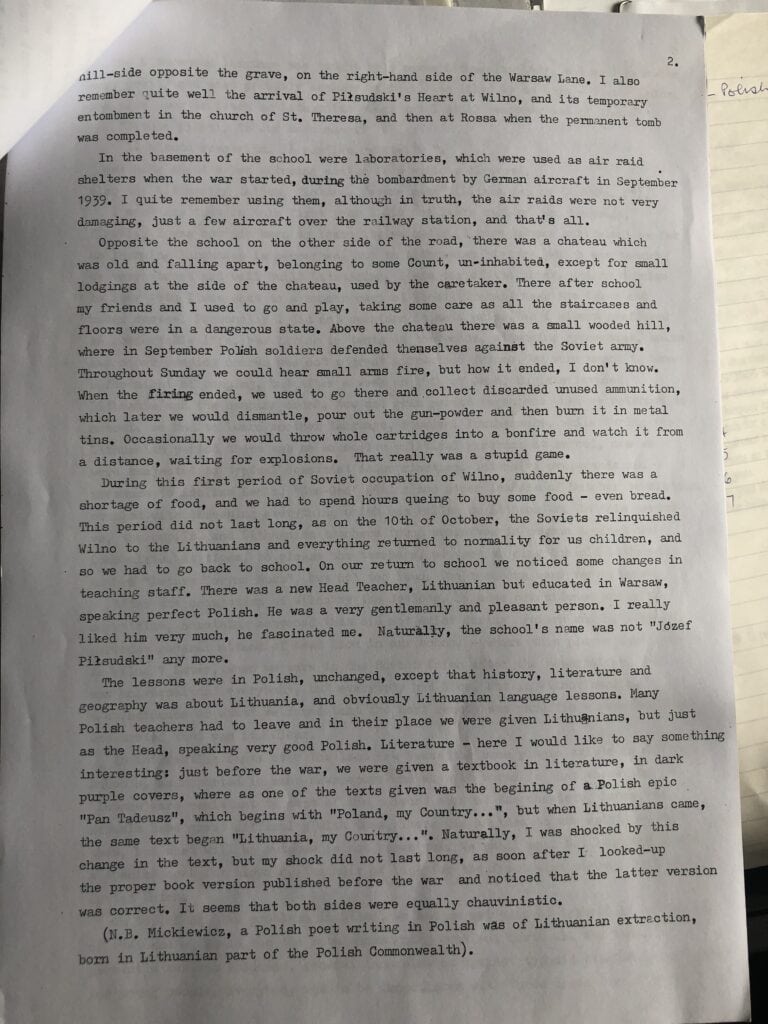
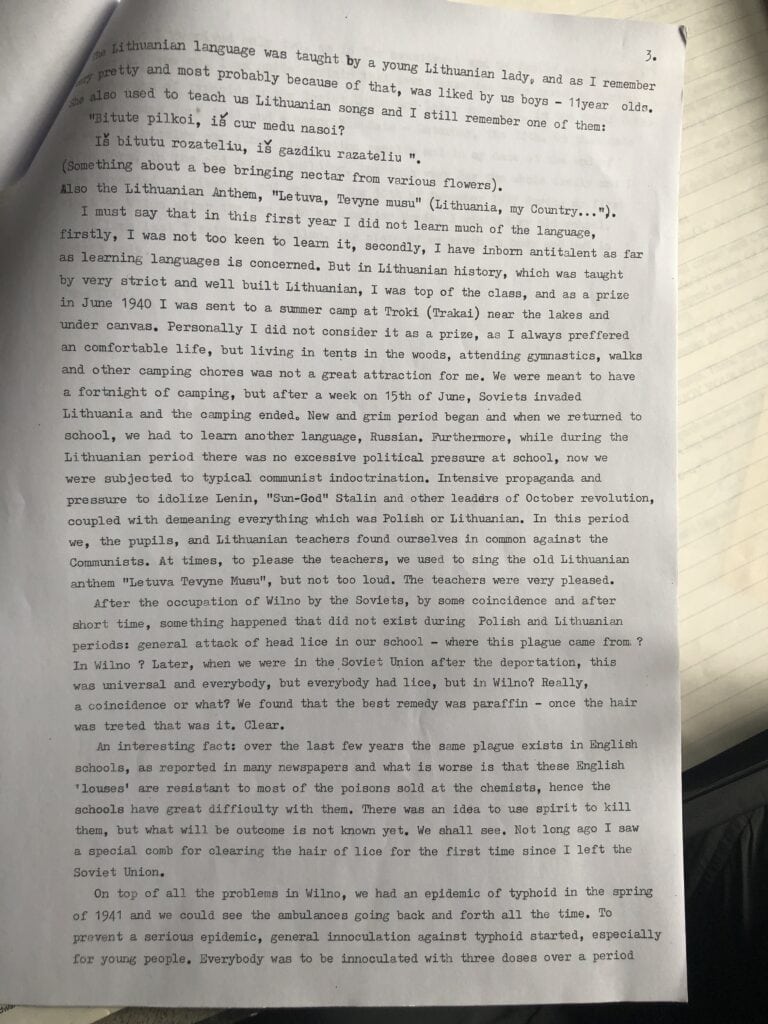
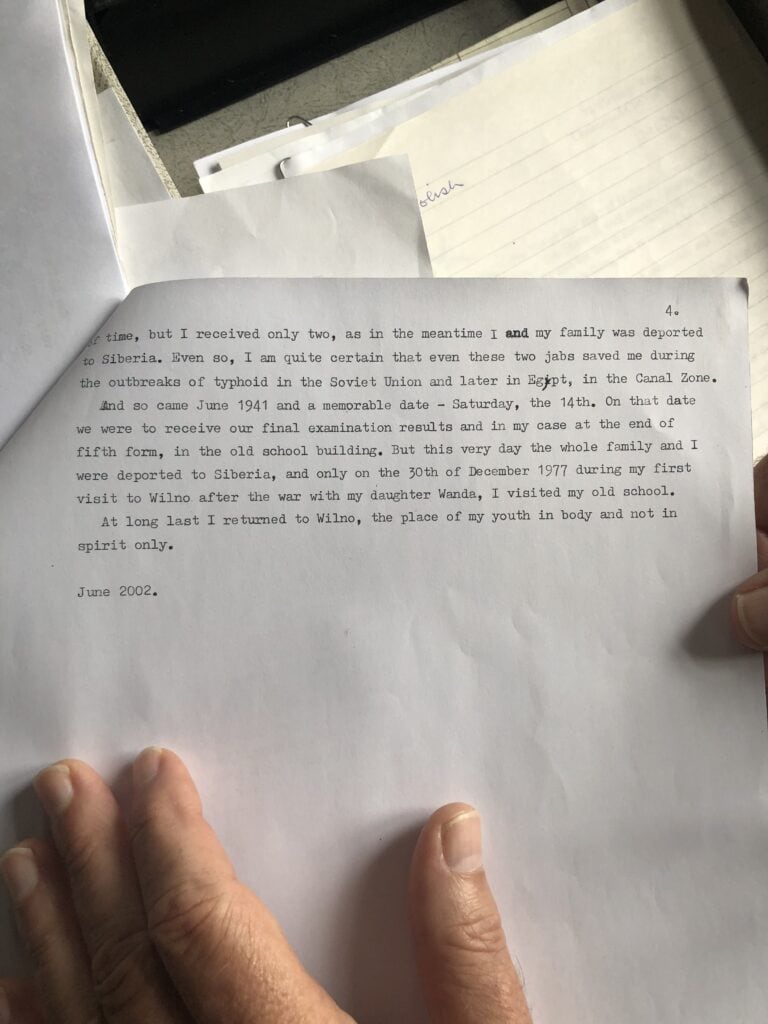
Letter Transcription – My School by Stefan Arkadjusz Petrusewicz
My School
After the death of my mother in 1935, when we were still living in Lipdwka (Liepkalnis) near the old radio station, my father remarried again and after the wedding we moved nearer town, to No. 13 Beliny Str., now Liepkalnio Gatve. The present number is different, as many buildings were demolished after the war, but it is the last tall building on the right-hand side of the street, going up. I was then six years old, and in September 1936 I started school. I don’t know by what miracle my father managed to arrange my starting a year early, as normally schooling in Poland commenced at the age of seven. I don’t remember whether I had any objections to starting early.
My school was very near to our house, on the left-hand side of our street, the second tall building from the railway bridge, but unfortunately it no longer exists. The school building was rather old, it had large halls and was three or four stories high and in this building was my Primary School No. 16. As usual in the lower classes we had a permanent teacher taking all subjects, and he stayed with us through the first few years. His name was Dymsza, although I am not quite certain of it. Mr. Dymsza was very pleasant and good teacher, was not too severe, but we all obeyed him all the same. Although he was gentlemanly, he was able, whenever necessary, to chastise us for any misdeeds in the class, or for not knowing the multiplication tables. The normal punishment was to stand in the corner of the classroom next to the blackboard, or for more serious offence, a slap on the hand with a flat piece of wood. As I remember, I to was punished with a slap, but really I don’t remember why, most probably for being stubborn of something.
I don’t really remember our Head Teacher, as we had very little to do with him, we saw him occasionally walking full of dignity – an old stocky gentleman with glasses. The periods between lessons were spent in the large hall next to the classrooms, with a large old-fashioned tiled stove used to heat the whole floor. It must be said that the whole building was old-fashioned and not suitable for a school, so it was no wonder that some time before the war, new school buildings were built on the same road, just above the unction with Nowy Świat Street.
The new school was completed in 1938 and named “Jozef Piłsudski” Primary School No. 16, but in which month it was officially opened slipped my memory, but my third year was spent wholly or partly at the new premises. The school consisted of two distinct parts – near the road for boys, and the other half facing the woods for girls (No. 2?). Both blocks were connected by a sports hall and a large room on the second floor. In the sports hall we had celebrations and shows, and during the very first one I was to recite a poem (as the top pupil in the class), but a day before I had an accident resulting in a badly bruised head, so I coult not take a part. Really, I was not bothered for missing it, quite the reverse.
In the years just before the war, our school always took part in a commemoration ceremony at the Rossa Cemetery by the grave holding the heart of Piłsudski and the remains of his mother. The schoolchildren had a specially reserved place on the hill-side opposite the grave, on the right-hand side of the Warsaw Lane. I also remember quite well the arrival of Piłsudski’s Heart at Wilno, and its temporary entombment in the church of St. Theresa, and then at Rossa when the permanent tomb was completed.
In the basement of the school were laboratories, which were used as air raid shelters when the war started, during the bombardment by German aircraft in September 1939. I quite remember using them, although in truth, the air raids were not very damaging, just a few aircraft over the railway station, and that’s all.
Opposite the school on the other side of the road, there was a chateau which was old and falling apart, belonging to some Count, uninhabited, except for small lodgings at the side of the chateau, used by the caretaker. There after school my friends and I used to go and play, taking some care as all the staircases and floors were in a dangerous state. Above the chateau there was a small wooded hill, where in September Polish soldiers defended themselves against the Soviet army. Throughout Sunday we could hear small arms fire, but how it ended, I don’t know. When the firing ended, we used to go there and collect discarded unused ammunition, which later we would dismantle, pour out the gunpowder and then burn it in metal tins. Occasionally we would throw whole cartridges into a bonfire and watch it from a distance, waiting for explosions. That really was a stupid game.
During this first period of Soviet occupation of Wilno, suddenly there was a shortage of food, and we had to spend hours queuing to buy some food – even bread. This period did not last long, as on the 10th of October, the Soviets relinquished Wilno to the Lithuanians and everything returned to normality for us children, and so we had to go back to school. On our return to school we noticed some changes in teaching staff. There was a new Head Teacher, Lithuanian but educated in Warsaw, speaking perfect Polish. He was a very gentlemanly and pleasant person. I really liked him very much, he fascinated me. Naturally, the school’s name was not “Józef Piłsudski” any more.
The lessons were in Polish, unchanged, except that history, literature and geography was about Lithuania, and obviously Lithuanian language lessons. Many Polish teachers had to leave and in their place we were given Lithuanians, but just as the Head, speaking very good Polish. Literature – here I would like to say something interesting: just before the war, we were given a textbook in literature, in dark purple covers, where as one of the texts given was the beginning of a Polish epic “Pan Tadeusz”, which begins with “Poland, my Country…”, but when Lithuanians came, the same text began “Lithuania, my Country…”. Naturally, I was shocked by this change in the text, but my shock did not last long, as soon after I looked up the proper book version published before the war and noticed that the latter version was correct. It seems that both sides were equally chauvinistic.
(N.B. Mickiewiz, a Polish poet writing in Polish was of Lithuanian extraction, born in Lithuanina part of the Polish Commonwealth).
The Lithuanina language was taught by a young Lithuanian lady, and as I remember very pretty and most probably because of that, was liked by us boys – 11 year olds, she also used to teach us Lithuanian songs and I still remember one of them:
“Bitute pilkoi, iš cur medu nasoi?
Iš bitutu rozateliu, iš gazdiku razateliu.”
(Something about a bee bringing nectar from various flowers).
Also the Lithuanian Anthem, “Letuva, Tevyne musu” (Lithuania, my Country…”).
I must say that in this first year I did not learn much of the language, firstly, I was not too keen to learn it, secondly, I have inborn antitalent as far as learning language is concerned. But in Lithuanian history, which was taught by very strict and well built Lithuanian, I was top of the class, and as a prize in June 1940 I was sent to a summer camp at Trocki (Trakai) near the lakes and under canvas. Personally I did not consider it as a prize, as I always preferred a comfortable life, but living in tents in the woods, attending gymnastics, walks and other camping chores was not a great attraction for me. We were meant to have a fortnight of camping, but after a week on 15th of June, Soviets invaded Lithuania and the camping ended. New and grim period began and when we returned to school, we had to learn another language, Russian. Furthermore, while during the Lithuanian period there was no excessive political pressure at school, now we were subjected to typical communist indoctrination. Intensive propaganda and pressure to idolize Lenin, “Sun-God” Stalin and other leaders of October revolution, coupled with demeaning everything which was Polish or Lithuanian . In this period we, the pupils, and Lithuanian teachers found ourselves in common against the Communists. At times, to please the teachers, we used to sing the old Lithuanian anthem “Letuva Tevyne Musu”, but not too loud. The teachers were very pleased.
After the occupation of Wilno by the Soviets, by some coincidence and after short time, something happened that did not exist during Polish and Lithuanian periods: general attack of head lice in our school – where this plague came from? In Wilno? Later, when we were in the Soviet Union after the deportation, this was universal and everybody, but everybody had lice, but in Wilno? Really, a coincidence or what? We found that the best remedy was paraffin – once the hair was treated that was it. Clear.
An interesting fact: over the last few years the same plague exists in English schools, as reported in many newspapers and what is worse is that these English ‘louses’ are resistant to most of the poisons sold at the chemists, hence the schools have great difficulty with them. There was an idea to use spirit to kill them, but what will be outcome is not known yet. We shall see. Not long ago I saw a special comb for clearing the hair of lice for the first time since I left the Soviet Union.
On top of all the problems in Wilno, we had an epidemic of typhoid in the spring of 1941 and we could see the ambulances going back and forth all the time. To prevent a serious epidemic, general inoculation against typhoid started, especially for young people. Everybody was to be inoculated with three doses over a period of time, but I received only two, as in the meantime I and my family was deported to Siberia. Even so, I am quite certain that even these two jabs saved me during the outbreaks of typhoid in the Soviet Union and later in Egypt, in the Canal Zone.
And so came June 1941 and a memorable date – Saturday, the 14th. On that date we were to receive our final examination results and in my case at the end of fifth form, in the old school building. But this very day the whole family and I were deported to Siberia, and only on the 30th of December 1977 during my first visit to Wilno after the war with my daughter Wanda, I visited my old school.
At long last I returned to Wilno, the place of my youth in body and not in spirit only.
June 2002
Related Reading
Introducing The Polish Forces at RAF Halton Resource
Apprentice Technical Training at RAF Halton
Letter By Eugene Borysiuk – Polish Apprentices at RAF Halton
Polish Aircraft Apprentices of RAF Halton
Trenchard Museum RAF Halton – Aviation History Hidden Gem
