Bodie State Historic Park – 15 Things to Know Before You Go
First visited: 2026 • Last updated: September 2026
There are ghost towns that have been rebuilt to look like the Old West—and then there is Bodie State Historic Park.
Bodie is different.
The weathered buildings scattered across this remote corner of California have not been restored to look shiny and new. Instead, Bodie is preserved in a condition known as “arrested decay.” Structures are stabilized when necessary, but the goal is to retain the appearance and character of the town that was left behind.
We visited Bodie while exploring California’s Eastern Sierra with our friends Lisa and Joe. Between the rough final stretch of road, empty streets, historic buildings, Standard Stamp Mill, cemetery, and even an unexpected cattle drive on our way out, Bodie turned out to be one of the most interesting stops of our trip.
If you’re considering a visit, here are the things we think you should know before you go.
The Places Where We Go contains affiliate links and is a member of the Amazon Services LLC Associates Program. As an Amazon Associate, we earn from qualifying purchases at no extra cost to you when you purchase using one of these Amazon links. Read our disclaimer and privacy policy for more information.
Is Bodie State Historic Park worth visiting?
Yes. Bodie State Historic Park is worth visiting if you enjoy history, photography, mining towns, Highway 395 road trips, or places that feel substantially different from a conventional tourist attraction.
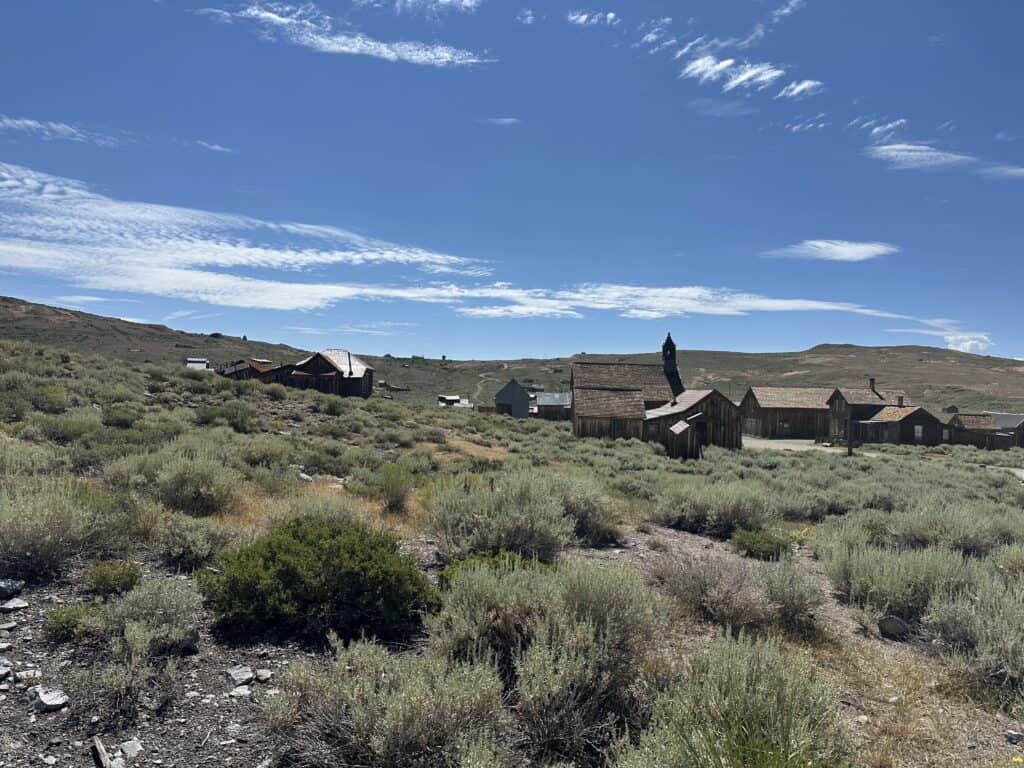
What impressed us most was that Bodie didn’t feel like someone had created an Old West attraction for tourists. It felt like we were walking through what remained of an actual community.
California State Parks describes Bodie as a genuine gold-mining ghost town preserved in a state of arrested decay. The town once contained roughly 2,000 structures and thousands of residents, while today only a fraction survives.
⬇️ Watch our Bodie State Historic Park video ⬇️
Come along with us as we drive the final road into Bodie, explore the historic buildings, tour the Standard Stamp Mill, walk to the cemetery, and share what we discovered during our visit.
Bodie State Historic Park at a glance
| Location | Near Bridgeport in Mono County, California |
| Best for | History, ghost towns, photography, and California road trips |
| Elevation | More than 8,300 feet |
| Recommended visit | About 3–4 hours for a relaxed visit with the mill tour and cemetery |
| Road | Final 3 miles are unpaved |
| Food | Bring your own |
| Restrooms | Available |
| Drinking water | Available |
| Don’t miss | Standard Stamp Mill Tour and Bodie Cemetery |
| Dogs | Allowed on leash outdoors, but not inside historic buildings, the museum, or the Stamp Mill |
| Drones | Not permitted |
California State Parks currently lists Bodie as 13 miles east of Highway 395 and seven miles south of Bridgeport. The park sits at more than 8,300 feet, with basic visitor facilities but no restaurant or gas station.
1. Bodie is a real ghost town—not a modern recreation
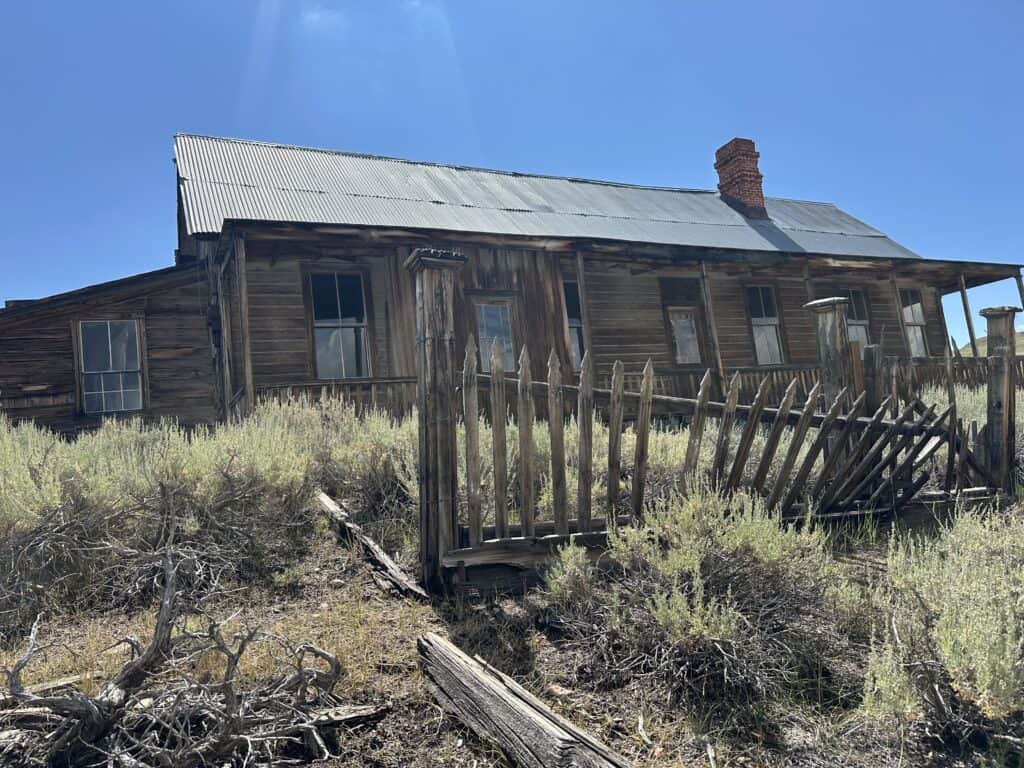
One of the most important things to understand before visiting Bodie is what the term arrested decay means.
The goal isn’t to restore Bodie’s buildings to how they looked when they were new. Instead, preservation teams work to keep the structures from collapsing while changing their appearance as little as possible.
That means crooked walls can remain crooked. Weathered wood still looks weathered. Rooms visible through windows may contain furniture, household goods, equipment, and other objects that help convey what life here once looked like.
California State Parks notes that archaeologists and preservation architects carefully document buildings before stabilization so that interventions can protect the structures while altering them as little as possible.
Around Bodie’s boom years, the community had thousands of residents. The 1880 federal census counted people born in 31 different countries, illustrating how diverse a mining boomtown could become.
Two major fires—in 1892 and 1932—destroyed much of what had survived, leaving less than ten percent of the roughly 2,000 structures that once stood here. Mining ultimately ceased in 1942.
That’s part of what makes walking through Bodie so fascinating.
You’re seeing what survived.
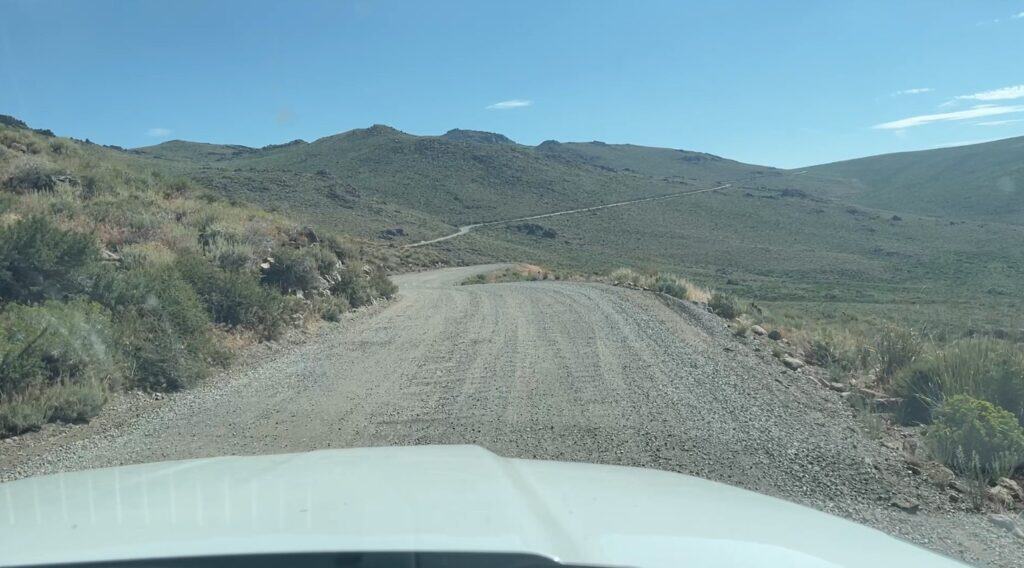
We photographed this section during our 2026 visit.
2. Getting to Bodie includes three miles of dirt road
Getting to Bodie is part of the experience.
The most commonly used route is State Route 270 from Highway 395. You’ll drive about 10 miles on pavement before reaching the final three miles of unpaved road.
During our visit, there was a very obvious moment when the smooth pavement ended and the gravel began.
We didn’t find the road technically difficult under the summer conditions we experienced, but you’ll definitely want to slow down. The surface can become rough, and road conditions can change after weather or heavy traffic.
California State Parks recommends Route 270 as the primary route into Bodie and posts a 15 mph speed limit on the dirt portion. The drive from Highway 395 to Bodie generally takes around 30–40 minutes.
If you’re visiting outside summer and early fall, check conditions before leaving. Snow and mud can make Bodie much more difficult—or impossible—to reach by normal vehicle.
Check the Bodie State Historic Park website for current driving information.
Our tip: Don’t plan your arrival based only on the number of miles remaining. Those final miles take longer than they look on a map.
3. Allow at least three hours if you want the full experience
California State Parks suggests allowing roughly one to three hours for a visit.
For the way we like to travel, we would allow closer to three or four hours, especially if you intend to:
- take the Standard Stamp Mill Tour,
- watch the history film,
- spend time photographing buildings,
- browse the museum,
- and walk to the cemetery.
Photography alone can slow you down considerably. There always seems to be another weathered building, doorway, abandoned vehicle, or interior detail worth photographing.
Bodie is not a place we would recommend rushing through simply to say you’ve been there.
4. Bring your own food—and don’t arrive with an empty gas tank
One thing Bodie deliberately does not have is a modern collection of restaurants, stores, gas stations, and tourist businesses.
That helps preserve the ghost-town atmosphere, but it also means visitors should arrive prepared.
California State Parks specifically advises that there are no commercial food or gasoline services in the park.
We packed food and ended our visit with a tailgate lunch in the parking lot, which worked perfectly for us.
Bring enough water, snacks, or lunch for the time you plan to spend at Bodie—and make sure your vehicle has plenty of fuel before heading away from Highway 395.
A small cooler can be particularly useful if Bodie is one stop on a longer Eastern Sierra road trip.
5. Bodie’s high-desert location affects the entire visit
It’s easy to look at Bodie’s open landscape and forget just how high you are.
Bodie sits above 8,300 feet in elevation, where the combination of altitude, strong sun, wind, and rapidly changing weather can make conditions feel very different from lower elevations.
California State Parks warns visitors to prepare for dry, windy high-desert conditions and notes that snow can affect access for a substantial part of the year.
Bring layers even if the weather looks pleasant when you leave Highway 395.
We’d also recommend sunscreen, a hat, water, sunglasses, and comfortable shoes.
The best general time to visit is summer through early fall, when roads are most likely to be accessible and interpretive programs and museum services are available. Early fall can offer the advantage of fewer summer crowds.
6. Start with the visitor information near the parking area
Before heading directly into town, take a few minutes around the parking area.
We found Welcome to Bodie signage and historical information that provided useful context before we began exploring.
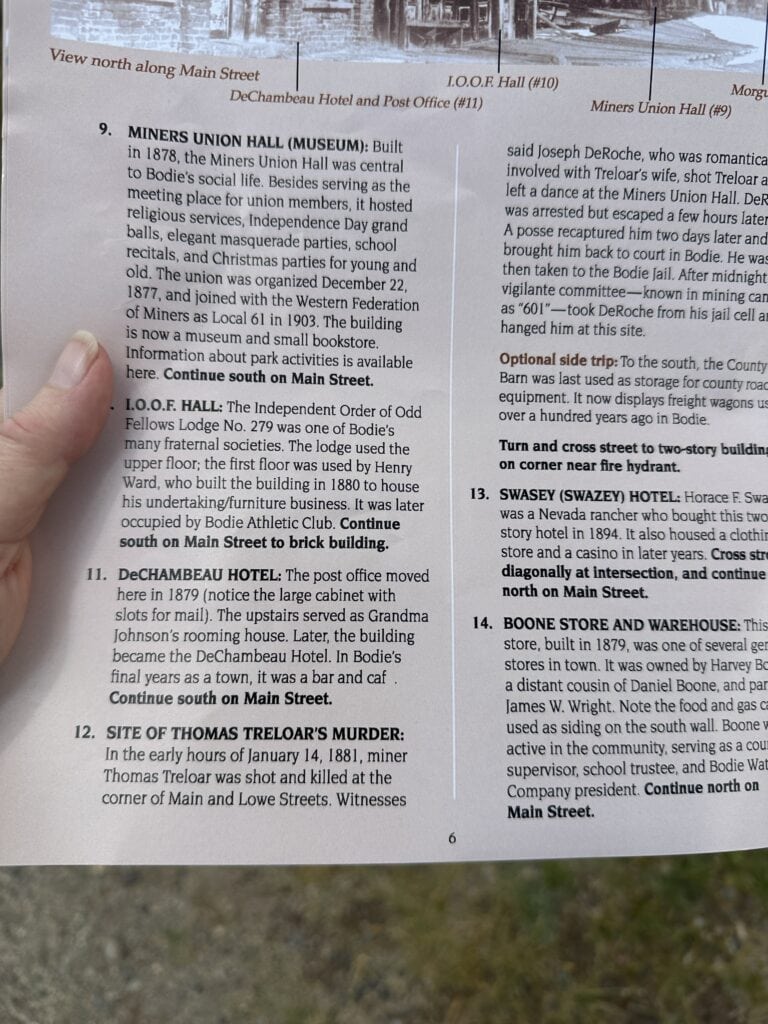
You’ll also want to consider purchasing the inexpensive self-guided tour booklet. California State Parks intentionally limits modern interpretive signage throughout the historic townsite, so having a guide helps identify what you’re seeing. Proceeds from the booklet also help support Bodie’s preservation.
Understanding even a little about the people and businesses associated with the buildings makes the empty streets much more meaningful.
7. Slow down and look through the windows
One of our favorite parts of visiting Bodie didn’t require entering a building at all.
We simply looked through the windows.
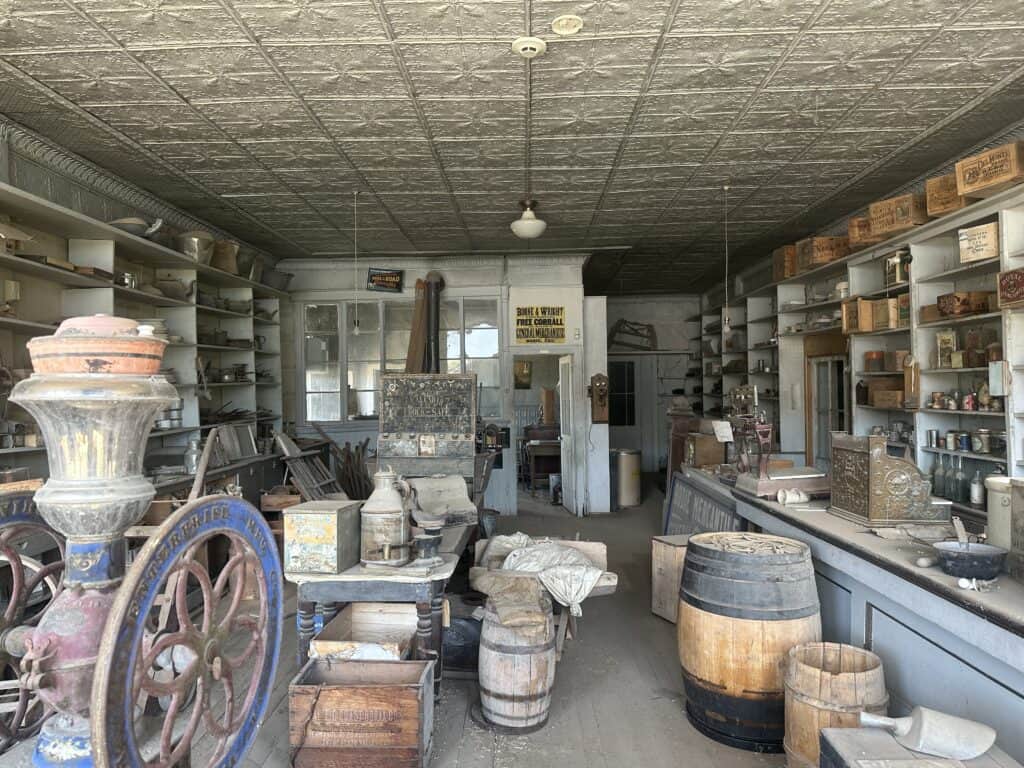
In many places, visitors can see furnishings, shelving, household objects, equipment, and other artifacts still inside the surviving buildings.
The effect can be surprisingly powerful.
Instead of seeing an empty shell, you begin imagining the families, business owners, miners, schoolchildren, and other residents who once used these spaces.
Bodie supported far more than mines and saloons. People operated hotels, stores, laundries, workshops, restaurants, churches, boarding houses, and other businesses required to support thousands of residents.
Take your time here.
Sometimes the smallest details tell the most interesting stories.
8. Don’t miss the Methodist Church
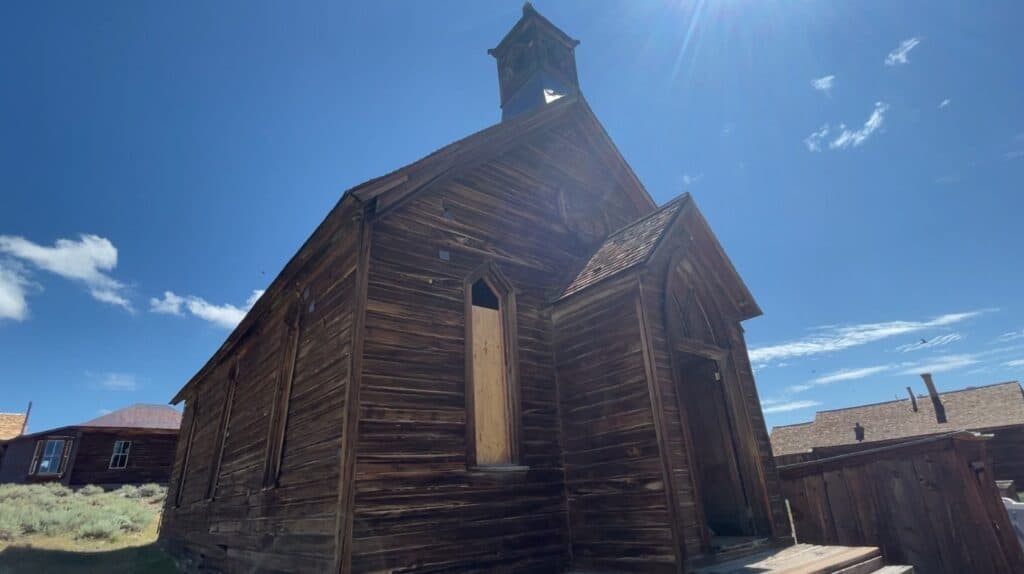
One of the first major buildings that caught our attention was the Methodist Church.
During our visit, the church was closed while stabilization work was underway.
That actually became an excellent example of what arrested decay means. Bodie isn’t simply left to deteriorate until everything disappears. Preservation crews intervene when necessary to keep historic structures standing.
The Bodie Foundation has identified the church as an important stabilization project because the structure developed a noticeable lean.
Conditions may be different when you visit, so check current information before assuming a particular building will be accessible.
Even when you can’t enter, the church is one of Bodie’s most recognizable structures and well worth seeing from outside.
9. Watch the Bodie history film
During our visit, a historical documentary played inside the Red Barn Theater.
If you’re visiting Bodie for the first time, we’d recommend watching the film fairly early rather than saving it for the very end.
Once you’ve seen photographs of Bodie filled with people and learned more about the town’s history, the buildings outside begin to feel less like abandoned structures and more like pieces of a former community.
History enthusiasts will naturally enjoy it, but the film is especially helpful for anyone who arrives knowing very little about Bodie.
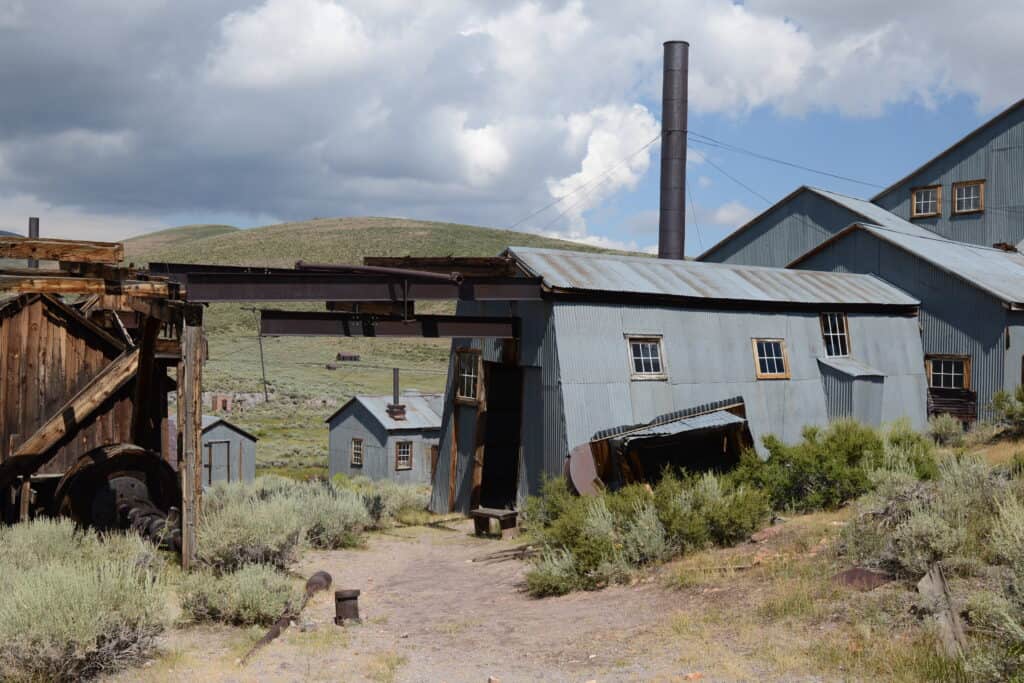
10. Take the Standard Stamp Mill Tour if you can
The Standard Stamp Mill Tour was one of the experiences we specifically planned during our visit, and we’d recommend adding it if tours are running.
Stamp mills played an essential role in extracting valuable gold and silver from mined rock. Huge stamps repeatedly crushed the ore before additional processes separated valuable material from the surrounding rock.
The Standard Mining Company also played a significant role in Bodie’s growth. By the 1890s, electricity was being transmitted roughly 13 miles to Bodie, helping power mining operations.
One reason the tour is particularly worthwhile is that the Standard Mill complex isn’t simply another place visitors can wander through independently.
As of September 2026, California State Parks is offering Stamp Mill tours on a seasonal schedule, with tickets sold in person on a first-come basis. Current tickets are $6 per person, but schedules and prices can change, so verify the latest information before your visit.
For visitors who want to go even deeper, the Bodie Foundation also offers seasonal private tours, including options involving the mill and other normally restricted areas.
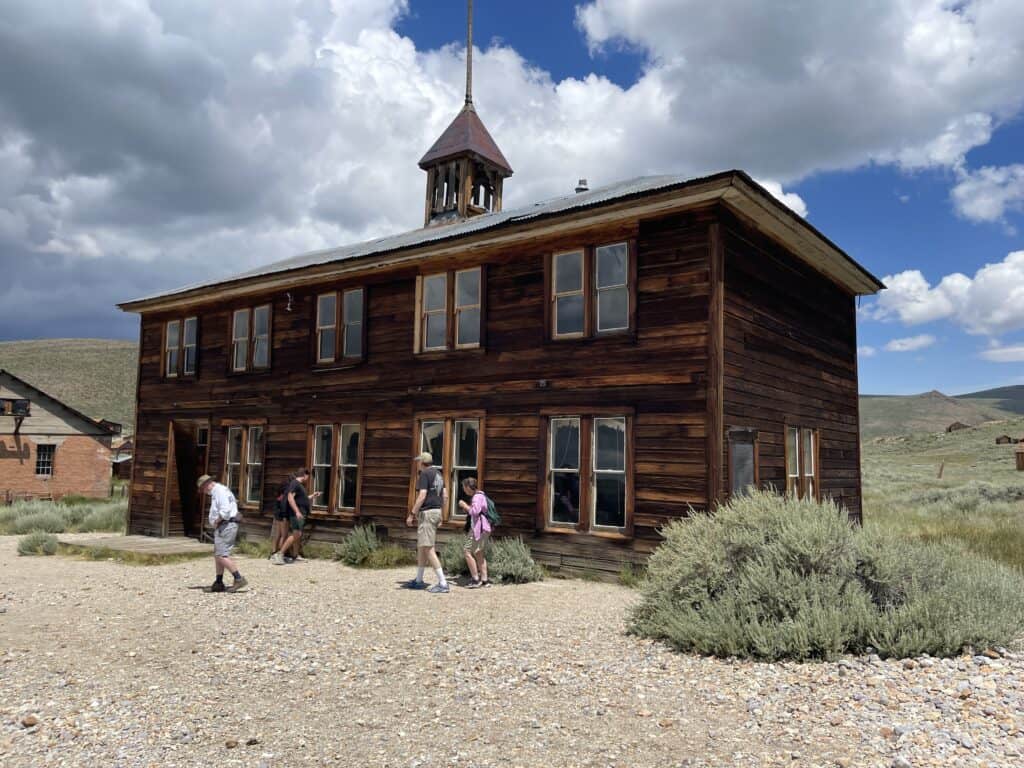
11. Look inside the old schoolhouse
The schoolhouse provides an entirely different perspective on Bodie.
Looking through the windows at old desks and classroom items reminded us that this wasn’t simply a place populated by miners chasing gold.
Families lived here.
Children went to school here.
People were trying to build ordinary lives in an extraordinary place.
That contrast is part of what makes Bodie so much more interesting than a collection of old mining equipment.
12. Visit the museum and gift shop
Bodie’s Miners Union Hall now serves as the museum and visitor center.
It’s a good place to see additional artifacts, browse books and souvenirs, learn more about daily programming, and purchase tickets for interpretive tours when offered.
We also learned one practical lesson during our visit: don’t automatically leave the museum until the final minutes of your day.
We arrived just as staff were stepping away and temporarily found ourselves locked out.
That was our experience rather than a scheduled daily lunch closure. As of September 2026, California State Parks lists regular museum and gift-shop hours of 9:30 a.m. to 5:30 p.m. during the current season.
Check the schedule when you arrive so you don’t miss anything you particularly want to see.
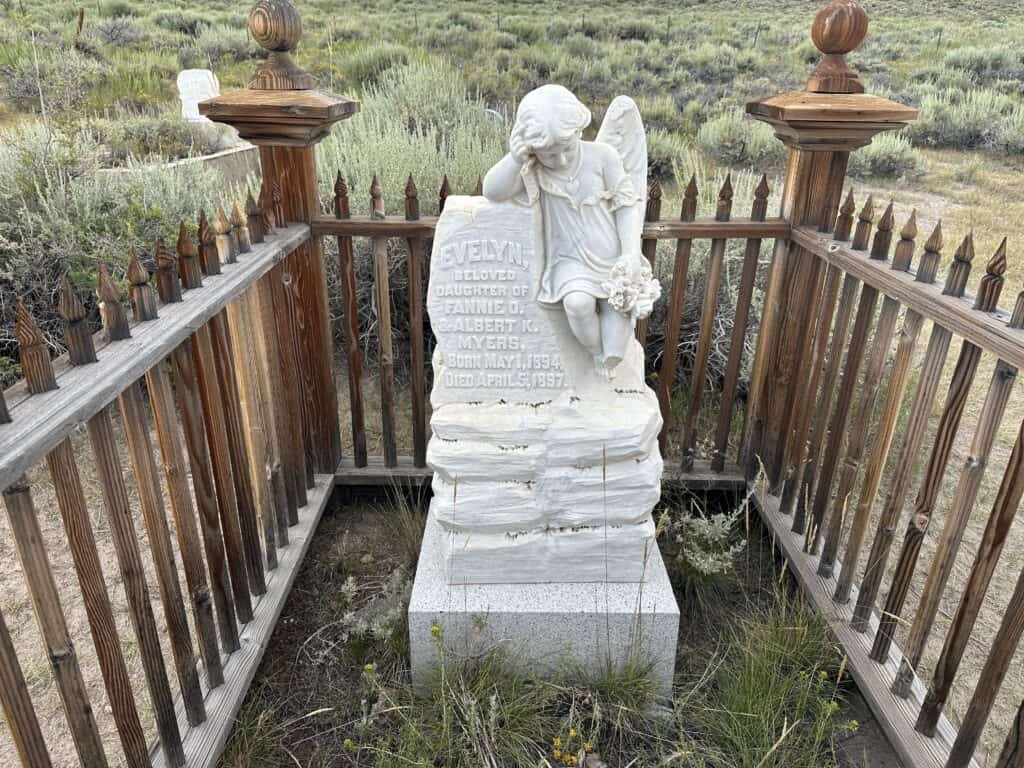
13. Make the walk to Bodie Cemetery
One stop we strongly recommend is Bodie Cemetery.
The cemetery is separate from the main cluster of town buildings, so visiting requires a little additional walking. You cannot simply move your vehicle to a parking space beside the cemetery entrance.
California State Parks identifies three historic cemetery areas at Bodie: Ward’s Cemetery, Masonic Cemetery, and Miners’ Union Cemetery.
The official map also identifies the Rosa May burial site and the historic morgue.
The cemetery provides a much more personal connection to Bodie’s story. After spending hours hearing about mines, mills, saloons, fires, and population numbers, you’re suddenly looking at the names of actual people who lived—and died—here.
The current cemetery trail is about 0.25 mile each way from the main parking area, although portions can include uneven or unstable surfaces.
The Bodie Foundation continues to support conservation of grave markers, fences, and unidentified burial areas.
Take your time here and treat the site with the same respect you would any historic cemetery.
For us, this was one of the more memorable parts of Bodie.
14. Know the rules before visiting Bodie
Because Bodie is a protected historic site, some rules are especially important. We recommend to check the Bodie State Historic Park website before your visit for current advisories.
Do not take artifacts—even small pieces of material you may see lying on the ground.
California State Parks prohibits collecting, and preserving what’s left is essential if future visitors are going to experience Bodie the way we can today.
Drones are also prohibited within Bodie State Historic Park.
Dogs are permitted in the park when leashed, but they aren’t allowed inside historic buildings, the museum, or on the Stamp Mill Tour.
Finally, expect uneven historic surfaces. You’ll encounter dirt, aggregate, old boardwalks and other surfaces that don’t resemble the perfectly level walkway of a modern attraction. Visitors with limited mobility should check the park’s accessibility information before arriving; the park offers some accessible facilities and may be able to help with particular access needs.
15. Bodie fits perfectly into a Highway 395 road trip
Bodie works particularly well as part of a larger Eastern Sierra and Highway 395 road trip.
We visited while staying farther south near Bishop, making Bodie one of the adventures on our Eastern Sierra travels.
Other destinations that can fit into a broader itinerary include Bridgeport, Mono Lake, Lee Vining, Mammoth Lakes, Bishop, the Alabama Hills, and Lone Pine.
Because the road into Bodie requires extra time, we wouldn’t try to cram too many major destinations into the same day.
Give Bodie room to breathe.
And keep your eyes open when you’re driving away.
We thought our Old West experience was finished until we unexpectedly spotted local cowboys and their dog moving cattle across the nearby hills—an ending we certainly hadn’t planned.
Fun Fact
Guiness World Records identifies Bodie as the Largest Gold-Mining Ghost Town.
Bodie vs. Calico Ghost Town: Which should you visit?
We’ve also explored Calico Ghost Town in Southern California, and the two places provide very different experiences.
Both originated as Western mining communities, but Calico was largely a silver-mining town, while Bodie became famous for its gold-mining boom.
The visitor experience is also different.
Calico was purchased by Walter Knott in the 1950s and underwent significant restoration. Bodie, by contrast, is intentionally preserved through arrested decay.
We think of them this way:
Calico provides more of a restored Old West attraction experience. Bodie feels more like walking through what physically survived from an actual town.
Neither approach automatically makes one better than the other—they simply offer different experiences.
If ghost towns interest you, we’d suggest seeing both.
You can watch our Calico Ghost Town visit on YouTube
You can also visit our article about Widtsoe Ghost Town in Utah, which turned out to be a very different ghost-town experience altogether. The existing Widtsoe article is a natural internal link for this new post.
What should you bring to Bodie State Historic Park?
We recommend packing:
- Water
- Lunch or snacks
- Sunscreen
- Hat
- Sunglasses
- Layers
- Comfortable walking shoes
- Camera
- Portable cooler
- Cash as a backup
- A charged phone
- Bodie self-guided guidebook once you arrive
California State Parks specifically recommends bringing cash in addition to a credit card because connectivity in this remote location may be unreliable.
Where to stay near Bodie State Historic Park
Bodie doesn’t have overnight accommodations within the historic townsite.
For most travelers, Bridgeport, Lee Vining, Mammoth Lakes, or Bishop can serve as bases depending on what else you plan to explore along Highway 395.
Bridgeport is the closest conventional town for many Bodie visitors, while Lee Vining works particularly well if your trip also includes Mono Lake or Yosemite’s eastern entrance.
We based our visit farther south while exploring the Bishop area.
Use our interactive map below to find nearby lodging options.
If you drive a rental car to Bodie State Historic Park, check your rental agreement about travel on unpaved roads.
Bodie State Historic Park FAQs
How long should you spend at Bodie State Historic Park?
California State Parks suggests approximately one to three hours. We recommend allowing three to four hours if you plan to take the Standard Stamp Mill Tour, visit the cemetery, watch the history film, browse the museum and spend time photographing the town.
Is the road to Bodie difficult?
The primary Route 270 approach includes approximately 10 paved miles followed by three miles of dirt road. Conditions vary, but California State Parks recommends reduced speeds and checking current conditions before visiting.
Can you drive to Bodie in a normal car?
The Route 270 approach is the primary visitor route and doesn’t carry the high-clearance/4WD recommendation that applies to some alternate roads. However, road conditions change, so check with California State Parks before visiting—especially after bad weather or outside the main summer season.
Is there food at Bodie State Historic Park?
No restaurant or commercial food service operates within the park. Bring your own food and water.
Are there bathrooms at Bodie?
Yes. Restrooms and drinking water are available near the main visitor area.
Can you go inside the buildings at Bodie?
Most historic buildings are viewed from outside or through windows. Some facilities, such as the museum and theater, are accessible to visitors, while guided tours offer access to areas such as the Standard Stamp Mill that aren’t open for independent exploration.
Are dogs allowed at Bodie?
Dogs are allowed in the park when leashed but aren’t permitted inside historic buildings, the museum, or the Standard Stamp Mill.
What is the best time of year to visit Bodie?
Summer and early fall generally provide the best combination of road access, weather and interpretive services. Winter and spring travel can be much more difficult because of snow and mud.
How much does it cost to visit Bodie?
As of September 2026, general admission is $8 for adults, $5 for visitors ages 4–17, and free for children age three and younger. Tour fees are separate. Prices can change, so verify current rates before your visit.
Is Bodie actually abandoned?
Not completely. People continued living in Bodie long after the boom years ended, caretakers remained afterward, and California State Parks employees continue to live and work at the site today. State Parks therefore notes that Bodie has never been entirely abandoned in the literal sense.
Final thoughts: Is Bodie worth the drive?
For us, Bodie State Historic Park was absolutely worth the drive.
We expected old buildings and mining history. What made the experience memorable was how much personality remained in the town—from furnishings visible through windows and the old schoolhouse to the Methodist Church, Standard Stamp Mill, and names found in the cemetery.
Bodie doesn’t need roller coasters, reenacted gunfights, or a street full of souvenir shops to be interesting.
Its appeal is precisely the opposite.
You’re walking through a place where thousands of people once worked, raised families, went to school, operated businesses, worshiped, celebrated, struggled and eventually left.
Much of Bodie disappeared.
What remains makes the journey worthwhile.
If you’d like to see what it’s like before planning your own visit, watch our complete Bodie State Historic Park video and come along with us to one of California’s most fascinating historic towns.
Don’t forget to check out our visit to Bodie State Historic Park on YouTube
And if ghost towns are your thing, explore our other ghost-town adventures from Calico, California, to Widtsoe, Utah, in our Ghost Towns of the American West video playlist.
We’ll see you at the places where we go.
Related Reading
Check out our California Travel Page, which features interesting destinations throughout the state, including places in the Eastern Sierra and Highway 395 corridor.
