
Best Catholic Churches in London for Mass – 5 Worth Visiting
Last updated: August 2026. We reviewed the churches’ current Mass schedules and visitor information to help you plan your visit with the most up-to-date details available.
Looking for beautiful and historic Catholic churches in London to visit for Mass, prayer, or quiet reflection? London is home to an impressive collection of Catholic churches, ranging from the magnificent Westminster Cathedral to smaller historic churches tucked away in the heart of the city.
During our travels in London, we visited several of these churches and attended particularly memorable Masses at Westminster Cathedral and the London Oratory. In this guide, we’ve selected five Catholic churches in London that stand out for their combination of worship, history, architecture, and atmosphere.
Our top choices include Westminster Cathedral for the city’s principal Catholic cathedral experience, the London Oratory for sacred music and Latin Mass, and St Etheldreda’s for an intimate connection with medieval Catholic London.
Below you’ll find what makes each church worth visiting, the nearest convenient Tube station, what type of traveler or worshipper it may appeal to most, and links to each church’s official Mass schedule.
Important: Mass times can change for Holy Days, special liturgies, choir holidays, and other events. We last reviewed the schedules in August 2026 and recommend confirming times on each church’s official website before your visit.
The Places Where We Go contains affiliate links and is a member of the Amazon Services LLC Associates Program. As an Amazon Associate, we earn from qualifying purchases at no extra cost to you when you purchase using one of these Amazon links. Read our disclaimer and privacy policy for more information.
Catholic Churches in London at a Glance
| Church | Best For | Mass Highlight |
|---|---|---|
|
Westminster Cathedral Victoria |
First-time visitors, cathedral worship & sacred music | Multiple Masses daily, including sung and solemn Masses |
|
The London Oratory South Kensington |
Sacred music & Latin Mass | Sunday 9 a.m. Mass using the 1962 Missal; 11 a.m. Solemn Latin Mass |
|
St George’s Cathedral, Southwark Lambeth North / Waterloo |
Catholic history & South Bank sightseeing | Sunday Solemn Mass; Spanish-language Mass also offered |
|
St Etheldreda’s Church Farringdon / Chancery Lane |
Medieval history & an intimate setting | Sunday 11 a.m. Sung Latin Mass |
|
Our Lady of the Assumption & St Gregory Piccadilly Circus |
Historic hidden church & West End location | Sunday 10:30 a.m. Solemn Mass |
Tip: Mass schedules can change for Holy Days, special liturgies, and choir holidays. Check each church’s official website before your visit.
Our quick recommendation: If you have time for only one, start with Westminster Cathedral. For the most memorable sacred-music experience, consider the London Oratory. For something smaller, quieter, and dramatically different from London’s great cathedrals, St Etheldreda’s is a fascinating choice.
Free Catholic London Mass & Church Planner
Planning to attend Mass during your London trip? Download our free Catholic London Mass & Church Planner featuring nine central London Catholic churches, nearest Tube stations, what each church is best for, nearby attractions, and quick links to current Mass schedules.
You’ll also get our suggested Catholic London in a Day route and a handy before-you-go checklist.
GET THE FREE CATHOLIC LONDON PLANNER
Map of London Catholic Churches Worth Visiting
1. Westminster Cathedral – Best for London’s Catholic Cathedral Experience
Westminster Cathedral is an excellent place to begin if you’re looking for a Catholic church in London for Mass, prayer, sacred music, and impressive architecture. Not to be confused with nearby Westminster Abbey, Westminster Cathedral is the seat of the Archbishop of Westminster and the mother church for Catholics in England and Wales. If you also plan to visit the Abbey, see our Churchill War Rooms to Westminster Abbey Visitor’s Guide for our firsthand experience and tips for planning a visit.
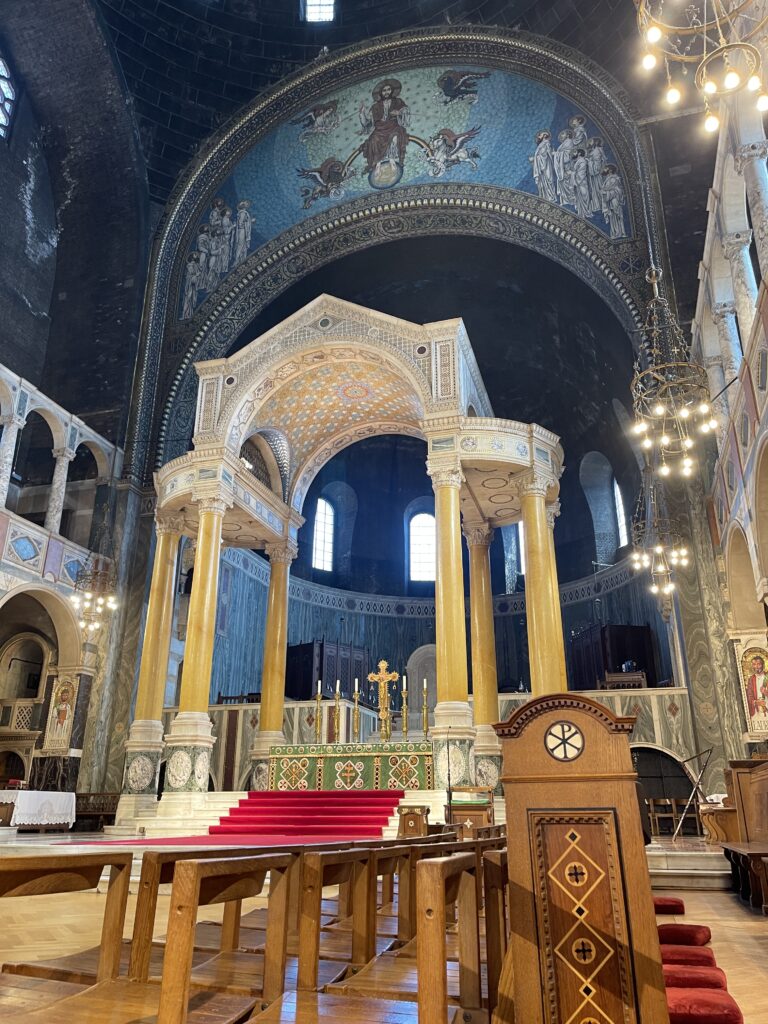
Construction began in 1895, and the cathedral was completed in 1903. Architect John Francis Bentley departed from the Gothic style associated with many English cathedrals, instead creating a striking Byzantine-inspired church influenced by early Christian basilicas. Its distinctive red-and-white striped exterior makes Westminster Cathedral immediately recognizable along Victoria Street.
What to See at Westminster Cathedral
The cathedral’s interior is dramatically different from its exterior. More than 100 varieties of marble from around the world decorate the church, while colorful mosaics fill many of the chapels. Interestingly, portions of the interior remain unfinished—the cathedral was designed with the expectation that future generations would continue adding decoration.
Among the highlights to look for are:
- The mosaics and marblework: Some of the cathedral’s most memorable artistic features, with styles representing more than a century of decoration.
- The Sanctuary and Baldacchino: The visual focus of the cathedral and the setting for the celebration of Mass.
- Eric Gill’s Stations of the Cross: Fourteen limestone reliefs installed on the great piers of the nave.
- The Chapel of St George and the English Martyrs: Here you’ll find the remains of St John Southworth, a Catholic priest who ministered to London’s poor and sick before being executed during the interregnum of Oliver Cromwell.
- The Campanile viewing gallery: The cathedral tower offers a viewing gallery approximately 210 feet above Victoria Street, reached by lift, with expansive views across London.
Our Experience at Westminster Cathedral
One of the things that caught our attention even before entering Westminster Cathedral was the Latin dedication above the entrance referring to the Most Precious Blood of Our Lord Jesus Christ, to whom the cathedral is dedicated.
Once inside, we were especially impressed by the elaborate marblework. The contrast between the darker, unfinished upper portions of the cathedral and the richly decorated chapels creates an interior unlike many of London’s better-known churches. Look closely as you walk through the cathedral—the varieties and patterns of marble are remarkable, and the mosaics become increasingly detailed as you explore the individual chapels.
Despite its size and central London location, Westminster Cathedral remains very much an active place of worship rather than simply a sightseeing attraction. If your schedule allows, attending Mass provides a very different experience from merely walking through the building.
Westminster Cathedral Mass Times and Visitor Information
Best for: First-time visitors, cathedral worship, sacred music, architecture and Catholic history
Location: Victoria Street, Westminster
Nearest Tube: Victoria. St James’s Park is another convenient option.
Admission: Entry to Westminster Cathedral is free.
Regular Sunday Masses: 8 a.m., 10 a.m. Sung Mass, 12 noon Solemn Mass, 5:30 p.m. Sung Mass and 7 p.m.
Weekday Masses: Several Masses are celebrated Monday through Friday, including a 10:30 a.m. Latin Mass and 5:30 p.m. Solemn Mass under the cathedral’s current regular schedule.
Saturday: Masses include an 8 a.m. Mass, 10:30 a.m. Solemn Latin Mass, 12:30 p.m. Mass and 6 p.m. Sung Vigil Mass.
Confession: The Sacrament of Reconciliation is available daily.
Don’t miss: The mosaics, marblework, Eric Gill Stations of the Cross, St John Southworth’s shrine and, if time permits, the Campanile viewing gallery.
Traveler tip: Westminster Cathedral is just a short walk from Victoria Station, making it one of the easiest Catholic churches to include in a London sightseeing itinerary. It is also convenient to Buckingham Palace, St James’s Park and the Westminster area.
Mass schedules can change for Holy Days, special liturgies and other events. Check the official Westminster Cathedral Mass schedule before your visit.
Mass Service Times: https://westminstercathedral.org.uk/spiritual-life/mass-and-offices/
Church Website: https://westminstercathedral.org.uk/
2. The London Oratory – Best for Sacred Music and Latin Mass
The London Oratory, also widely known as the Brompton Oratory, is one of the most impressive Catholic churches in London and one we particularly recommend to travelers interested in sacred music and Latin Mass. Officially named the Church of the Immaculate Heart of Mary, it stands along Brompton Road near South Kensington and Knightsbridge.
The Congregation of the Oratory was founded by St Philip Neri in Rome during the 16th century. After St John Henry Newman brought the Oratory to England, a group of converts that included Father Frederick William Faber established the London Oratory.
The present church was designed by architect Herbert Gribble and constructed between 1880 and 1884. Its deliberately Italianate design was intended to bring something of the atmosphere of the great churches of Rome to Victorian London. The church was consecrated in 1884, while its façade and outer dome were completed later in the 1890s.
Today, the London Oratory remains an active Catholic parish as well as one of London’s outstanding destinations for traditional Catholic liturgy and sacred music.
What to See at the London Oratory
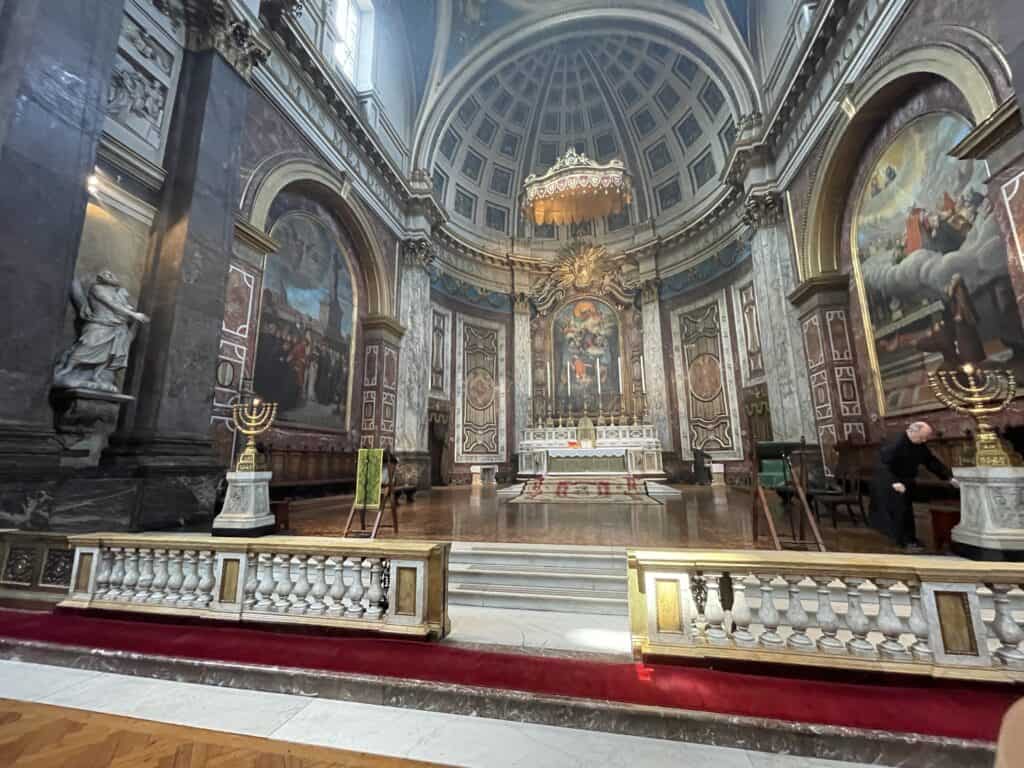
Stepping inside the Oratory can feel surprisingly like entering a church in Rome. Its soaring dome, elaborate chapels, marble, statues, side altars and monumental sanctuary create a dramatically different atmosphere from many of London’s Gothic churches.
Among the features worth noticing are:
- The High Altar: Set within an exceptionally deep sanctuary, the High Altar remains the visual and liturgical focus of the church.
- St Wilfrid’s Chapel: Father Frederick William Faber, one of the founders of the London Oratory, is buried here. The chapel also contains a triptych depicting St Thomas More, St John Fisher and an execution scene at Tyburn.
- The Lady Altar: Originally from a Dominican church in Brescia, Italy, this elaborate altar includes the statue known as Our Lady of Victories.
- The Altar of St Philip Neri: Dedicated to the founder of the Congregation of the Oratory, it includes a wax effigy of the saint beneath the altar.
- The side chapels and altars: Take time to walk through the church rather than viewing it only from the nave. Many of its most interesting artistic details are found along the sides of the building.
For travelers who enjoy European church architecture, this is one London church where it is worth allowing some extra time simply to explore the interior.
Sacred Music at the London Oratory
Sacred music is one of the major reasons to consider attending Mass at the London Oratory. The church describes itself as an internationally recognized custodian of sacred music in the Catholic tradition, supported by several choirs and professional musicians.
The principal musical liturgy takes place at the 11 a.m. Solemn Latin Mass on Sundays, accompanied by the Choir of the London Oratory. Solemn Latin Vespers with the choir follows at 3:30 p.m.
The Oratory also offers a 9 a.m. Sunday Mass in Latin using the 1962 Missal, making this an especially useful church for visitors specifically looking for a Traditional Latin Mass in London.
Our Experience Attending Mass at the London Oratory
We attended the 11 a.m. Solemn Latin Mass during our visit, and the music became one of our most memorable Catholic Mass experiences in London.
The church has a highly reverberant acoustic, and once the choir began singing, the sound seemed to fill the entire building. The choral music was so beautiful that we felt as though we could almost reach out and touch the notes as they wafted through the church.
We heard the choir chant the Asperges Me as Mass commenced, immediately establishing the solemn atmosphere of the liturgy. Rather than trying to categorize this Mass as a variation of the Traditional Latin Mass, it is better to use the Oratory’s own description: the Sunday 11 a.m. liturgy is a Solemn Latin Mass. Travelers specifically seeking Mass according to the 1962 Missal should instead look to the Sunday 9 a.m. Mass.
The church itself added considerably to the experience. With its large statues, numerous side altars, ornate sanctuary and distinctly Italianate character, it reminded us of some of the larger churches we had visited in Rome.
For us, this was one of the most beautiful Masses we have experienced while traveling. If attending a reverent Catholic liturgy accompanied by exceptional sacred music appeals to you, the London Oratory deserves a place near the top of your list.
London Oratory Mass Times and Visitor Information
Best for: Sacred music, Latin Mass, traditional Catholic liturgy and Italianate church architecture
Address: Brompton Road, London SW7 2RP
Nearest Tube: South Kensington and Knightsbridge
Regular Sunday Masses: 8 a.m., 9 a.m. Latin Mass using the 1962 Missal, 10 a.m. Family Mass, 11 a.m. Solemn Latin Mass, 12:30 p.m., 4:30 p.m. and 7 p.m.
Saturday Vigil: 6 p.m., with choir during school term
Monday through Friday: Masses are normally celebrated at 7 a.m., 8 a.m. using the 1962 Missal, 12:30 p.m. and 6 p.m. in Latin.
Confession: Confessions are offered regularly throughout the week, including after several Sunday morning Masses.
Sacred music tip: For the fullest choral experience, consider the Sunday 11 a.m. Solemn Latin Mass. The Choir of the London Oratory also sings Solemn Latin Vespers at 3:30 p.m. on Sundays.
Don’t miss: The High Altar, St Wilfrid’s Chapel, the Lady Altar, St Philip Neri’s Altar and the many side chapels.
Traveler tip: The London Oratory is particularly easy to combine with a day exploring South Kensington. The Victoria and Albert Museum, Natural History Museum and Science Museum are nearby, while Harrods and Knightsbridge are within walking distance in the opposite direction.
Mass times, choir schedules and special liturgies can change during the year. Check the London Oratory’s official Mass and service schedule before your visit.
Mass Service Times: https://www.bromptonoratory.co.uk/regular-mass-service-times
Church Website: https://www.bromptonoratory.co.uk/#about
Watch our video of Westminster Cathedral and the London Oratory
3. St George’s Cathedral, Southwark – Best for Catholic History South of the Thames
St George’s Cathedral, Southwark is the mother church of the Roman Catholic Archdiocese of Southwark and one of the most historically significant Catholic churches in London. Located just south of the Thames, it is particularly convenient for travelers exploring the Imperial War Museum, Waterloo, or London’s South Bank.
The cathedral’s history stretches back to the revival of Catholic life in 19th-century England. Architect Augustus Welby Northmore Pugin, a leading figure of the Gothic Revival who also worked on the Houses of Parliament, designed the original church. St George’s opened in 1848, and following the restoration of the Catholic hierarchy in England and Wales, it became the first Roman Catholic cathedral in London since the Reformation in 1852.
For approximately half a century—until Westminster Cathedral opened—St George’s stood at the center of Catholic life in London.
The cathedral’s story took a dramatic turn during World War II. On April 16, 1941, an incendiary bomb struck the building, starting a fire that destroyed its wooden roof and much of the cathedral. Architect Romilly Craze later designed the rebuilt church, incorporating surviving portions of Pugin’s original building into a combination of Gothic Revival and Arts and Crafts influences. The restored cathedral reopened in 1958.
What to See at St George’s Cathedral
Because of its destruction and reconstruction, St George’s is especially interesting for visitors who enjoy seeing how different periods of history can coexist within a single church.
Look for these highlights during your visit:
- The Blessed Sacrament Chapel: One of the most important surviving portions of Pugin’s original 1848 church. Its altar, reredos, encaustic floor tiles and wrought-iron gates are original Pugin designs.
- The East Window: Located behind the sanctuary, this window depicts the Crucifixion along with saints connected to the history of the Catholic Church in England and Wales. The stone tracery is part of Pugin’s original design.
- The West Window: Created by Harry Clarke Studios of Dublin during the 1950s, it depicts the Coronation of Mary as Queen of Heaven.
- The Baptistery: Completed in 1966, the steps descend into the Baptistery as a reference to the early Christian practice of baptism by immersion.
- The Romero Cross and Memorial: Installed in 2013, the memorial honors St Oscar Romero, the Archbishop of San Salvador who was assassinated while celebrating Mass in 1980.
- The chapels and memorials: Take time to explore beyond the central nave, where you’ll find additional reminders of the cathedral’s history and the Catholic communities it has served.
The cathedral also has an established tradition of sacred music. The Sunday noon Solemn Mass is sung by the Cathedral Choir and features music that can include plainsong and polyphony.
Our Experience at St George’s Cathedral
We found the atmosphere inside St George’s Cathedral surprisingly tranquil, particularly considering its location in busy central London. The stained glass adds welcome bursts of color to the church, while the chapels, memorials, and architectural details encourage you to slow down and look around rather than simply walk through the nave.
We were especially interested in learning how extensively the cathedral had been rebuilt following the World War II bombing. Knowing that portions of the church survived while others date from the postwar reconstruction makes exploring the interior more interesting—you are seeing both the legacy of Pugin’s original cathedral and the story of a Catholic community that rebuilt its church after wartime destruction.
Information available inside the cathedral helped us better understand that history during our visit.
St George’s also makes sense from a sightseeing perspective. We combined our exploration of this part of London with other nearby attractions, and the Imperial War Museum is particularly convenient. Pairing the two creates an interesting day centered around different chapters of British history.
St George’s Cathedral Mass Times and Visitor Information
Best for: Catholic history, sacred music, South Bank sightseeing and visitors interested in World War II history
Main entrance: Lambeth Road, London SE1 6HR
Nearest Tube: Lambeth North on the Bakerloo Line. Waterloo, Southwark and Elephant & Castle stations are also within approximately a 10- to 15-minute walk.
Regular Sunday Masses: 8 a.m., 10 a.m. Family Mass, 12 noon Solemn Mass, 1:30 p.m. Mass in Spanish and 6 p.m.
Monday through Friday: Masses are normally celebrated at 7:30 a.m. and 12:30 p.m.
Saturday: Mass at 9:30 a.m., followed by the First Mass of Sunday at 6 p.m.
Confession: Confession is available during published times throughout the week, including before or during selected weekend Masses.
Adoration: Eucharistic Adoration normally takes place on Thursdays following the 7:30 a.m. Mass until 5 p.m., as well as on Saturday mornings.
Sacred music tip: Consider the Sunday noon Solemn Mass if you’d like to experience the Cathedral Choir and St George’s tradition of plainsong and polyphony.
Don’t miss: The surviving Pugin-designed Blessed Sacrament Chapel, the East and West stained-glass windows, the Baptistery and the Romero Cross and Memorial.
Traveler tip: St George’s Cathedral is less than a mile from many major South Bank attractions. It pairs particularly well with a visit to the Imperial War Museum, which is only a short walk away.
Mass and confession schedules can change for Holy Days, holidays and special services. Check the official St George’s Cathedral Mass and service schedule before your visit.
Mass Service Times: https://www.stgeorgescathedral.org.uk/services/
Church Website: https://www.stgeorgescathedral.org.uk/

St. Etheldreda’s Church – Diliff, CC BY-SA 3.0 https://creativecommons.org/licenses/by-sa/3.0, via Wikimedia Commons
4. St Etheldreda’s Church – Best for Medieval Catholic London
Hidden along historic Ely Place near Holborn, St Etheldreda’s Church offers one of the most unusual Catholic church experiences in London. While London’s great cathedrals impress through their scale, St Etheldreda’s stands out for something quite different: intimacy, medieval history, and the feeling of discovering a sacred space tucked away from the modern city.
The church dates to around 1290 and was built by John de Kirkby, Bishop of Ely and Treasurer of England during the reign of Edward I. It originally served as the chapel of the Bishops of Ely’s London residence and is one of the few surviving medieval buildings in London from that period.
Following the Reformation, the chapel underwent centuries of varied uses before Father William Lockhart purchased it on behalf of the Rosminians in 1874. Restoration followed, and St Etheldreda’s was formally reconciled to Catholic worship in 1879.
Today, St Etheldreda’s remains an active Roman Catholic church and an extraordinary physical link between medieval Catholic England and modern London.
What to See at St Etheldreda’s
The greatest attraction here is the historic building itself. Unlike many grand London churches constructed or substantially rebuilt in later centuries, St Etheldreda’s allows visitors to step inside a space whose origins stretch back more than 700 years.
Among the features worth looking for are:
- The medieval Upper Church: The stonework and proportions of the chapel offer a rare surviving glimpse of Edward I-era ecclesiastical architecture.
- The Crypt: Located beneath the Upper Church, the crypt adds another layer to the building’s long history and connection with the medieval Bishops of Ely.
- The East Window: Installed in 1952 and designed by Edward Joseph “Eddy” Nuttgens, the colorful window depicts Christ enthroned along with Mary, St Joseph, St Etheldreda, St Brigid, the Evangelists, and other religious imagery.
- The West Window: Created by Charles Blakeman in 1964, it commemorates Catholics who suffered during the English Reformation.
- Catholic martyr memorials: Statues and imagery throughout the church recall Catholics who remained faithful during periods of religious persecution.
- The historic setting of Ely Place: Part of the experience is simply finding the church. Ely Place is a gated historic street that feels remarkably removed from the surrounding busy streets.
Although stained glass is a prominent feature of St Etheldreda’s, the windows visitors see today are largely 20th-century. The church itself, rather than medieval stained glass, is the remarkable survivor from the Middle Ages.
Sacred Music at St Etheldreda’s
St Etheldreda’s also has a notable tradition of sacred music.
The church maintains one of the relatively few fully professional Roman Catholic church choirs in the country. The professional choir sings at the 11 a.m. Sung Latin Mass each Sunday, as well as on major feast days and solemnities.
For travelers interested in combining historic surroundings with Latin liturgy and sacred music, the Sunday 11 a.m. Mass is an especially appealing time to visit.
Our Experience at St Etheldreda’s
One of the things we enjoyed most about visiting St Etheldreda’s was simply discovering it. Tucked away on Ely Place, the church feels removed from the energy of central London despite being only a short distance from some of the city’s busiest streets.
Stepping inside gave us a much more intimate experience than visiting London’s larger churches and cathedrals. The ancient stonework immediately reinforces the building’s age, while the vivid stained-glass windows bring color to what otherwise feels like a distinctly medieval space.
We originally expected the stained glass itself to be centuries old, but its story is actually more recent. St Etheldreda’s suffered bomb damage during World War II, and much of the glass visible today was created during the church’s postwar restoration. That combination of medieval architecture and modern stained glass became one of the more interesting aspects of our visit.
There is also something special about standing inside a Catholic church where worship took place before the Reformation and where Catholic Mass is once again celebrated today. Of the churches on our list, St Etheldreda’s provided perhaps the strongest sense of stepping directly into London’s Catholic past.
St Etheldreda’s Mass Times and Visitor Information
Best for: Medieval history, a quieter church experience, Latin Mass and sacred music
Address: 14 Ely Place, London EC1N 6RY
Nearest Tube: Chancery Lane on the Central Line and Farringdon on the Circle, Hammersmith & City and Metropolitan lines
Regular Sunday Masses: 9 a.m. Mass in English and 11 a.m. Sung Latin Mass
Monday through Friday: Mass is normally celebrated at 1 p.m., except on Bank Holidays.
Holy Days of Obligation: Masses are normally celebrated at 1 p.m. and 6 p.m.
Confession: Confessions are normally available Monday through Friday following the 1 p.m. Mass, at approximately 1:20 p.m., as well as by request.
Opening hours: The church is generally open from 8 a.m. to 5 p.m. Monday through Sunday, with Saturday opening at 9 a.m. It is closed on Bank Holiday Mondays.
Sacred music tip: Consider the Sunday 11 a.m. Sung Latin Mass, when St Etheldreda’s professional choir normally sings.
Don’t miss: The medieval Upper Church and crypt, the East and West stained-glass windows, the historic stonework and the atmosphere of Ely Place itself.
Traveler tip: Don’t expect a large cathedral visible from blocks away. St Etheldreda’s is part of the pleasure of exploring London’s quieter historic corners. Allow a few extra minutes to find Ely Place, particularly if this is your first visit.
Mass times and opening hours can change for Holy Days, Bank Holidays and special events. Check the official St Etheldreda’s Mass schedule before your visit.
Mass Service Times: https://www.stetheldreda.co.uk/masstimes
Church Website: https://www.stetheldreda.co.uk/
5. Our Lady of the Assumption and St Gregory – Best Hidden Catholic Church in the West End
Tucked away on Warwick Street just off Regent Street, Our Lady of the Assumption and St Gregory is easy to overlook among the shops, restaurants, and busy streets of London’s West End. Yet behind its understated exterior is one of the more fascinating stories of Catholic survival in London.
The church’s history reaches back to a time when Catholics in England faced significant restrictions on public worship. Foreign embassies, however, were permitted to maintain Catholic chapels, and English Catholics could attend Mass at these embassy churches.
Beginning in 1724, the Portuguese ambassador occupied houses on nearby Golden Square and maintained a Catholic chapel behind them. When the Portuguese Embassy moved, the property was taken over by the Bavarian ambassador, and the chapel became associated with the Bavarian Embassy.
That connection proved important during the anti-Catholic Gordon Riots of 1780, when the Bavarian chapel was attacked and damaged.
The church that visitors see today was constructed in 1789–1790 on the site of that earlier embassy chapel. Designed by architect Joseph Bonomi, it opened on March 12, 1790—the feast of St Gregory the Great.
Remarkably, the present church therefore opened before the Second Catholic Relief Act of 1791 substantially relaxed restrictions on Catholic worship. Its history provides an unusual window into how Catholics practiced their faith in London during an era when openly established Catholic churches were severely restricted.
What Makes Warwick Street Church Special
The exterior is deliberately restrained, but step inside and the church becomes much more elaborate. Its relatively intimate size also creates a very different atmosphere from London’s great cathedrals.
Among the details worth looking for are:
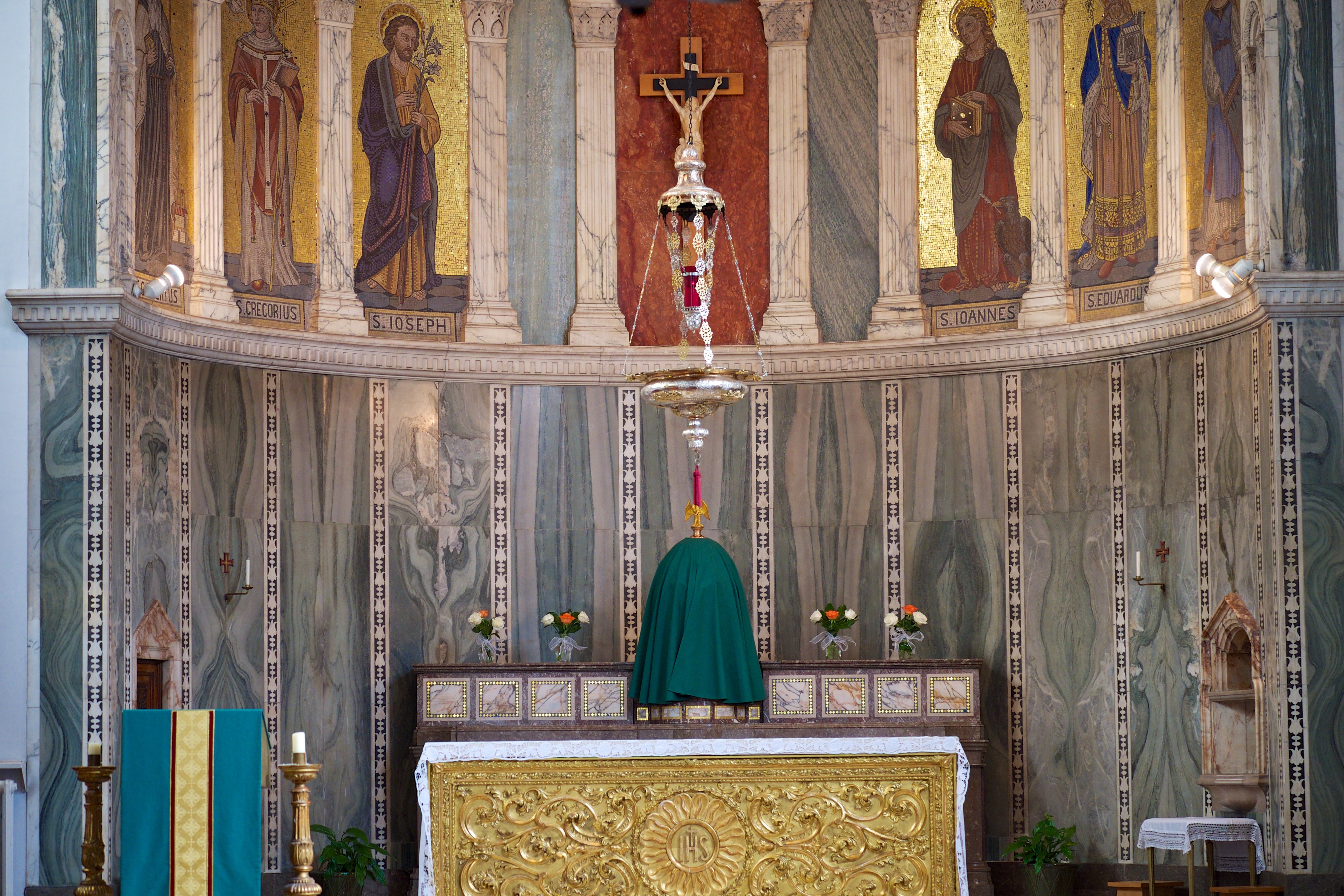
- The sanctuary: Architect John Francis Bentley—who later designed Westminster Cathedral—remodeled the sanctuary in 1875, adding an apse decorated with marble and mosaics.
- The Assumption relief: A bas-relief depicting the Assumption of the Virgin Mary was created by Irish sculptor John Edward Carew in 1853. It can now be seen above the entrance to the sacristy.
- The historic galleries: Portions of the original 18th-century gallery seating survive, offering another tangible connection with the church’s earliest years.
- The organ: The church’s organ has roots extending back to approximately 1791, although it has been enlarged and rebuilt over the centuries.
- The Bavarian connection: The church retains reminders of its historical association with the Royal House of Bavaria.
- The contrast with Soho: Part of the appeal is simply finding such a peaceful historic Catholic church only steps from Regent Street, Piccadilly Circus, and the bustle of central London.
The relatively plain exterior also makes more sense when you understand the church’s history. Early Catholic chapels in London were not buildings intended to advertise their presence prominently. Warwick Street’s understated appearance reflects an era when Catholic worship occupied a much more precarious position in England.
The Church and the Personal Ordinariate of Our Lady of Walsingham
Today, Our Lady of the Assumption and St Gregory has another distinction: it serves as the central church of the Personal Ordinariate of Our Lady of Walsingham.
The Ordinariate was established to enable former Anglicans to enter into full communion with the Roman Catholic Church while preserving elements of their Anglican spiritual, liturgical, and musical heritage. Warwick Street was dedicated to the life of the Ordinariate in 2013.
For travelers, the important point is that this is a Roman Catholic church. Catholics attending Mass here fulfill their Sunday Mass obligation.
The principal 10:30 a.m. Sunday Solemn Mass is celebrated according to Ordinariate Use, incorporating elements drawn from the Anglican liturgical tradition within Catholic worship. Music is an important part of this Mass and reflects the rich choral tradition inherited from Anglicanism.
This makes Warwick Street particularly interesting for Catholic travelers who have attended Mass in many different places and would like to experience a liturgy that may feel somewhat different while remaining fully Catholic.
History: This church holds a unique place in London’s Catholic history, as one of the first churches granted legal recognition following the Catholic Emancipation Act of 1829. Its current building was consecrated in 1790 and stands on the site of a former chapel attached to the Portuguese Embassy.
The Experience at Our Lady of the Assumption and St Gregory
What stands out the is the contrast between the church and its surroundings.
You can be exploring the lively streets of Soho and the West End one moment and, just a short distance away, step into a quiet church filled with centuries of Catholic history. It feels very much like a hidden sanctuary in the middle of London.
The church is considerably more intimate than Westminster Cathedral, the London Oratory, or St George’s Cathedral. That smaller scale was part of its appeal for us. Rather than feeling like another major London landmark to check off a sightseeing list, Warwick Street felt like a place of discovery.
Knowing the history also changes the way you experience the building. This was not simply another church constructed during the great Victorian revival of Catholicism. Catholic worship took place on this site during a period when embassy chapels provided one of the few opportunities for Catholics to attend Mass relatively openly in London.
For travelers interested in both faith and history, Our Lady of the Assumption and St Gregory make a rewarding addition to a London itinerary.
Mass Times and Visitor Information
Best for: A hidden historic Catholic church, Ordinariate worship, sacred music, and travelers exploring Soho and the West End
Address: 10 Warwick Street, London W1B 5LZ
Nearest Tube: Piccadilly Circus
Regular Sunday Masses: 10:30 a.m. Solemn Mass and 5 p.m., both celebrated according to Ordinariate Use
Saturday Vigil Mass: 6 p.m.
Weekday Mass: 12:45 p.m. Tuesday through Friday
Traditional Latin Mass: The church’s current schedule also lists a 6:30 p.m. Missa Cantata on Wednesday and a noon Low Mass or Missa Cantata on Saturday.
Confession: Normally available Tuesday through Friday from 12:15 to 12:35 p.m. and Saturday from 5:15 to 5:45 p.m.
Sacred music tip: The Sunday 10:30 a.m. Solemn Mass is the best choice for visitors interested in experiencing the church’s distinctive Ordinariate liturgy and musical tradition.
Don’t miss: The sanctuary remodeled by John Francis Bentley, the Assumption relief, historic galleries, and surviving reminders of the church’s Bavarian connections.
Traveler tip: The church entrance is on Warwick Street between Beak Street and Glasshouse Street, just off Regent Street. Its location makes it especially easy to combine with sightseeing around Piccadilly Circus, Regent Street, Carnaby, Soho, and the West End.
Mass and confession schedules can change for Holy Days and special services. Check the official Our Lady of the Assumption and St Gregory Mass schedule before your visit.
Church Website and Mass Times: https://warwickstreet.org.uk/
More Catholic Churches in London Worth Knowing
| Catholic Church | Why Consider It |
|---|---|
|
Church of the Immaculate Conception (Farm Street) Mayfair |
A beautiful Jesuit church known for its Gothic Revival architecture, sacred art, and convenient Mayfair location. A good choice for travelers looking for frequent daily Masses. |
|
Corpus Christi Catholic Church Covent Garden / Maiden Lane |
The Diocesan Shrine of the Blessed Sacrament and an especially convenient Catholic church for travelers sightseeing around Covent Garden and the West End. |
|
St James’s Catholic Church, Spanish Place Marylebone |
Notable for its striking Gothic interior, historic connections with the Spanish Embassy, and traditional Catholic liturgy, including a Sunday Solemn Latin Mass. |
|
St Patrick’s Catholic Church, Soho Soho Square |
An active Catholic parish in the heart of Soho with a strong worship and music tradition. Its central location makes it particularly easy to include in a West End itinerary. |
Tip: These are additional Catholic churches worth considering beyond our five featured choices. Mass schedules can change, so check each church’s official website before visiting.
How to Choose a Catholic Church for Mass in London
With so many historic Catholic churches in London, the best choice often depends on the kind of experience you want and where you plan to spend the rest of your day.
- Best for a first visit: Westminster Cathedral is the strongest all-around choice for first-time visitors. It combines frequent Masses, impressive architecture, sacred music, and a convenient location near Victoria, Buckingham Palace, and Westminster.
- Best for sacred music: Choose the London Oratory if choral music is an important part of the experience. Its Sunday 11 a.m. Solemn Latin Mass is especially memorable for the quality of the choir and the church’s resonant acoustics.
- Best for Traditional Latin Mass: The London Oratory currently offers a Sunday 9 a.m. Mass using the 1962 Missal. Always verify the current schedule before visiting.
- Best for medieval atmosphere: St Etheldreda’s Church offers the strongest sense of stepping into medieval Catholic London. Its intimate setting on Ely Place makes it very different from the city’s larger churches.
- Best for Catholic history south of the Thames: St George’s Cathedral, Southwark is an excellent choice for travelers interested in post-Reformation Catholic history, Gothic Revival architecture, and World War II history.
- Best for the West End and Soho: Our Lady of the Assumption and St Gregory is especially convenient if your plans include Piccadilly Circus, Regent Street, Soho, or Carnaby. Its embassy-chapel history also makes it one of the most unusual churches on our list.
- Best for Eucharistic devotion: Consider Corpus Christi Catholic Church on Maiden Lane, the Diocesan Shrine of the Blessed Sacrament, if Eucharistic worship and a central Covent Garden location appeal to you.
- Best for Jesuit tradition: The Church of the Immaculate Conception on Farm Street is a good choice for visitors interested in Jesuit spirituality, beautiful Gothic Revival architecture, and a convenient Mayfair location.
If your schedule is flexible, we recommend choosing a church based not only on location but also on the type of Mass or worship experience that interests you most. And because Mass times, choir schedules, and special liturgies can change, check the church’s official website before setting out.
Tips for Attending Catholic Mass in London as a Visitor
Attending Mass can be a meaningful part of a London visit, especially if you enjoy experiencing local churches as active places of worship rather than simply historic attractions.
- Check the current Mass schedule before you go. Times can change for Holy Days, choir holidays, special liturgies, and seasonal services.
- Arrive 10–15 minutes early. This gives you time to find a seat, settle in, and look around without disrupting the service.
- Dress respectfully but comfortably. Most central London Catholic churches do not require formal attire, but modest clothing is appropriate.
- Limit sightseeing during Mass. Avoid walking around, taking photos, or filming once the liturgy begins.
- Visitors are welcome. You do not need to be a parishioner to attend Mass, although non-Catholics should generally refrain from receiving Holy Communion.
- Use public transportation. Most of the churches in this guide are easy to reach by Tube, and driving in central London is rarely the most convenient option.
- Allow extra time for sacred music. If you are attending a sung or solemn Mass, the service may last longer than a typical weekday Mass.
Above all, remember that these churches are living places of worship. A little preparation and respectful behavior will help you experience them in a way that is meaningful both for you and for the local congregation.
Frequently Asked Questions About Catholic Churches in London
Westminster Cathedral is the principal Roman Catholic church in London and the seat of the Archbishop of Westminster. It is also the mother church for Catholics in England and Wales.
Yes. Westminster Cathedral is Roman Catholic and should not be confused with nearby Westminster Abbey, which is part of the Church of England. Westminster Cathedral celebrates Mass daily and is free to enter.
Yes. Visitors are welcome to attend Catholic Mass in London, including at the churches featured in this guide. Remember that these are active places of worship, so arrive a little early, silence phones, and avoid sightseeing or photography during Mass.
Several central London churches offer Mass in Latin. The London Oratory currently offers a Sunday 9 a.m. Mass using the 1962 Missal and an 11 a.m. Solemn Latin Mass, while St Etheldreda’s offers a Sunday 11 a.m. Sung Latin Mass. Always confirm current schedules with the church before visiting.
For Westminster and Buckingham Palace, Westminster Cathedral is especially convenient. The London Oratory is close to the Natural History Museum, Victoria and Albert Museum, and Harrods; St George’s Cathedral works well with the Imperial War Museum and South Bank; and Our Lady of the Assumption and St Gregory is convenient for Soho, Regent Street, and Piccadilly Circus.
St Etheldreda’s Church in Ely Place describes itself as London’s oldest Catholic church. Its medieval chapel dates to around the late 13th century and today remains an active Roman Catholic church offering both English and Latin Masses.
Listen to our podcast episode highlighting London churches
Want to hear more about our experiences visiting some of London’s remarkable churches? In this podcast episode, we share highlights from our time exploring historic Catholic churches in London, along with the architecture, history, worship, and memorable moments that made these sacred spaces stand out during our visit.
Final Thoughts on Attending Catholic Mass in London
London offers Catholic travelers an impressive range of churches, from grand cathedrals to smaller historic sanctuaries hidden in the heart of the city. If this is your first visit, Westminster Cathedral is the best all-around choice. For exceptional sacred music and Latin Mass, consider the London Oratory. Choose St Etheldreda’s for medieval atmosphere, St George’s Cathedral for Catholic history south of the Thames, or Our Lady of the Assumption and St Gregory for a quieter West End church with a fascinating embassy-chapel story.
If you’re building these churches into a larger London itinerary, you may also enjoy our 12 Fun Things to Do in London for Couples, where we share more ideas from our time exploring the city together.
Whichever church you choose, try to experience it as more than another sightseeing stop. Attending Mass, spending a few quiet moments in prayer, or simply taking time to notice the architecture and history can add a meaningful dimension to a London trip. Before heading out, check the church’s official website for current Mass times and special services, then choose the location that fits naturally with the rest of your London itinerary.
Thanks for stopping by to read our recommendations for Catholic Churches in London.
Art & Julie – The Places Where We Go
Recommended Reading
The History of England’s Cathedrals Paperback by Nicholas Orme
Byzantine Art (Oxford History of Art) by Robin Cormack
Newman’s London – A Pilgrim Handbook by Joanna Bogle
Catholic Churches of London by Denis Evinson
Catholic London A Century Ago by Bernard Ward
The King and the Catholics – The Fight For Rights 1829 by Lady Antonia Fraser
Spiritual Teachings of Father Sebastian Bowden of the London Oratory by Father Sebastian Bowden
Etheldreda by Moyra Caldecott
The Great Churches of London by Derry Brabbs
More Activities in London
Fun Things To Do in London For Couples
The Vibrant Food Scene of London
Two Days in London – A Perfect Itinerary For Your Visit
Top 10 Polish History Sites to Explore in London
Is The London RAF Museum Worth Visiting?
Richmond Palace – Can You Find This Hidden Gem in London?
England Travels – Check out our articles and resources for England Travel
