
Why Devil’s Golf Course in Death Valley Will Surprise and Amaze You
Devil’s Golf Course in Death Valley National Park is one of those unusual places you might never think to visit until someone tells you about it. That’s exactly how we discovered it!
During our Death Valley road trip, we traveled with friends who had split off to explore the park on their own. When we caught up with them, they recommended a stop at a place called Devil’s Golf Course. We had never been there before, but the name was intriguing enough to convince us to investigate.
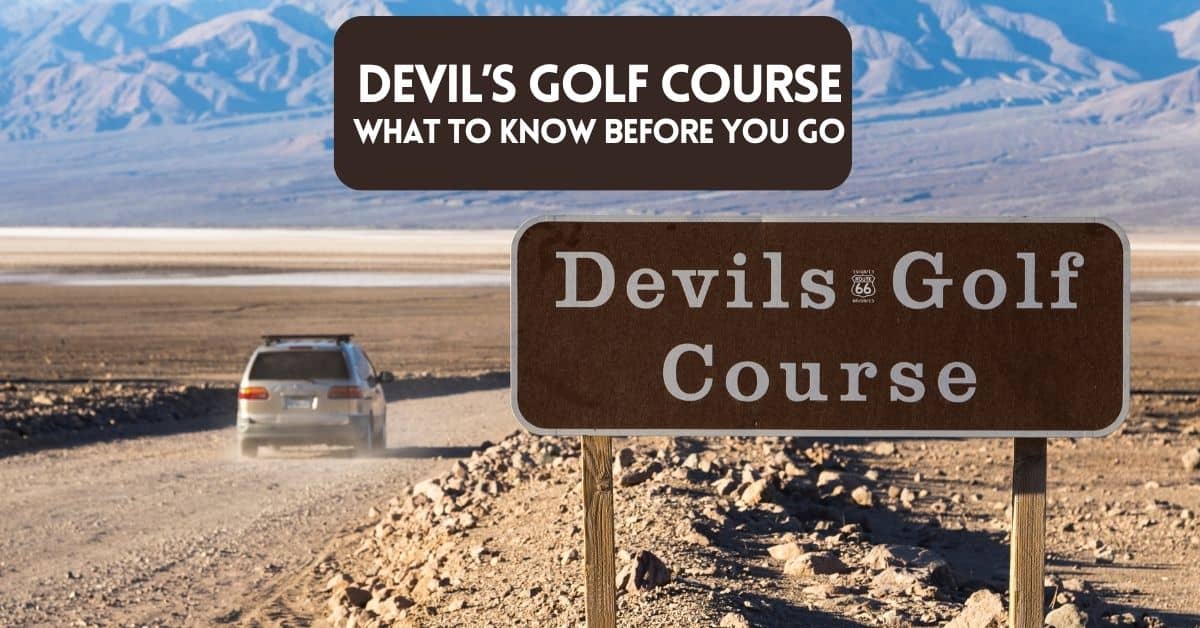
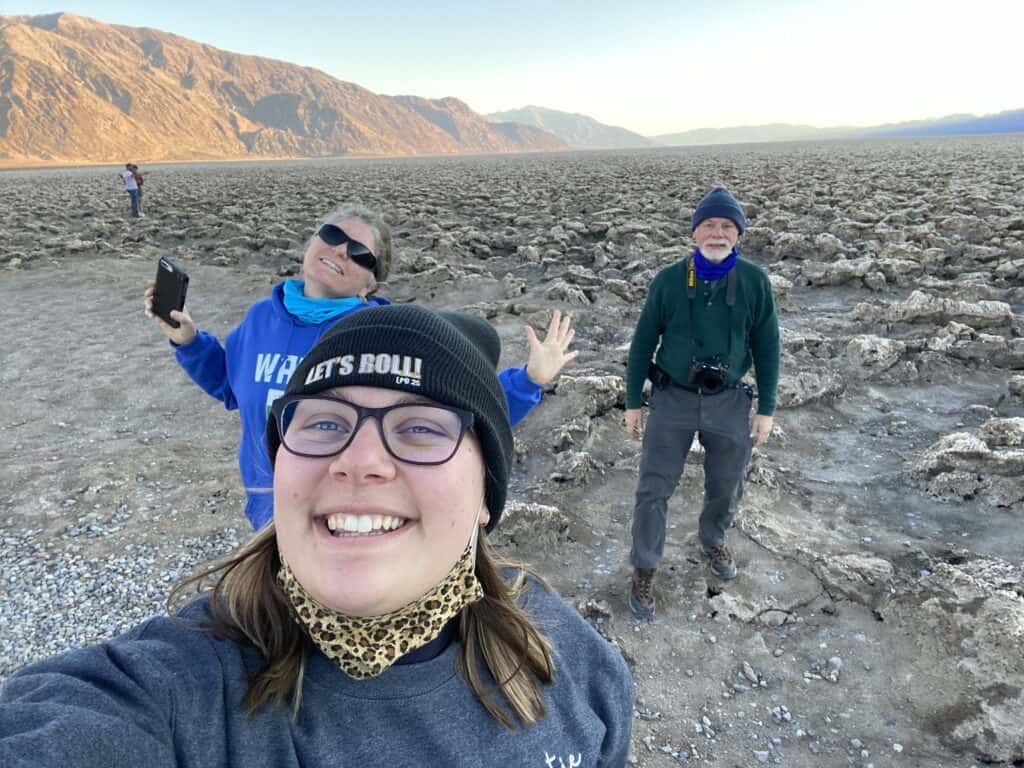
After turning off Badwater Road, we headed down a dusty gravel road toward a small parking area. What we discovered was an enormous landscape covered with jagged salt formations unlike anything we had encountered elsewhere in Death Valley.
And despite the name, there’s no putting green in sight!
In this guide, we’ll share our experience visiting Devil’s Golf Course in Death Valley, explain how these unusual salt formations developed, and offer practical tips to help you decide whether this attraction deserves a place on your Death Valley itinerary.
The Places Where We Go contains affiliate links and is a member of the Amazon Services LLC Associates Program. As an Amazon Associate, we earn from qualifying purchases at no extra cost to you when you purchase using one of these Amazon links. Read our disclaimer and privacy policy for more information.
What Is Devil’s Golf Course in Death Valley?
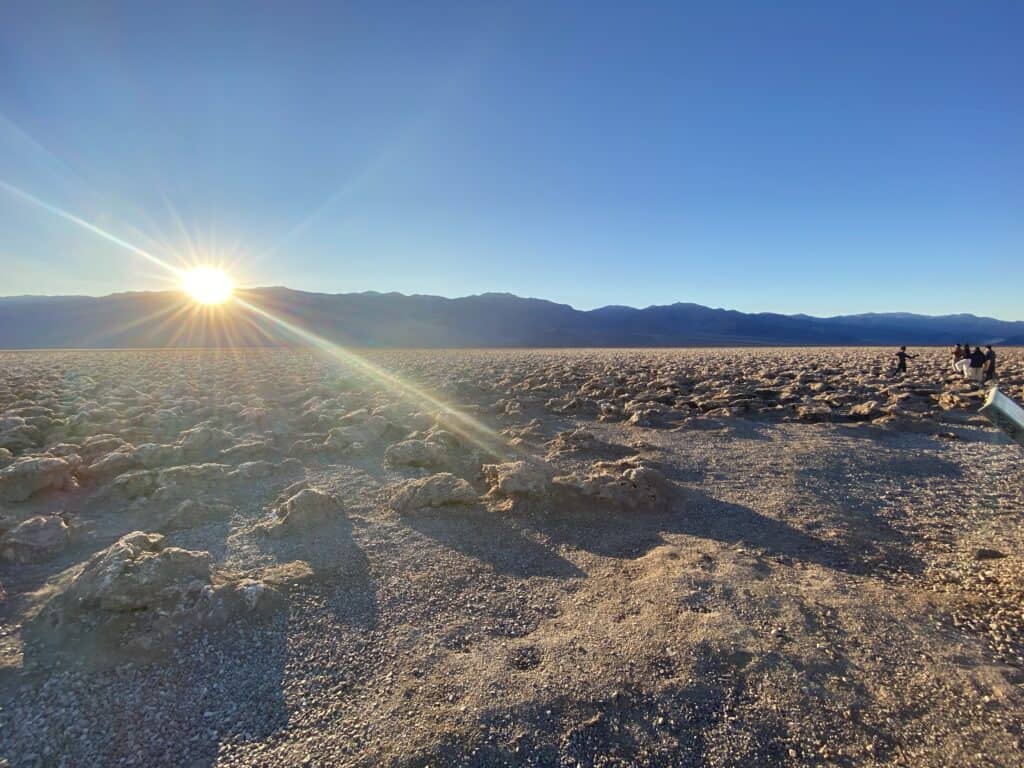
Devil’s Golf Course is a vast area of rugged, crystallized salt formations on the floor of Death Valley National Park in California.
The landscape looks almost otherworldly. Instead of smooth ground, the terrain is covered with irregular mounds, sharp ridges, and jagged salt pinnacles. Some of these formations rise one or two feet above the surrounding surface, creating an endless field of rough, uneven salt.
It’s an extraordinary sight, particularly against the backdrop of the surrounding desert mountains. These formations are part of the Death Valley salt pan, one of North America’s largest protected salt pans.
While many visitors are familiar with the smooth salt flats of nearby Badwater Basin, Devil’s Golf Course offers something entirely different. And the unusual formations are continuously changing through natural geological processes.
Devil’s Golf Course at a Glance
| Visitor information | What to know |
|---|---|
| Location | Death Valley National Park, California |
| Access | Unpaved gravel road off Badwater Road |
| Recommended visit | 20–30 minutes |
| Main attraction | Jagged crystalline salt formations |
| Hiking required | No |
| Best viewing location | Parking area |
| Best season | Late fall through early spring |
| Restrooms | None at the site |
| Admission | Included with Death Valley National Park admission |
Our Experience Visiting Devil’s Golf Course
One of the things we love about road trips is discovering places that weren’t originally on our itinerary. That was certainly the case with Devil’s Golf Course.
We had already been exploring some of Death Valley’s incredible scenery, including Badwater Basin. After our friends suggested checking out Devil’s Golf Course, we decided to take the short detour.
Driving the Gravel Road to Devil’s Golf Course
The first thing we noticed was that the paved road ended and the journey continued on gravel. And it wasn’t exactly a smooth ride!
We were traveling in our half-ton truck, so we felt comfortable proceeding, although we drove slowly to navigate the uneven surface.
Interestingly, we watched other drivers turn onto the gravel road, reconsider their decision, and turn around.
That experience taught us something worth sharing with future visitors: the road may be passable for many vehicles, but your comfort level and current road conditions matter.
Eventually, we reached the small gravel parking area. From there, we could look across an immense landscape of salt formations stretching toward the mountains.
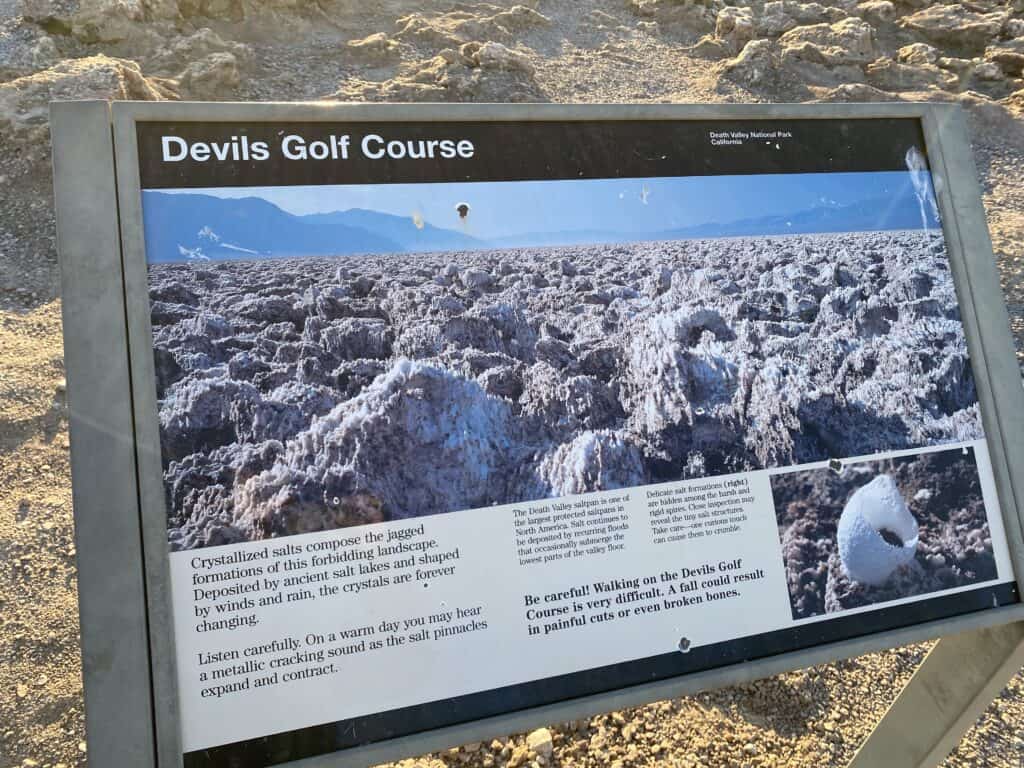
An interpretive sign helped explain the geology and the unusual name.
Seeing the Jagged Salt Formations Up Close
What impressed us most was how different the terrain looked compared with other places in Death Valley.
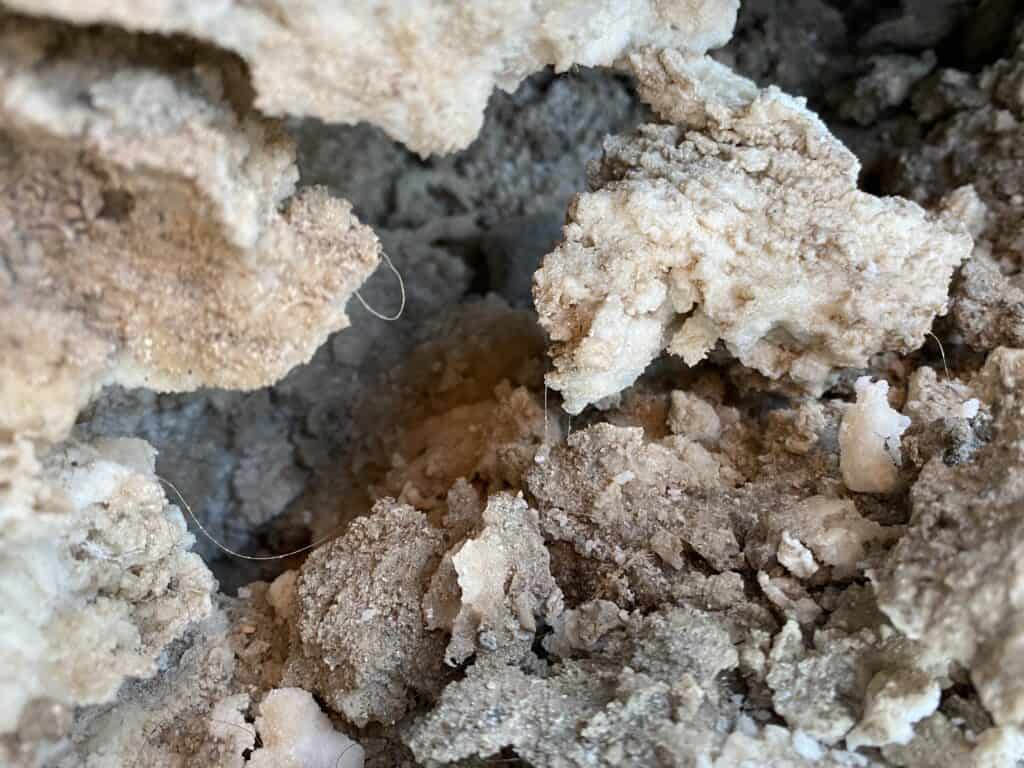
The salt formations jutted upward from the ground, creating an incredibly rugged surface. Some looked like miniature mountain peaks. Others had pointed edges that appeared sharp enough to cause serious injury.
During our visit, we discussed how astonishing it was that these unusual formations could cover such an enormous landscape.
We also learned something important from the park’s warning signs: the salt formations are both dangerous to walk on and surprisingly fragile.
This is definitely a place where observing the scenery is better than attempting to walk across it.
Why Is It Called Devil’s Golf Course?
Despite the name, Devil’s Golf Course is not an actual golf course. Its name comes from the incredibly rough terrain. A 1934 National Park Service guidebook described the surface as so rugged that only the devil could play golf on it.
Looking across the sharp, uneven salt formations, we could immediately understand the comparison. Imagine attempting to hit a golf ball across a landscape where you can barely find a level place to stand!
There’s also another interesting connection to golf. Some of the salt formations can develop hollow, rounded shapes resembling golf balls. We discussed these delicate formations during our visit, although we didn’t personally spot them.
Historical descriptions say some are so fragile that even a light touch can cause them to crumble.
And while the name has reportedly confused a few golf enthusiasts over the years, this is certainly not somewhere to bring your golf clubs.
If you’re genuinely interested in playing golf in Death Valley, there is a real course at Furnace Creek.
We explain more about the park’s unusual features in our article on fun facts about Death Valley.
How Were the Salt Formations at Devil’s Golf Course Created?
One of the most fascinating aspects of Devil’s Golf Course is understanding how this extraordinary landscape developed.
The Ancient Lake Manly
Thousands of years ago, Death Valley was much wetter. During the Ice Age, a large lake known as Lake Manly covered substantial portions of the valley floor. Water flowing into the basin carried dissolved minerals from the surrounding mountains. Because Death Valley is a closed basin, the water had no natural outlet to the ocean.
As the climate became drier, the lake gradually evaporated, leaving behind enormous deposits of minerals and salt. These ancient deposits became the foundation of today’s salt formations.
Why Are the Salt Formations So Jagged?
The salt formations keep changing as the environment acts on them. Occasional floods bring water and additional minerals into the basin. Water can dissolve existing salt, and evaporation leaves new crystals behind.
Over long periods, wind and rain reshape the surface into irregular ridges and sharp pinnacles. The result is an enormous field of jagged salt formations that looks dramatically different from Badwater Basin’s comparatively flat surface.
According to the National Park Service, exploratory drilling has revealed that salt deposits in the Devil’s Golf Course area reach depths of as much as 4,000 feet.
That’s a remarkable amount of salt beneath the surface!
Can You Hear the Salt Crystals Popping?
Here’s something unusual to listen for when visiting Devil’s Golf Course.
On a quiet day, you may hear tiny popping, cracking, or pinging sounds coming from the salt formations. These noises occur as salt crystals expand and contract with temperature changes. The National Park Service describes the sounds as countless tiny salt crystals breaking apart.
We discussed this phenomenon in our video, and it’s a fascinating detail that visitors might otherwise overlook.
If you visit when the area is quiet, take a moment to listen to the landscape.
⬇️ Watch Our Devil’s Golf Course Death Valley Video ⬇️
Want to see what Devil’s Golf Course actually looks like?
Join us as we travel the dusty gravel road, explore the viewing area, examine the unusual salt formations, and discuss the fascinating geology behind this strange landscape.
You’ll also see some of our favorite moments from the visit, including the late-afternoon scenery that made this unexpected detour particularly memorable.
Watch: Why This Spot in Death Valley Is Called Devils Golf Course
We hope our firsthand experience helps you decide whether Devil’s Golf Course belongs on your Death Valley sightseeing list.
Is It Safe to Walk on Devil’s Golf Course?
This is one of the most important questions to consider before visiting.
The National Park Service recommends viewing Devil’s Golf Course from the parking area.
The salt formations are incredibly jagged, and walking across them can be dangerous.
During our visit, the park’s warning signs explained that falling on the salt formations could cause painful cuts or even broken bones. After seeing the terrain firsthand, we understood why. Many formations have sharp points and irregular edges. Even a minor stumble could lead to an unpleasant injury.
There is also an environmental consideration. The salt formations can be fragile, and walking on or touching them can damage the delicate crystal structures.
We encourage visitors to:
- Enjoy the scenery from the designated parking area.
- Avoid climbing or walking across the jagged salt pinnacles.
- Keep children closely supervised.
- Leave the fragile salt crystals undisturbed.
- Follow all posted park safety warnings.
You don’t need to venture into the salt field to appreciate the incredible landscape. We were able to experience plenty of the scenery from the parking area itself.
How to Get to Devil’s Golf Course in Death Valley
Devil’s Golf Course is located along the Badwater Road corridor in Death Valley National Park. The attraction sits between Artist’s Drive and Badwater Basin.
From Furnace Creek, head south along Badwater Road and look for the signed, unpaved turnoff to Devil’s Golf Course.
After turning off the paved road, follow the gravel access road to the small parking area.
Do You Need a Four-Wheel-Drive Vehicle?
Not necessarily.
The National Park Service describes the compacted gravel access road as suitable for most vehicles under normal conditions. However, the road is unpaved, and its condition can change following storms or flooding.
Our experience traveling in a half-ton truck was comfortable enough, but we still proceeded slowly. We also saw other visitors turn around rather than continue down the gravel road.
If you’re traveling in a low-clearance vehicle or are uncomfortable driving on uneven gravel, consider whether this detour makes sense for you.
Always check the latest Death Valley road conditions before heading out.
How Long Should You Spend at Devil’s Golf Course?
We spent about 20 minutes at Devil’s Golf Course, which was enough time to appreciate the landscape and take photos.
For most visitors, we recommend allowing 20 to 30 minutes at the viewpoint. This gives you time to read the interpretive information, photograph the formations, and appreciate the surrounding scenery.
Because there’s no established hiking trail to complete, this is an easy attraction to add to a broader sightseeing day.
Just remember to allow additional time for the drive along the gravel access road.
If you only have one day in the park, we’ve included Devil’s Golf Course in our suggested one-day Death Valley itinerary.
Best Time to Visit Devil’s Golf Course
The best time of year to visit Devil’s Golf Course is generally between November and March, when daytime temperatures are more comfortable.
Summer temperatures in Death Valley can exceed 120°F, making even short sightseeing stops potentially dangerous.
Devil’s Golf Course has virtually no shade, so plan accordingly.
Learn more about seasonal conditions in our guide to the best time to visit Death Valley.

Why We Loved Visiting Near Sunset
One of our favorite memories from Devil’s Golf Course actually had less to do with salt formations and more to do with photography.
As our visit ended, the sun began to set. The late-afternoon sunlight illuminated the surrounding mountains and created a beautiful backdrop for our truck.
We started taking photographs, and one particular image stood out. Our truck, positioned against the desert mountains with the warm sunlight falling across the landscape, looked like something straight out of a Ford brochure!
In fact, we thought it might be the photograph of the entire day.
That’s one of the joys of travel. Sometimes your favorite memories come from the most unexpected moments.
We also enjoyed sharing this stop with our niece, making it a fun part of our family road trip.
❤️ Couples Travel Tip:
If you’re visiting Devil’s Golf Course together, consider arriving in the late afternoon, when the sunlight casts beautiful shadows across the salt formations. It’s a great opportunity to take photos together with the desert mountains in the background. Remember to leave enough daylight for the return drive.
What to Bring When Visiting Devil’s Golf Course
Although this is a relatively brief sightseeing stop, Death Valley’s extreme desert environment still requires preparation.
Here are a few essentials we recommend:
- Drinking water: Carry plenty of water, even for short sightseeing stops.
- Sturdy shoes: Wear closed-toe shoes suitable for gravel and uneven ground.
- Sun protection: Bring sunscreen, sunglasses, and a wide-brimmed hat.
- Camera or smartphone: The unusual salt formations and mountain scenery make for excellent photo opportunities.
- Offline maps: Mobile phone reception can be unreliable in Death Valley.
- Vehicle emergency supplies: Prepare for driving through remote desert areas where assistance may not be readily available.
Devil’s Golf Course has no restrooms or drinking-water facilities. The National Park Service lists the nearest restrooms at Badwater Basin, about 2.5 miles away.
For additional preparation advice, read our Death Valley packing list.
Other Places to Visit Near Devil’s Golf Course
Devil’s Golf Course sits near several of Death Valley’s most recognizable attractions. If you’re exploring this area of the park, consider combining your visit with the following destinations.

Badwater Basin
Badwater Basin is one of Death Valley’s most famous landmarks. At 282 feet below sea level, it is the lowest point in North America.
Unlike the jagged salt formations at Devil’s Golf Course, Badwater Basin is known for its expansive white salt flats and intricate polygon patterns.
Visiting both locations offers a fascinating comparison of the park’s salt landscapes.

Artist’s Drive and Artist’s Palette
Artist’s Drive is a scenic road through colorful hills created by different mineral deposits. The highlight is Artist’s Palette, where the mountains display striking shades of green, pink, purple, red, and yellow.
It’s another beautiful example of the geological diversity that makes Death Valley such an extraordinary destination.

Zabriskie Point
If you enjoy desert photography, Zabriskie Point is one of our favorite places to experience the changing light around sunset.
The viewpoint overlooks an extraordinary landscape of sculpted badlands, ridges, and distant mountains.
Read our guide to experiencing sunset at Zabriskie Point for tips on planning your visit.
Is Devil’s Golf Course Worth Visiting?
Yes! We think Devil’s Golf Course is worth visiting, particularly if you’re already exploring the Badwater Road area of Death Valley.
It’s not an attraction you’ll spend several hours at, but that’s part of its appeal.
In just 20 or 30 minutes, you can experience an extraordinary landscape unlike most other places in the national park.
For us, Devil’s Golf Course was an unexpected discovery recommended by friends.
We enjoyed learning about the unusual salt formations, sharing the experience with our niece, and capturing some beautiful late-afternoon photographs. And despite the bumpy gravel road, we’re glad we made the detour.
If you’re interested in geology, unusual natural landscapes, or photography, Devil’s Golf Course is an excellent addition to a Death Valley road trip.
Frequently Asked Questions About Devil’s Golf Course
Is Devil’s Golf Course an actual golf course?
No. Devil’s Golf Course is a natural field of jagged salt formations in Death Valley National Park. Its name refers to the incredibly rough surface, which would make playing golf practically impossible.
How long does it take to visit Devil’s Golf Course?
Most visitors can enjoy the site in approximately 20 to 30 minutes, excluding the drive along the unpaved access road. We spent about 20 minutes there.
Do you need a four-wheel-drive vehicle to reach Devil’s Golf Course?
Four-wheel drive is not normally required. The National Park Service describes the gravel access road as suitable for most vehicles, although conditions can change following storms. We traveled there in our half-ton truck.
Can you walk on the salt formations at Devil’s Golf Course?
The National Park Service recommends viewing the formations from the parking area. The jagged salt formations can cause serious injuries if you fall, and walking on them may damage the fragile crystals.
Why does Devil’s Golf Course make popping sounds?
The salt crystals expand and contract with temperature changes, sometimes producing tiny popping, cracking, or pinging noises.
Is Devil’s Golf Course free to visit?
There is no additional attraction-specific admission charge. Access is included with the entrance fee or valid park pass for Death Valley National Park.
Are there restrooms at Devil’s Golf Course?
No. There are no restrooms at Devil’s Golf Course. The nearest facilities are approximately 2.5 miles away at Badwater Basin.
Can you visit Devil’s Golf Course with children?
Families can enjoy viewing the formations from the parking area. However, children should be closely supervised because the sharp salt pinnacles are potentially dangerous.
Listen To Our Podcast For More Death Valley Inspiration
In episode 40 of The Places Where We Go Podcast, we discuss our visit to the Devil’s Golf Course, plus Father Crowley Vista Point, Badwater Basin, Mesquite Flat Sand Dunes, and Artist’s Drive.
You can listen on Podbean (link below) or find us on most podcast streaming services including Spotify and Apple Podcasts.
Pin It For Later
Final Thoughts on Devil’s Golf Course in Death Valley
Sometimes the most memorable road trip experiences are the ones you never planned. For us, Devil’s Golf Course was one of those discoveries.
We followed a friend’s recommendation, drove down a dusty gravel road, and found ourselves looking out over an enormous field of jagged salt formations.
It was fascinating to learn how the landscape developed and to appreciate how different it was from the other sights we had seen throughout Death Valley. We came away with wonderful family memories and a favorite photo of our truck against the desert mountains.
If you’re planning a visit to Death Valley National Park, we recommend stopping at Devil’s Golf Course on your sightseeing route.
Be sure to watch our Devil’s Golf Course YouTube video to see what this extraordinary landscape looks like.
For additional travel inspiration, explore our one-day Death Valley itinerary and guide to where to stay in Death Valley.
Thanks for stopping by The Places Where We Go!
The Places Where We Go
Get More Travel Inspiration From The Places Where We Go
Enjoy discovering unusual destinations like Devil’s Golf Course? Join our free weekly travel newsletter for destination inspiration, practical travel-planning tips, and timely travel news.
Let us help you discover more incredible places to go!
