
RAF Halton Hidden Documents (1944) – A Polish Wartime Mystery
Last researched and updated: September 2026
What can four pieces of paper hidden inside a wall tell us about Polish airmen training in Britain during World War II?
The Mystery: Four Documents Hidden at RAF Halton
The wartime documents we present below were discovered inside a partition wall in one of the old wooden huts at RAF Halton in Buckinghamshire. The papers, later preserved by the RAF Halton Archive, include what appears to be coded or technical material, a Polish-language report dated January 25, 1944, an English-language account concerning the war, and an electrical diagram drawn over another page of coded text.
At least one document may be connected to Bolesław Karczmarczyk, a Polish airman whose RAF service record identifies him as a wireless operator. However, the identification is not yet definitive, and several portions of the documents remain untranslated or unexplained.
This article brings together what we can currently establish from the documents, what remains uncertain, and the questions we hope historians, Polish-language readers, former RAF personnel, communications specialists, and other researchers may eventually help us answer.
This research is part of our larger project documenting the Polish aircraft apprentices who trained at RAF Halton during and after World War II—a subject with a personal connection for our family.
Updated September 2026:
Additional research has strengthened the possible identification of the name on Document 2. Krzystek’s List of Polish Air Force personnel currently records Bolesław Karczmarczyk, RAF service number 705346, born January 2, 1922, in Wierzbie, Poland. His RAF rank is listed as LAC, his trade as Wireless Operator, and 300 Squadron as his known or last posting.
We continue to regard the connection to these documents as probable rather than proven, particularly because the handwritten name and rank still require interpretation.
The Krzystek record now directly supports the service number, birth details, ranks, wireless-operator trade, and 300 Squadron posting.
How the RAF Halton Documents Were Discovered
The documents were brought to our attention in 2021 by Francis Hanford of the Trenchard Museum at RAF Halton.
Hanford explained that several people had been removing a partition wall from one of RAF Halton’s old wooden huts. The partition appeared to have been a wartime-era, self-built construction. Inside the hardboard layers they discovered waste paper that apparently had been stuffed into the wall, possibly as insulation.
Much of the surviving paper appeared to be Polish, and some of it looked like coded or technical material. The legible documents were passed to the museum rather than discarded.
Hanford described one of the papers as apparently written by an airman whose name he read as “Karcsmanyk B.” That reading ultimately led us to investigate whether the individual might instead have been Bolesław Karczmarczyk.
The original material was retained by the RAF Halton Archive for future research.
“A few years ago some friends of mine removed a partition wall in one of the old wooden huts. As they took it apart, it became obvious that this had been a self-help job dating back, possibly, to wartime. The outer layers of hardboard had been stuffed with waste paper, probably for sound insulation purposes. They handed over all the legible paper to the museum because it appeared to be of Polish origin, a lot of it in code. I attach 4 photos of samples and hope that you might be able to translate the one written by AC 2 (aircraftsman second class) Karcsmanyk B at least. If anyone can come up with anything on the others, other than the straight English, that will be a real bonus, if not a miracle!” – Francis Hanford of the Trenchard Museum at RAF Halton.
Polish Aircraft Apprentices at RAF Halton in 1944
The date on Document 2 is particularly interesting when viewed against the history of the Polish apprentices at RAF Halton.
According to an account preserved by former Polish apprentice Eugene Borysiuk, about 270 Polish boys arrived at Halton in August 1943, and the group later grew to about 300. Formal trade assignments began in January 1944, and about 100 apprentices were transferred to No. 1 Radio School at Cranwell.
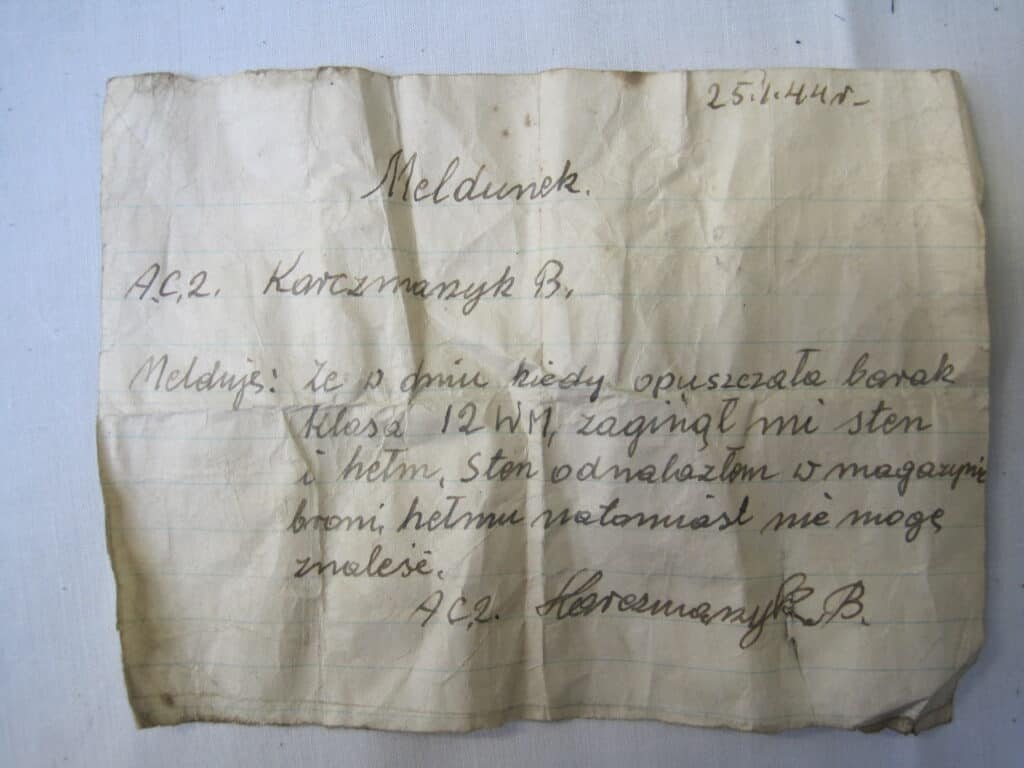
The document shown below is dated January 25, 1944. Krzystek’s List identifies Bolesław Karczmarczyk as a Wireless Operator, making the timing intriguing. It does not prove that he wrote the document or establish where it was written, but it gives researchers another potentially useful clue.
Who Was Bolesław Karczmarczyk?
The handwritten surname on Document 2 was initially difficult to identify. Francis Hanford interpreted it as something resembling “Karcsmanyk.” Searching Polish Air Force personnel records, however, led us to Bolesław Karczmarczyk, whose details provide a plausible match.
Krzystek’s List currently records:
- Name: Bolesław Karczmarczyk
- RAF service number: 705346
- Born: January 2, 1922
- Birthplace: Wierzbie, Zamość, Poland
- RAF rank: LAC
- Polish rank: st. szeregowiec
- Trade: Wireless Operator
- Known or last posting: 300 Squadron
For now, we consider this a possible identification rather than a confirmed attribution. The handwriting itself, the rank appearing on the document, and the relationship between the four recovered papers still require additional research.
Examining the Four RAF Halton Documents
| Document | What Is Visible | Current Interpretation | Confidence |
|---|---|---|---|
| Document 1 | Coded, abbreviated, or technical-looking notation | Possibly an RAF technical, radio, communications, or training exercise | Low |
| Document 2 | Handwritten Polish text dated January 25, 1944, including what appears to be the word “Meldunek” | Possibly a report or training document; the handwritten name may correspond to Bolesław Karczmarczyk | Moderate |
| Document 3 | Handwritten English text containing references that appear to concern the war | Possibly notes, an assignment, or a personal account relating to wartime events | Low |
| Document 4 | An electrical or communications-style diagram combined with coded or abbreviated text | Possibly connected with electrical, radio, wireless, or communications training | Low |
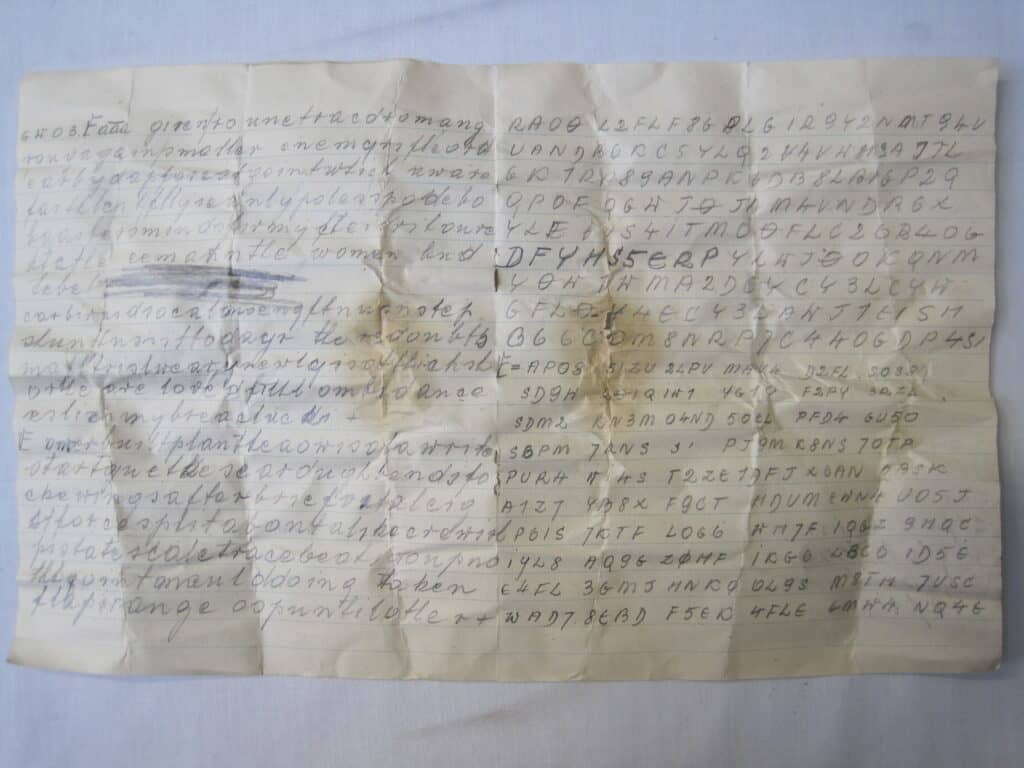
Document 1: Technical Exercise or Actual Code?
The first document contains material that appears technical or coded. Given RAF Halton’s role in technical training, one possibility is that this was a classroom or communications exercise rather than an operational message.
At present, however, we have not identified enough of the notation to determine its purpose confidently.
Research question: Does the format resemble a known RAF radio, signals, Morse, cipher, or technical-training exercise used during the 1940s?
Document 2 — Polish Report Dated January 25, 1944
This may be the most promising document in the group. It is dated January 25, 1944, and its heading appears to read “Meldunek,” a Polish term commonly associated with a report or message.
The handwritten name may correspond to Bolesław Karczmarczyk, although that identification remains provisional.
The January 1944 date is significant because Polish apprentices at RAF Halton were being assigned to technical trades during this period. Karczmarczyk is recorded as a wireless operator, adding another potentially relevant clue.
Research questions:
Can the entire Polish text be transcribed accurately? Does the terminology indicate a military report, classroom assignment, disciplinary report, technical exercise, or something else?
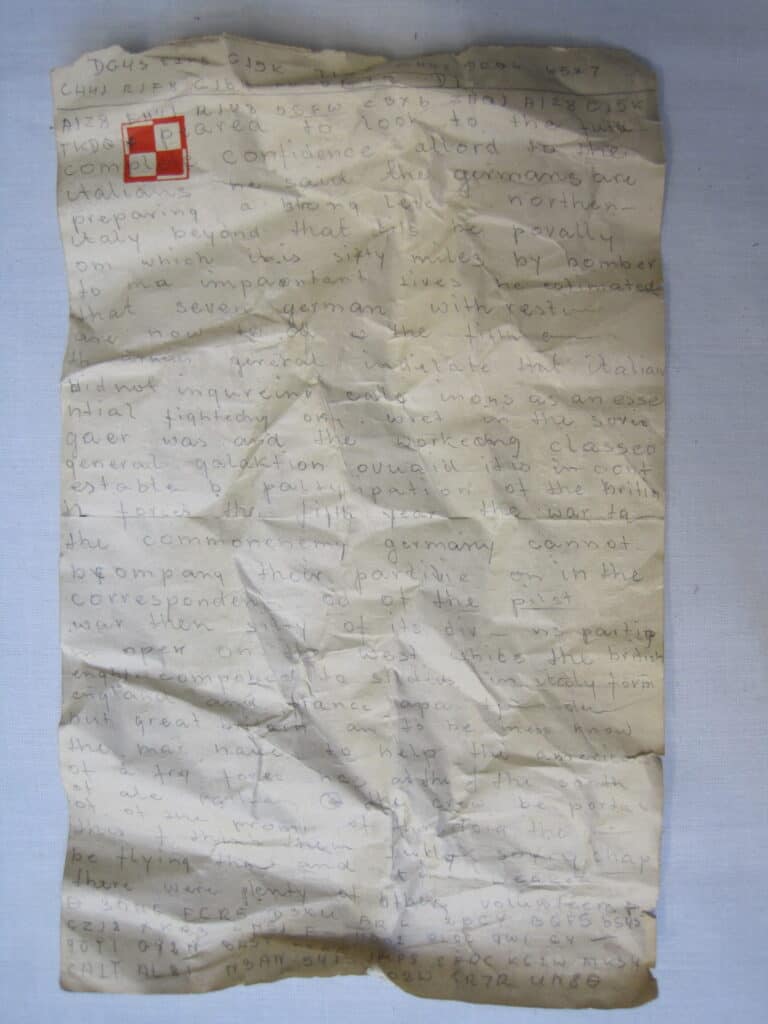
Document 3 — An English-Language Account of the War
Document 3 differs from the others because much of it appears to be written in English. References appear to concern Germany, Italy, Britain and the wider war, although the handwriting makes a reliable transcription difficult.
We have included our original working transcription below, but it should not be regarded as a verified transcript.
Provisional Transcription:
“…to look to the full complete confidence afford to the Italians. He said the Germans are preparing a strong (?) northern Italy beyond that (?) be (?) on which it is sixty miles by bomber to (?) … he estimated that seven German with rest? are now (??? … ???) that Italian did not (???) as an essential (???) … (???) forces the fifth year. The war … the common enemy Germany cannot (???) on in the correspondence …
open on the west while the British … in Italy … England and France …
…and Great Britain am to be mess know .. have to help the American …
…there were plenty of other volunteers…”
Document 4 — Electrical Diagram and Coded Text
The final document combines what appears to be an electrical or communications diagram with another layer of coded or abbreviated text.
Because RAF Halton specialized in technical training—and because Karczmarczyk is recorded as a wireless operator—there is a tempting possibility that the document relates to radio or electrical instruction. There is not yet enough evidence, however, to make that connection confidently.
Research question: Can anyone familiar with wartime RAF electrical, radio or signals training identify the circuit or notation shown here?

Document provenance: Images were supplied to The Places Where We Go by Francis Hanford of the Trenchard Museum in 2021. The recovered material was retained by the RAF Halton Archive for historical research.
What We Know—and What Remains Uncertain
What we can establish
- The documents were recovered from material inside an old partition wall at RAF Halton.
- They appear to date from the wartime period.
- At least some of the material is Polish.
- Document 2 carries the date January 25, 1944.
- Bolesław Karczmarczyk was a Polish RAF airman with service number 705346 and was trained/employed as a wireless operator.
- The documents were retained by the RAF Halton Archive.
What we cannot yet establish
- Whether all four documents were written by the same person.
- Whether Bolesław Karczmarczyk definitely wrote Document 2.
- Whether Document 1 represents an actual cipher or merely a training exercise.
- The complete meaning of the Polish text.
- The author of Document 3.
- The exact purpose of the electrical diagram in Document 4.
- Why these particular papers ended up inside the wall.
Can You Help Identify or Translate These Documents?
More than eight decades after these papers were written, several questions remain unanswered.
We would particularly appreciate hearing from readers with experience in:
- reading handwritten Polish from the 1940s;
- Polish military terminology;
- RAF technical or apprentice training;
- wartime radio and wireless communications;
- electrical engineering;
- signals, codes or cipher systems; or
- the history of Polish personnel serving with the RAF.
If you can contribute, please email comments@theplaceswherewego.com. When writing, please identify the document number and, where possible, the particular line, word, symbol or diagram you are interpreting. We would also appreciate knowing what led you to your conclusion.
Useful findings may be incorporated into future updates to this article and shared with the RAF Halton historical community.
Sources and Further Research
Trenchard Museum / RAF Halton Archive
The Trenchard Museum at RAF Halton preserves and shares the history of RAF Halton, including its long association with technical training and the famous aircraft apprentice program. Its collections, exhibits, and archive provide valuable insight into the people who trained and served at Halton, including Polish personnel who were based there during World War II. Note: We understand RAF Halton, including the museum, may be closing by 2030.
Krzystek’s List – Bolesław Karczmarczyk
Krzystek’s List is an online database documenting Polish Air Force personnel who served alongside the Royal Air Force during World War II. It is an especially useful research resource for tracing individual service members, with entries that may include RAF service numbers, ranks, trades, birth details, and known unit assignments.
Eugene Borysiuk – Polish Apprentices at RAF Halton
Our article is available with a letter authored by Eugene Borysiuk.
Polish Forces at RAF Halton
Related information is archived on our website here: Polish Forces at RAF Halton
Visit the Trenchard Museum and RAF Halton Archive
The documents featured in this article came to us through the historical work of the Trenchard Museum and RAF Halton Archive. Travelers interested in RAF history can also visit the museum at RAF Halton near Wendover.
As of our September 2026 review, the Trenchard Museum lists public opening hours of Wednesdays and the second Saturday of each month from 10:00 a.m. to 4:00 p.m. Because the museum is located on an active RAF station, visitors must pre-book with at least three days’ notice. The Archive separately lists Wednesday and Thursday opening hours from 10:00 a.m. to 3:30 p.m. Always confirm current arrangements before traveling.
For our firsthand experience, read our guide to visiting the Trenchard Museum at RAF Halton.
Planning a Visit to RAF Halton?
Need a place to stay near RAF Halton? Search hotels in Wendover and the surrounding Buckinghamshire area.
#rafhalton
Further Reading About RAF Halton and Polish Wartime History
A Question of Honor: The Kościuszko Squadron: Forgotten Heroes of World War II
Halton Boys: True Tales from Pilots and Ground Crew Proud to be Called ‘Trenchard Brats’
Continue Exploring Polish History at RAF Halton
Polish Aircraft Apprentices of RAF Halton
Apprentice Technical Training at RAF Halton
Eugene Borysiuk: Polish Apprentices at RAF Halton
Visiting the Trenchard Museum at RAF Halton
Walking in the Footsteps of Bolesław Dobrucki (my dad)
Top 10 Polish History Sites to Explore in London
