
How Rising Fuel Prices Impact Travel Costs: From RVs to Flights and Cruises
Planning a vacation involves more than finding affordable hotels, booking attractions, and choosing where to eat. Transportation can represent a significant portion of your travel budget, and changing fuel prices can make that expense surprisingly unpredictable.
When gasoline or diesel prices rise, the impact extends far beyond the gas station. RV travelers may face hundreds of dollars in additional expenses, airlines can experience higher operating costs, motorcoach companies may introduce fuel surcharges, and cruise operators must account for the energy required to power their ships.
Even travelers who never drive during their vacation can feel the effects.
Understanding how rising fuel prices impact travel costs can help you develop a more realistic vacation budget, whether you’re planning a cross-country road trip, an RV adventure, a guided tour, or an international getaway.
Let’s explore why diesel prices matter so much to the travel industry, how different transportation methods are affected, and where travelers may encounter unexpected expenses.
The Places Where We Go contains affiliate links and is a member of the Amazon Services LLC Associates Program. As an Amazon Associate, we earn from qualifying purchases at no extra cost to you when you purchase using one of these Amazon links. Read our disclaimer and privacy policy for more information.
Listen to Our Podcast: How Rising Fuel Prices Impact Travel Costs
Prefer listening? In this episode of The Places Where We Go, Art explores how changing fuel prices—particularly rising diesel costs—can affect everything from RV road trips and motorcoach tours to airline tickets, passenger trains, and cruises. We’ll examine real-world cost examples, explain where fuel-related expenses can show up in your vacation budget, and discuss why transportation costs deserve a closer look when planning your next trip.
Where to Check Current Fuel Prices
Fuel prices change frequently and vary by location. For the latest figures, consult these regularly updated sources:
- AAA Gas Prices — National and state gasoline and diesel averages.
- U.S. Energy Information Administration — Weekly retail gasoline and diesel price data.
Why Fuel Prices Have Such a Far-Reaching Impact on Travel
Fuel is a fundamental expense in transporting people from one destination to another.
Every vehicle requires energy, whether that comes from gasoline, diesel, jet fuel, marine fuel, or electricity.
When energy costs rise, transportation providers face a choice: absorb the extra expense, raise prices, add surcharges, or adjust operations.
These decisions can affect everything from the cost of a motorcoach tour to the availability of airline flights.
However, the relationship between fuel prices and travel costs isn’t always immediate or straightforward.
A traveler driving a personal vehicle experiences higher fuel prices immediately at the pump. An airline passenger, by contrast, might not see higher ticket prices until an airline adjusts its fares.
Some companies purchase fuel in advance or use financial arrangements that reduce their exposure to short-term price fluctuations. Others may be more directly affected.
As a result, rising fuel prices can affect travel expenses in several ways, and not all transportation methods respond equally.
Why Diesel Prices Matter Beyond Diesel-Powered Vehicles
Diesel deserves particular attention because it powers many vehicles involved in transportation and tourism.
According to the U.S. Energy Information Administration, diesel powers trucks, buses, trains, boats, and other heavy-duty transportation applications.
That means diesel price increases can affect travelers who never personally purchase a gallon of diesel.
For example, a guided tour company operating diesel motorcoaches may experience higher expenses. A passenger rail operator using diesel locomotives can face increased operating costs. Tourism businesses that rely on diesel-powered transportation may also experience additional financial pressure.
However, diesel is not the fuel used by every transportation provider. Most commercial aircraft use jet fuel, while cruise ships may use various marine fuels or liquefied natural gas.
The broader issue is that changes in energy markets can affect several transportation fuels simultaneously, even though their prices do not necessarily move together.
The takeaway: Diesel prices can be an important indicator of transportation cost pressures, but they should not be treated as a direct measure of every travel industry’s fuel expenses.
How Rising Fuel Prices Affect RV Travel
RV travel is one of the clearest examples of how fuel price increases can directly affect a vacation budget.
Unlike travelers purchasing airline or train tickets, RV owners typically pay their transportation fuel expenses directly.
Whether you’re driving a diesel motorhome, towing a travel trailer with a pickup truck, or operating a gasoline-powered RV, fuel consumption can become a major expense during a long journey.
Why Diesel Motorhomes and Tow Vehicles Can Be Particularly Vulnerable
Many large motorhomes and heavy-duty pickup trucks run on diesel.
These vehicles can consume substantial amounts of fuel, especially when towing, climbing mountains, or traveling long distances.
When diesel prices rise, even a relatively modest increase per gallon can translate into hundreds of dollars in additional expenses.
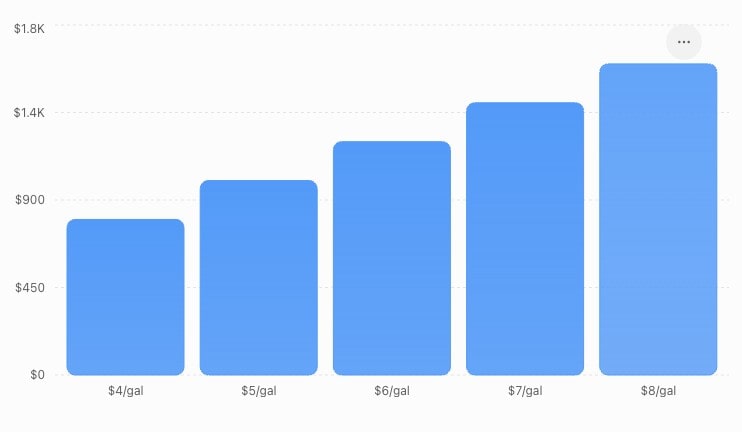
Consider a hypothetical 2,000-mile RV road trip in a vehicle averaging 10 miles per gallon.
What happens when diesel prices rise?
Example: 2,000 miles · 10 mpg · 200 gallons required
Illustrative calculation; not a current fuel-price forecast.
+$800
Additional fuel expense when diesel rises from $4 to $8 per gallon.
At four dollars per gallon, the trip costs $800 in fuel.
At $8 per gallon, the same journey costs $1,600.
That’s an additional $800 without changing the destination, distance, or itinerary.
The actual expense depends on fuel economy, regional fuel prices, driving conditions, and how much fuel you buy along the route.
Nevertheless, the example demonstrates why diesel price increases can be especially consequential for RV travelers.
Gasoline-Powered RVs Face Similar Challenges
Not all RVs use diesel.
Many motorhomes and tow vehicles operate on gasoline, and their owners are exposed to fluctuations in gasoline prices instead.
Although gasoline and diesel prices often respond to similar energy-market conditions, they don’t necessarily increase by the same amount.
A gasoline-powered RV may therefore experience a different cost increase from an otherwise comparable diesel-powered vehicle.
The key variables are the vehicle’s fuel economy, total distance traveled, and the price of its fuel.
For RV travelers, these factors can make transportation one of the most unpredictable components of a vacation budget.
How Higher Gasoline Prices Affect Road Trips and Rental Cars
Traditional road trips are also vulnerable to changing fuel prices, although the impact is generally smaller for fuel-efficient passenger vehicles than for large RVs traveling the same distance.
The difference comes down to fuel consumption.
A passenger car averaging 30 miles per gallon requires considerably less fuel than a large motorhome averaging 10 miles per gallon.
The Cost of a 2,000-Mile Road Trip
Consider a vehicle averaging 25 miles per gallon.
A 2,000-mile journey would require approximately 80 gallons of gasoline.
| Gasoline price | Trip fuel cost |
|---|---|
| $3 per gallon | $240 |
| $4 per gallon | $320 |
| $5 per gallon | $400 |
| $6 per gallon | $480 |
If gasoline increases from $3 to $6 per gallon, the transportation expense doubles.
The additional $240 may not seem as dramatic as the increase a large RV would see, but it still represents money that wasn’t required when fuel prices were lower.
For a family planning a lengthy national parks road trip, the cumulative expense can become meaningful.
Rental Car Travelers Aren’t Immune
Travelers renting vehicles encounter the same fuel-price fluctuations as those driving their own cars.
The rental agreement may set the vehicle cost, but fuel is generally a separate expense.
Someone renting a car for a short weekend may experience a relatively small increase.
A traveler renting an SUV for an extended driving itinerary could encounter a considerably larger fuel bill.
Rental car companies may also face higher operating expenses from vehicle transportation and other fuel-dependent services, although those costs don’t necessarily translate directly into rental rates.
Get Free Weekly Travel Planning Guide
Destination Ideas – Practical Tips – Timely Travel News

How Diesel Prices Affect Bus Travel and Motorcoach Tours
Diesel is an important fuel for the motorcoach industry.
Large buses that transport dozens of passengers can consume significant quantities of fuel, especially on long-distance journeys.
When diesel prices increase, motorcoach operators must account for higher transportation expenses.
According to the U.S. Energy Information Administration, diesel is commonly used in buses and other heavy-duty transportation vehicles.
Why Guided Tours May Become More Expensive
Consider a multi-day guided tour that transports passengers between several cities.
The operator may need to cover hundreds or thousands of miles, with fuel representing one component of the overall operating budget.
If diesel prices increase after the tour was originally priced, the company faces an unexpected expense.
Depending on its contracts and pricing policies, the operator might absorb the increase, raise prices for future departures, or introduce a fuel surcharge.
For travelers, the additional expense may appear as a higher advertised tour price or a separate fee.
Public Buses and Private Motorcoaches Respond Differently
It’s important to distinguish between public transportation and privately operated tours.
Public bus systems may receive government funding, use alternative fuels, or have fares established through formal approval processes.
Private motorcoach companies operate under different financial arrangements and may have greater flexibility to adjust prices.
Consequently, an increase in diesel prices does not automatically produce an equivalent increase in every bus fare.
However, fuel remains an operating expense that can influence transportation costs over time.
How Rising Diesel Prices Affect Passenger Train Travel
Rail travel presents a more complicated relationship between fuel prices and passenger fares.
Some passenger trains operate using electricity, while others rely on diesel-electric locomotives.
The type of train, its route, and the operator’s financial arrangements all influence how fuel costs affect ticket prices.
Diesel-Powered Passenger Trains
Many passenger rail services outside electrified corridors use diesel-powered locomotives.
When diesel prices rise, operating these trains can cost more.
However, passengers don’t necessarily see an immediate fare increase.
Rail operators may purchase fuel through long-term agreements, absorb temporary increases, or adjust fares based on demand and other financial considerations.
Electrified Trains Have Different Energy Costs
Electrified rail systems don’t rely on diesel for propulsion.
Instead, they purchase electricity, whose price depends on the energy sources, utility arrangements, and market conditions involved.
Although electricity prices can also fluctuate, they don’t necessarily follow diesel prices.
For travelers, this means that rising diesel prices may affect some train routes more directly than others.
The important distinction: Higher diesel prices can increase passenger rail operating expenses, but they are not sufficient evidence that train ticket prices will increase by a corresponding amount.
How Rising Fuel Prices Affect Airline Tickets
Air travel is another transportation category where changing fuel prices can have far-reaching consequences.
However, commercial jet aircraft generally use aviation turbine fuel, commonly called jet fuel, rather than the diesel purchased at highway fuel stations.
Both products are derived from petroleum, and their prices can respond to common pressures in global energy markets.
According to the U.S. Energy Information Administration, jet fuel is a major energy source for the transportation sector, distinct from the diesel used by many trucks, buses, and trains.
Why Jet Fuel Prices Matter to Airlines
Airlines purchase enormous quantities of fuel to operate their aircraft.
When jet fuel becomes more expensive, operating flights costs more.
Airlines may respond by adjusting ticket prices, modifying schedules, reducing service on certain routes, or absorbing some of the additional expense.
The precise response depends on several factors, including passenger demand, competition, fuel purchasing arrangements, and the profitability of individual routes.
Higher fuel prices don’t guarantee that every airline ticket will become more expensive.
However, they can create substantial financial pressure across the industry.
How Fuel Surcharges Can Affect Airfare
Some airlines build fuel-related charges into ticket prices.
These may be described as carrier-imposed surcharges or appear under other labels, depending on the airline and itinerary.
A surcharge should not automatically be interpreted as a direct reflection of the airline’s current fuel expense. Airlines establish their own pricing structures, and these charges may remain in place even when fuel prices decline.
For travelers, the most relevant figure is the total ticket price, including mandatory charges.
The U.S. Bureau of Labor Statistics includes applicable fuel surcharges and certain other fees when measuring airline fares in its Consumer Price Index.
Why Families May Feel Airfare Increases More Acutely
Airfare increases can feel especially significant when multiple passengers travel together.
For example, imagine an airline ticket that previously cost $400 and now costs $500.
A couple purchasing two tickets would pay an additional $200.
A family purchasing five tickets would pay an additional $500.
This is a hypothetical example, not a prediction of airfare inflation, but it shows how relatively modest per-ticket increases can become substantial household expenses.
Airline ticket prices depend on many factors beyond fuel, so don’t attribute changes in airfare exclusively to rising energy costs.
How Rising Fuel Prices Affect Cruises and Ferry Travel
Cruise ships require substantial energy to propel their vessels and run onboard systems.
Depending on the ship, that energy may come from marine fuel oil, marine gas oil, liquefied natural gas, or other sources.
The price of diesel at a local gas station therefore does not accurately reflect what every cruise operator pays for fuel.
Nevertheless, changing energy prices can influence the economics of operating a cruise ship.
Why Cruise Lines Are Exposed to Fuel Price Increases
A cruise ship may travel hundreds or thousands of miles during a voyage while simultaneously operating restaurants, entertainment venues, climate-control systems, and other onboard facilities.
Fuel and energy expenses are therefore important operating considerations.
When those expenses increase, cruise lines may experience pressure on profitability.
They may respond by changing future cruise fares, making operational adjustments, or adding fuel-related charges where permitted under their booking terms.
However, higher fuel prices don’t automatically mean that every cruise passenger will face an additional fee.
Understanding Cruise Fuel Surcharges
Some cruise lines include provisions in their booking agreements that allow them to introduce fuel supplements under certain conditions.
These provisions vary by company and may establish specific limits on the amount that can be charged.
For example, consider a hypothetical surcharge of $10 per passenger per day.
For two travelers on a seven-day cruise, that would represent an additional $140.
The example illustrates the potential budget impact of a surcharge, not a claim that every cruise operator currently collects such a fee.
The key point is that the advertised cruise fare may not tell the whole story if the booking agreement allows additional charges.
Ferries and Smaller Passenger Vessels
Ferries can also be sensitive to changing fuel prices, particularly when operating frequent crossings or transporting vehicles.
Some ferry operators use fuel surcharges that change in response to their operating expenses.
Others incorporate fuel costs into their regular fares.
Travelers using ferries as part of a road trip, island vacation, or international itinerary may therefore encounter fuel-related expenses even when they aren’t driving themselves.
The Hidden Impact of Diesel Prices on Other Vacation Expenses
Transportation tickets and fuel purchases are only part of the story.
Diesel is also essential to the movement of goods and supplies that support the tourism industry.
According to the U.S. Energy Information Administration, diesel-powered trucks and trains transport a substantial portion of the products consumed throughout the United States.
When diesel becomes more expensive, delivering goods may cost more.
Those expenses can work their way through the tourism economy.
Hotels and Resorts
Hotels rely on regular deliveries of food, beverages, linens, cleaning supplies, and other products.
Higher freight expenses can increase the cost of obtaining these items.
Some properties may absorb the additional expense, while others may eventually adjust room rates or other charges.
However, hotel pricing also depends heavily on occupancy, seasonality, labor expenses, and local demand.
It would be inaccurate to attribute an increase in hotel rates solely to diesel prices.
Restaurants and Food Costs
Restaurants depend on transportation networks to receive ingredients and supplies.
Higher diesel prices can increase the cost of transporting food, particularly over long distances.
Those expenses may contribute to higher menu prices, although food costs are also influenced by agricultural production, labor, weather, and other factors.
For travelers who eat most of their meals away from home, even modest changes in restaurant prices can affect the total vacation budget.
Tours, Attractions, and Excursions
Tourism businesses often rely on vehicles and transported supplies.
Airport transfer services, sightseeing buses, shuttle operators, and certain adventure-tour companies may be directly exposed to changing fuel prices.
Other attractions may experience indirect increases through deliveries, maintenance, and supplier expenses.
The result is that rising diesel prices can influence expenses beyond the transportation portion of a vacation.
These secondary effects are less predictable, however, and should be considered potential cost pressures rather than guaranteed price increases.
Which Types of Travel Are Most Sensitive to Rising Fuel Prices?
Not every traveler experiences fuel-price increases in the same way.
The most important distinction is whether the traveler purchases fuel directly or pays a transportation company that manages its own fuel expenses.
The following table summarizes how changing fuel prices can affect different travel experiences.
Fuel price impact on different travel modes
General relationships, not a ranking of current fares or predictions of future prices.
| Travel mode | How travelers may be affected |
| Diesel RV | Direct fuel expense; large fuel purchases can magnify increases. |
| Gasoline road trip | Direct expense determined by mileage and fuel economy. |
| Rental car | Fuel purchased during the rental adds to the vehicle cost. |
| Motorcoach tour | Higher operating expenses may affect fares or surcharges. |
| Passenger train | Diesel-powered routes face fuel pressure; fares depend on other factors too. |
| Airplane | Jet fuel costs can influence ticket prices and route decisions. |
| Cruise ship | Marine fuel costs may affect fares or contractual supplements. |
| Ferry | Fuel expenses may appear in fares or separate surcharges. |
Direct Fuel Purchases Create the Most Immediate Impact
Travelers driving their own vehicles encounter changing fuel prices directly.
If diesel rises by $2 per gallon, someone purchasing 200 gallons will spend an additional $400.
There is no uncertainty about whether a transportation company will pass along the expense.
The traveler pays it immediately.
Transportation Companies Can Spread Costs Across Passengers
Airlines, trains, buses, and cruise ships carry multiple passengers.
Fuel expenses are distributed across operations rather than billed to each traveler based on individual fuel consumption.
This can reduce an individual passenger’s direct exposure, but it doesn’t eliminate the possibility of higher ticket prices.
The amount passed along depends on the company’s financial position, competition, contracts, and pricing decisions.
The Biggest Dollar Impact Depends on the Trip
A long-distance diesel RV journey may experience a substantial increase in direct fuel expenses.
A family purchasing several international airline tickets could encounter an even larger total increase if fares rise.
A short train journey might experience little or no noticeable price change.
There is no single transportation mode that always produces the greatest additional expense.
The answer depends on distance, fuel consumption, passenger count, ticket prices, and how much of the operator’s increased costs reach the traveler.
Why Travel Prices Don’t Always Fall When Fuel Prices Decline
One important aspect of fuel-related travel inflation is that transportation prices don’t necessarily move in perfect synchronization with energy costs.
When fuel prices increase rapidly, operators may face immediate financial pressure.
But when prices subsequently decline, ticket prices and surcharges don’t always decrease at the same speed.
There are several reasons for this.
Transportation companies may have purchased fuel in advance, entered into contracts, or established fares months before a trip takes place.
Demand and competition also influence pricing.
An airline operating a popular route during peak vacation season may maintain higher fares even if its fuel costs decline.
Similarly, a cruise line may adjust its prices according to booking demand rather than making changes that precisely mirror energy markets.
Travelers should therefore distinguish between falling fuel prices and falling transportation prices.
The two are related, but they are not interchangeable.
Frequently Asked Questions About Fuel Prices and Travel
Why does diesel cost affect travel if I don’t drive a diesel vehicle?
Diesel powers many buses, trains, trucks, and other vehicles involved in tourism and transportation. When diesel prices rise, companies that depend on these vehicles may experience higher operating costs. Some of those expenses can eventually reach travelers through fares, surcharges, or the prices of tourism-related goods and services.
Do higher diesel prices cause airline tickets to increase?
Not directly. Commercial airlines generally use jet fuel rather than highway diesel. However, diesel and jet fuel prices can respond to similar changes in petroleum markets. Rising jet fuel costs can put upward pressure on airfares, although demand, competition, and other factors also determine ticket prices.
Are diesel RVs more expensive to operate when fuel prices rise?
Diesel RVs become more expensive to fuel when diesel prices increase, assuming the same fuel consumption. The total impact depends on miles traveled, fuel economy, and the price increase. Whether a diesel RV is more expensive than a comparable gasoline RV requires a broader comparison of fuel economy, fuel prices, maintenance, and vehicle costs.
Can cruise lines add fuel surcharges after booking?
Some cruise lines include provisions in their booking agreements allowing fuel supplements under specified conditions. Policies vary, and the existence of a surcharge provision doesn’t mean a charge is currently being collected. Travelers should review the terms applicable to their particular reservation.
Do train ticket prices increase when diesel prices rise?
Not necessarily. Diesel-powered trains may experience higher operating costs, but ticket prices depend on numerous factors. Electrified trains have different energy requirements, and rail operators may use purchasing agreements, subsidies, or pricing structures that affect how quickly fuel costs influence fares.
Why do travel prices sometimes stay high after fuel prices fall?
Transportation prices reflect more than fuel costs. Passenger demand, labor expenses, competition, contracts, and previously purchased fuel can all influence pricing. Consequently, a decline in fuel prices doesn’t guarantee an immediate reduction in fares.
Final Thoughts: Fuel Prices Deserve a Place in Every Travel Budget
Rising fuel prices can affect nearly every aspect of travel, from the obvious expense of filling an RV’s fuel tank to the less visible costs built into airline tickets, guided tours, cruises, and other vacation experiences.
Diesel is especially important because of its widespread use throughout transportation and the supply chain. Its influence extends well beyond travelers who personally drive diesel-powered vehicles.
However, higher operating costs don’t always translate into immediate or proportional increases in passenger fares.
The financial impact depends on the type of transportation, the distance traveled, the amount of fuel consumed, and the pricing decisions made by transportation providers.
For travelers, the lesson is simple: transportation costs deserve careful attention when estimating a vacation’s total price.
Understanding how changing fuel prices influence travel is the first step toward building a realistic vacation budget.
And whether you’re planning a weekend road trip, a cross-country RV adventure, or an international vacation, that awareness can help you avoid unexpected surprises.
Thanks for reading our article about the impact of fuel cost on travel!
Art & Julie – The Places Where We Go
