
Is Christ Cathedral in Orange County Worth Visiting? Here Is What You Will Find
You’ve probably seen photos of Southern California’s famous Crystal Cathedral. Its enormous glass walls and distinctive architecture made it one of America’s most recognizable churches.
But have you ever wondered what the building looks like today?
Now known as Christ Cathedral, this remarkable landmark in Garden Grove, California, has undergone an extraordinary transformation. What was once a Protestant megachurch is now the spiritual home of the Roman Catholic Diocese of Orange.
On our first visit, we discovered there’s much more here than the famous glass building. From a magnificent sanctuary and extraordinary pipe organs to an intimate Byzantine-inspired chapel beneath the cathedral, the property offers plenty to explore.
We also experienced The Shroud of Turin: An Immersive Experience, an exhibition combining cinematic presentations with displays exploring the history, science, and enduring mystery of one of Christianity’s most debated artifacts.
Whether you’re interested in architecture, history, Catholic pilgrimage, music, or simply discovering unusual places in Southern California, we think Christ Cathedral deserves a place on your travel list.
Here’s what we discovered during our visit, along with our recommendations for planning your own experience.
The Places Where We Go contains affiliate links and is a member of the Amazon Services LLC Associates Program. As an Amazon Associate, we earn from qualifying purchases at no extra cost to you when you purchase using one of these Amazon links. Read our disclaimer and privacy policy for more information.
Christ Cathedral at a Glance
| Detail | Visitor Information |
|---|---|
| Location | Garden Grove, Orange County, California |
| Address | 13280 Chapman Avenue, Garden Grove, CA 92840 |
| Former name | Crystal Cathedral |
| Current role | Cathedral of the Roman Catholic Diocese of Orange |
| Original architects | Philip Johnson and John Burgee |
| Cathedral dedicated | July 17, 2019 |
| General campus hours | Daily, 6 AM–10 PM; buildings close earlier |
| Guided tours | Free; donations appreciated |
| Tour duration | Approximately 60–90 minutes |
| Suggested visit duration | 1.5–2 hours for the cathedral and grounds; longer with the Shroud experience |
| Shroud exhibition | Separately ticketed; allow at least 90 minutes |
| Parking | Free parking available on campus |
| Official website | Christ Cathedral |
Information reviewed October 2026. Access to individual buildings and chapels may vary around religious services, special events, and maintenance.
Is Christ Cathedral Worth Visiting?
Yes. We recommend visiting Christ Cathedral, particularly if you enjoy architecture, sacred art, historic churches, or culturally significant places.
One of Christ Cathedral’s most interesting features is the contrast between its different spaces.
The main sanctuary is contemporary, with sweeping glass walls, impressive architectural details, and an extraordinary pipe organ. Downstairs, St. Callistus Chapel offers a completely different experience, with colorful mosaics, traditional Christian symbolism, and richly detailed religious artwork.
Add the outdoor shrines and sculptures, and there’s plenty to see without ever leaving the property.
The campus is also convenient for visitors staying in the Anaheim area, making it a worthwhile addition to a Southern California itinerary.
For us, the combination of architectural history, remarkable artwork, and the Shroud of Turin exhibition made this much more than a quick sightseeing stop.
⬇️ Watch Our Christ Cathedral Visit on YouTube ⬇️
Come along as we explore the cathedral, discover St. Callistus Chapel, and share our firsthand experience at the Shroud of Turin exhibition.
Our video includes footage from across the campus, along with our impressions from the visit.
From Crystal Cathedral to Christ Cathedral: A Remarkable Transformation
Before discussing what to see, it’s worth understanding the unusual history of this Orange County landmark.
The Crystal Cathedral Years
The building was originally constructed for the congregation led by Reverend Robert Schuller, whose television program, Hour of Power, brought the Crystal Cathedral into homes around the world.
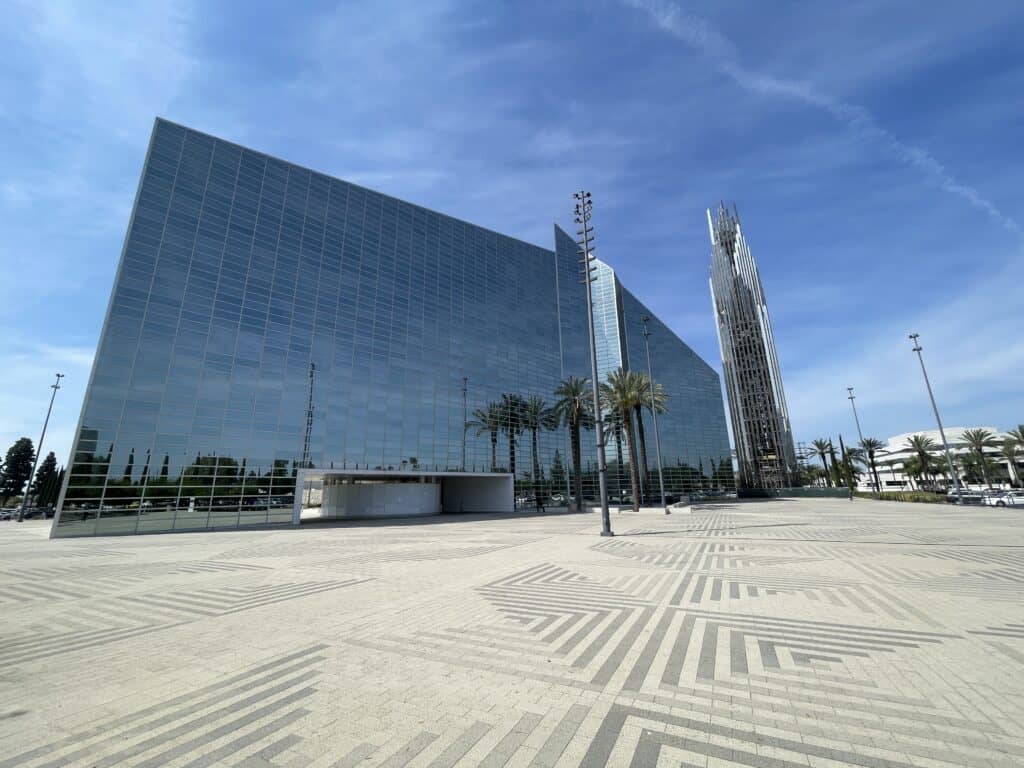
Architects Philip Johnson and John Burgee designed the Crystal Cathedral, which opened in 1980. Its architecture was unlike that of a traditional church. Instead of stone walls and stained-glass windows, the building featured thousands of reflective glass panes supported by an enormous steel framework.
From the outside, it resembles a giant glass sculpture. It became a Southern California landmark and an internationally recognized example of modern religious architecture.
How the Crystal Cathedral Became a Catholic Church
After Crystal Cathedral Ministries faced financial difficulties, the Roman Catholic Diocese of Orange acquired the property in 2012. The transformation into a Catholic cathedral required more than simply changing the building’s name.
An extensive renovation redesigned the interior to accommodate Catholic worship while preserving the recognizable exterior architecture. Changes included new sacred furnishings, an altar, decorative artwork, and architectural improvements to control heat, sunlight, and acoustics. The renovation also incorporated thousands of specially designed interior quatrefoil panels to filter sunlight through the enormous glass walls.
On July 17, 2019, the building was formally dedicated as Christ Cathedral. Today, it continues to serve as a place of worship while also welcoming visitors interested in its unusual history and architecture.
What to See at Christ Cathedral
1. The Spectacular Glass Exterior and Bell Tower
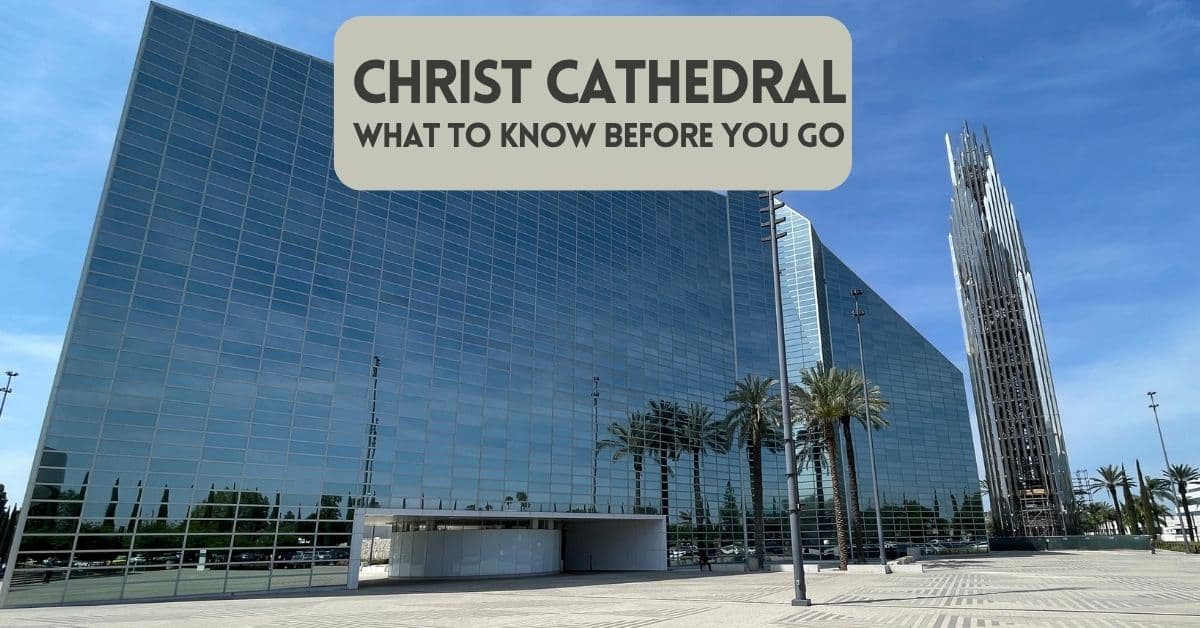
Our visit began outside, where the cathedral’s enormous glass façade immediately commands attention. The reflective, blue-tinted glass, angular rooflines, and sheer scale make it hard to mistake Christ Cathedral for an ordinary church.
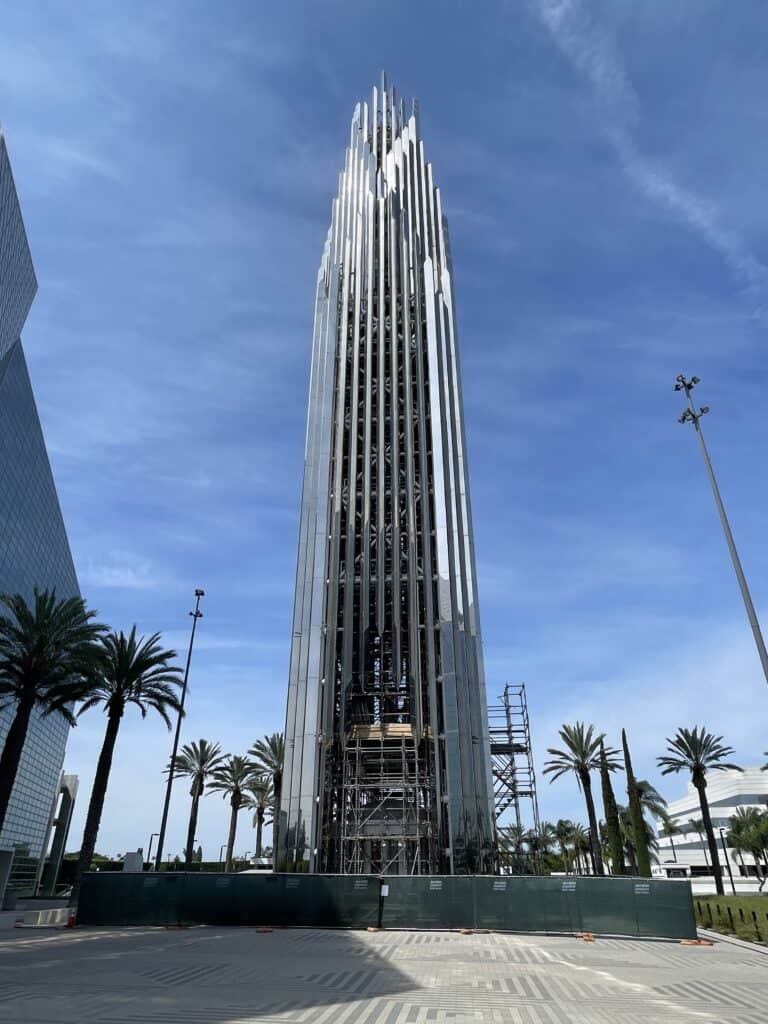
From different angles, the architecture almost looks different as the glass reflects the surrounding palm trees and Southern California sky. Another prominent feature is the striking steel bell tower, known as the Crean Tower, which rises above the surrounding plaza.
Take a few moments to walk around the cathedral before heading inside.
Our tip: The exterior is one of the best places to appreciate the building’s unusual geometry. Step back from the entrance for photographs that capture both the cathedral and its distinctive tower.
2. Our Lady of La Vang Shrine
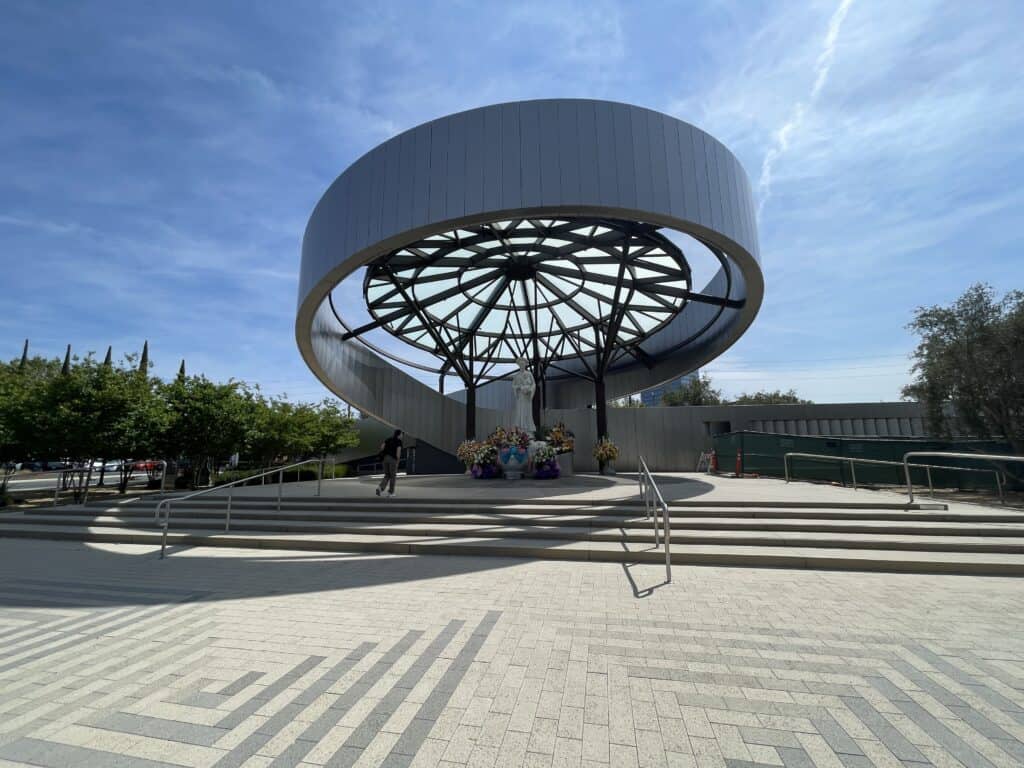
One of our first stops was the impressive Our Lady of La Vang Shrine, an important religious landmark on the cathedral grounds. Dedicated in July 2021, the shrine honors the Virgin Mary and has particular significance for Vietnamese Catholics.
Its history is connected to a reported Marian apparition in Vietnam in 1798, during a period when Catholics faced religious persecution. According to tradition, the Virgin Mary appeared to believers seeking refuge in a remote forest, offering hope and encouragement.
The shrine’s centerpiece is a beautiful 12-foot-tall statue of Mary holding the infant Jesus, carved from Italian marble. An elaborate contemporary canopy surrounds the statue, recalling the forest associated with the apparition.
Beyond its religious significance, the shrine also recognizes the history and contributions of Orange County’s Vietnamese Catholic community. This is a worthwhile stop even for visitors who are primarily interested in architecture or cultural history.
For more background, visit the official Our Lady of La Vang Shrine website.
3. The Holy Oils and Baptismal Font
As we entered the cathedral, we encountered several features connected to Catholic sacramental traditions. Among them are the three holy oils used in the sacramental life of the Church:
- Oil of Catechumens: Used to prepare catechumens for baptism.
- Sacred Chrism: Used in baptism, confirmation, and ordination, as well as certain church consecrations.
- Oil of the Sick: Used in the sacrament of Anointing of the Sick.
For visitors unfamiliar with Catholic traditions, these displays offer insight into the cathedral’s religious life. We also admired the baptismal area, which includes a striking cross-shaped baptismal font.
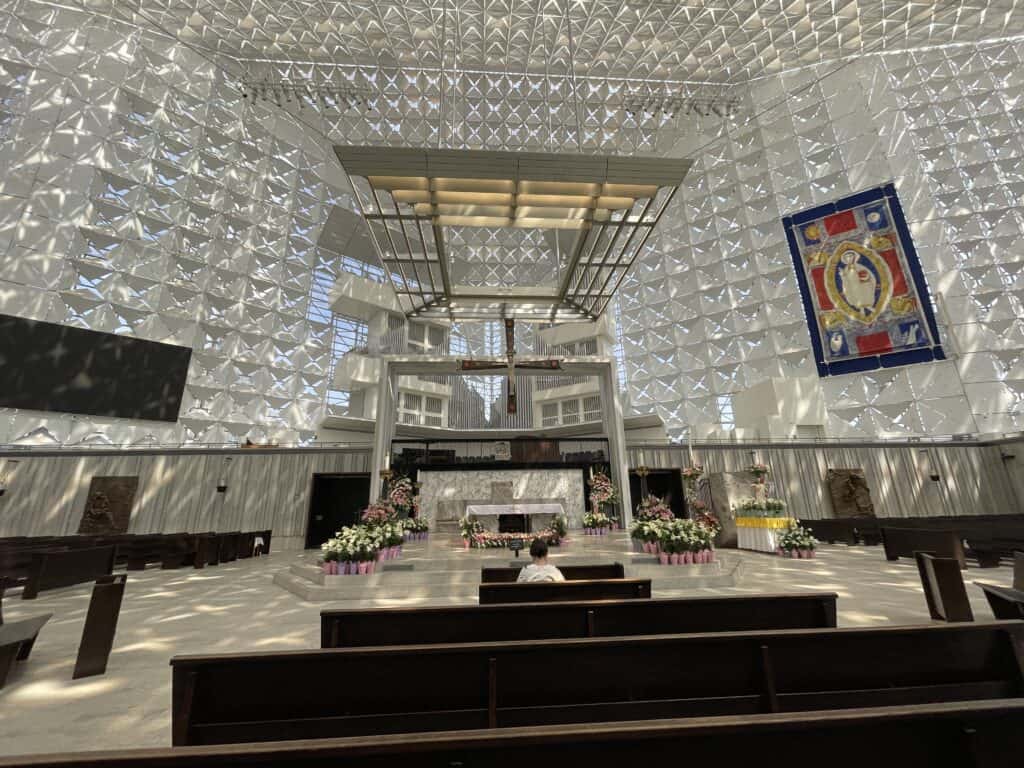
4. Inside the Magnificent Main Sanctuary
Stepping into the main sanctuary is a highlight of a visit to Christ Cathedral. The first impression is one of tremendous openness.
The cathedral’s glass walls and soaring ceiling create a sense of space that photographs alone can’t convey. The sanctuary is bright and contemporary, a striking contrast to the architecture commonly associated with historic Catholic cathedrals.
Looking toward the altar, visitors will notice the impressive suspended crucifix, the Crux Gemmata. This enormous cross serves as the sanctuary’s visual focal point.
The cathedral’s interior design blends traditional Christian elements with an unmistakably modern architectural setting. The result is unusual and memorable. We recommend taking time to look around rather than rushing through the sanctuary. You’ll discover interesting details in the ceiling, lighting, altar area, artwork, and surrounding architectural elements.
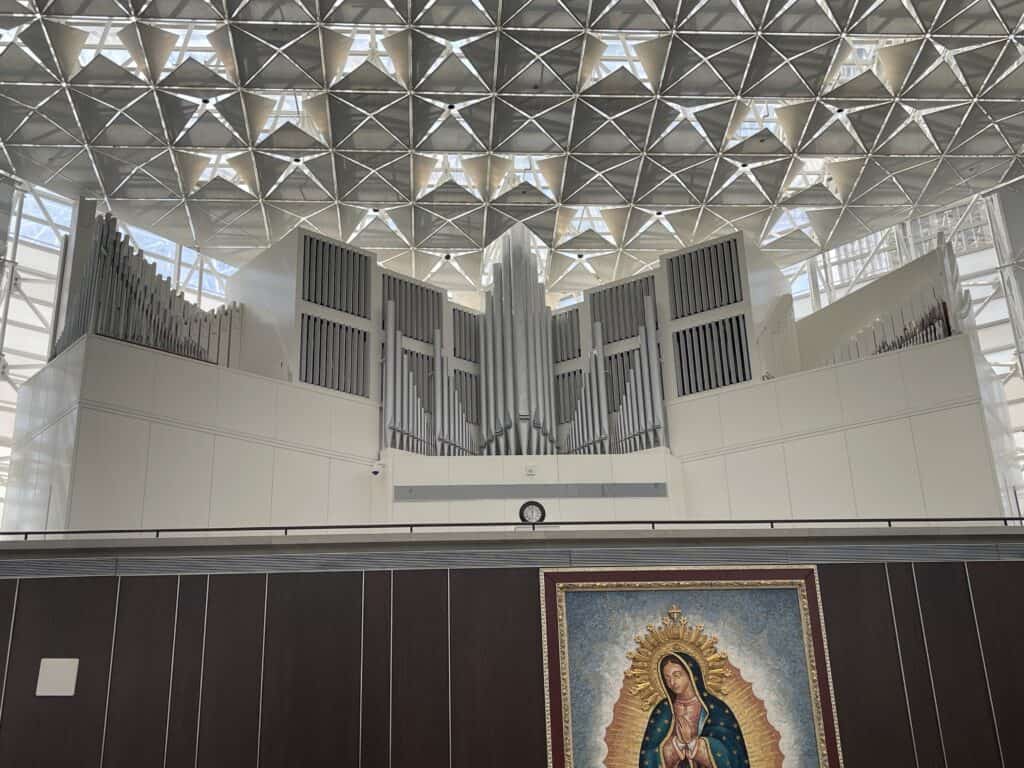
5. The Hazel Wright Organ: A Treasure for Music Lovers
One of Christ Cathedral’s most extraordinary features is the Hazel Wright Organ. For anyone who appreciates music, particularly pipe organs, this instrument is an attraction in its own right.
Named for its principal benefactor, Hazel Wright, the organ was originally installed during the Crystal Cathedral era. With more than 17,000 pipes, it ranks among the world’s largest pipe organs.
Unlike many traditional church organs, where most of the pipes are concentrated in one area, the Hazel Wright Organ has divisions distributed around the cathedral. This arrangement creates a remarkable musical environment, with sound potentially coming from different directions throughout the building.
After the building became Christ Cathedral, the organ underwent an extensive restoration in Italy. The restored instrument was formally celebrated in 2022.
As a musical household, we especially appreciate impressive pipe organs, and the Hazel Wright Organ is certainly one of the most notable instruments we’ve encountered on our travels. Even when the instrument isn’t being played, its extensive ranks of pipes make an architectural statement.
Music lover’s tip: Check the Christ Cathedral music program for concerts and other opportunities to hear this magnificent instrument in performance. Seeing it is impressive, but hearing it would add another dimension to a visit.
6. Sacred Art and Sculptural Reliefs
Although the architecture naturally receives much of the attention, Christ Cathedral also contains beautiful religious artworks. During our visit, we took time to examine several three-dimensional sculptural reliefs. These artworks depict scenes from Christian scripture and traditions, including the Passion of Christ. The artwork connects the cathedral’s contemporary setting to the much older artistic traditions of the Catholic Church.
For travelers who enjoy historic churches, this is a familiar pleasure: there’s often far more to see than the overall architecture. Small artistic details frequently reveal stories and symbolism that might otherwise go unnoticed.
We recommend walking slowly through the sanctuary and allowing time to appreciate these individual elements.
St. Callistus Chapel: A Beautiful Surprise Beneath the Cathedral
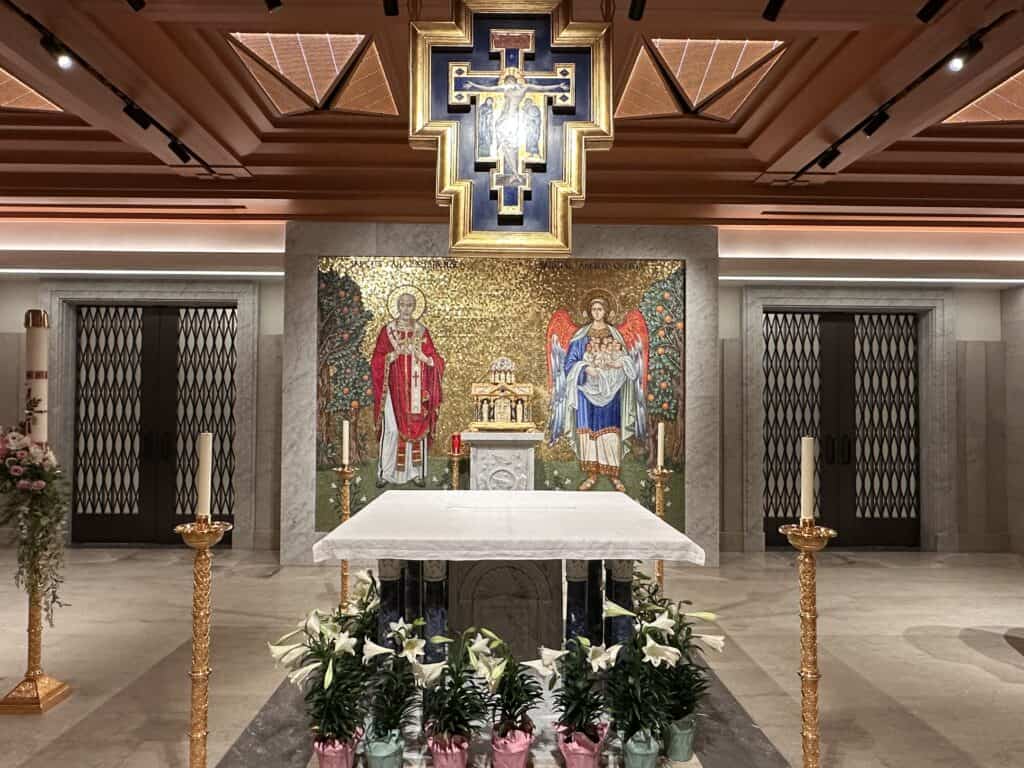
One highlight of our visit came when we went downstairs. Beneath the enormous contemporary sanctuary is St. Callistus Chapel, a much more intimate worship space with an entirely different architectural character.
Dedicated in October 2024, this chapel was designed in a Romano-Byzantine style. Where the main cathedral emphasizes glass, light, and contemporary architectural forms, St. Callistus Chapel features warm tones, traditional religious imagery, colorful mosaics, and intricate craftsmanship. The contrast is remarkable.
Why Is It Called St. Callistus Chapel?
The chapel honors the former St. Callistus Parish in Garden Grove. Founded in 1961, the parish closed in 2013 as part of the transition involving the former Crystal Cathedral property. Its congregation became part of the new Christ Cathedral community.
Naming the chapel after St. Callistus preserves an important connection to that earlier parish and its history.
The Beautiful Altar Mosaic
The magnificent mosaic behind the altar immediately caught our attention.
Against a brilliant gold background, the artwork depicts Pope St. Callistus I, who served as pope in the early third century, and a guardian angel holding figures representing the faithful of the former St. Callistus Parish.
The mosaic also incorporates imagery with local significance. Look closely, and you’ll notice orange trees, referencing Orange County’s agricultural heritage. Marigolds represent hope, while Easter lilies symbolize life. Another interesting detail is the eight-pointed star symbolism near the tabernacle, inspired by Byzantine Christian artistic traditions. The eighth day represents the Resurrection and new creation.
These details make the mosaic more than a beautiful decoration. It’s an artwork filled with historical and religious meaning.
The Marble Altar and Its Symbols
The chapel’s altar is made of Italian marble that matches the material used for the main cathedral’s altar.
Five crosses incorporated into the altar represent Christ’s five wounds during the Crucifixion. Its pedestal includes other traditional Christian symbols. The Chi Rho, an ancient monogram representing Christ, appears on the front. Other decorations include a fish, an anchor representing hope, and scallop shells associated with baptism.
The amount of symbolism packed into such a small space is extraordinary.
The Ornate Tabernacle
Another striking feature is the richly detailed tabernacle situated behind the altar. The tabernacle is the sacred receptacle that reserves the consecrated Eucharist.
This example was inspired by masterpieces of medieval European goldsmithing, especially religious artworks from 12th-century Germany. It was crafted using gold-plated brass, copper, and colorful enamel.
The architectural design recalls historic Christian shrines and even draws on the Church of the Holy Sepulcher in Jerusalem. Its miniature columns, figures, decorative panels, and elaborate dome reward close observation.
The chapel’s sacred artwork was created by Talleres de Arte Granda, a religious art workshop based in Madrid, Spain.
A Hand-Painted Crucifix from Assisi, Italy
Above the mosaic is a painted wooden crucifix handmade in Assisi, Italy. Its design was inspired by the medieval Italian painter Cimabue.
The brilliant blue background is particularly striking and echoes other blue elements incorporated into the chapel’s altar area.
The crucifix came from the personal sacred art collection of Monsignor Arthur Holquin, who donated it to the chapel. It’s another example of how the chapel brings together artistic influences from different periods and regions of Christian history.
A Relic of Pope St. Callistus I
The chapel also contains a reliquary holding a relic associated with Pope St. Callistus I. According to the chapel’s interpretive information, the relic was brought from Rome to the United States and was previously located at the original St. Callistus Parish. Its presence creates another connection between the former parish and the new chapel.
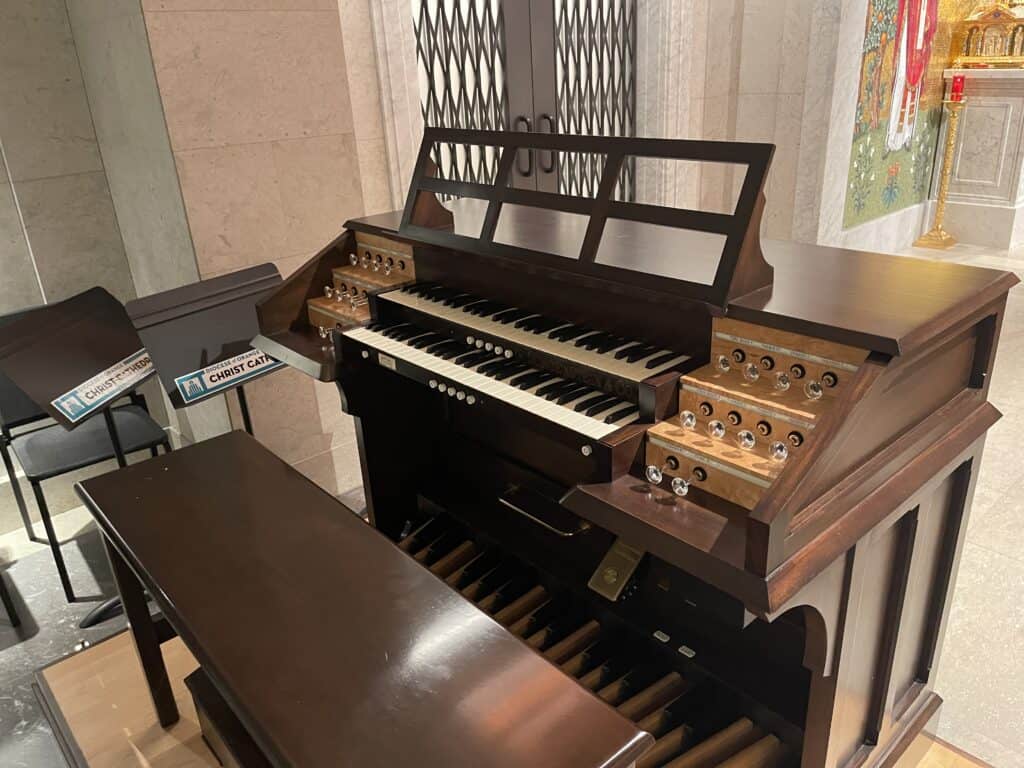
A Second Pipe Organ
Christ Cathedral’s famous Hazel Wright Organ isn’t the only pipe organ worth seeing. St. Callistus Chapel also has its own smaller instrument, built by Schoenstein & Company of Benicia, California.
Originally built for a private residence, the organ was adapted for chapel use. It contains eight ranks and 405 pipes. One interesting feature is its two-manual console, with crystal drawknobs that reference the campus’s earlier identity as the Crystal Cathedral.
For music enthusiasts, it’s an interesting contrast to the much larger Hazel Wright Organ upstairs.
Bishops’ Crypts and Columbaria
The lower level also contains the Bishops’ Crypts, designed as a final resting place for generations of bishops of the Diocese of Orange. The chapel complex includes 40 bishops’ crypts and nearby columbaria with niches for the faithful’s cremated remains.
Visitors should treat these areas as sacred places of remembrance, not ordinary tourist exhibits.
The lower-level complex also features additional religious artwork, including a mosaic depicting Christ as the Good Shepherd.
Our recommendation: Don’t skip St. Callistus Chapel. Its artwork, historical connections, and intimate atmosphere make it one of the cathedral’s most rewarding spaces to explore.
Exploring the Outdoor Grounds and Religious Sculptures
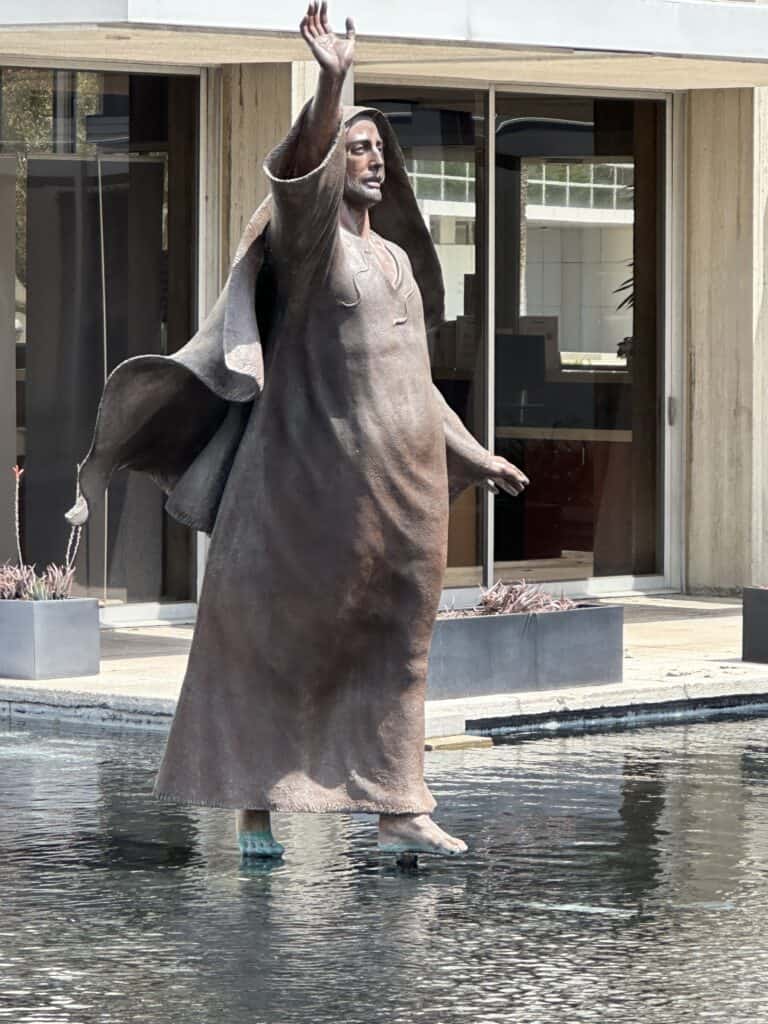
After visiting the cathedral’s lower level, we continued exploring the grounds. The campus includes several outdoor areas, sculptures, and places for reflection. Among the most memorable is a bronze sculpture depicting Jesus walking on water.
Peace Be Still Sculpture
Artist Dallas Anderson created this sculpture, known as Peace Be Still. Set in a reflecting pool, the statue shows Jesus walking on water with one arm raised. It’s one of the artworks preserved from Crystal Cathedral’s history.
The surrounding water creates an interesting visual effect, making it seem like Jesus is walking across the pool. Take a few moments to admire the sculpture and photograph it from different angles.
Christ Cathedral Gift Shop
We also stopped at the cathedral gift shop. Visitors will find religious books, devotional objects, gifts, and souvenirs connected to the Catholic faith and cathedral. This can be a worthwhile stop for anyone looking for a keepsake or gift.
The Shroud of Turin: An Immersive Experience
One of the main reasons we wanted to spend more time on the Christ Cathedral campus was the chance to attend The Shroud of Turin: An Immersive Experience. Located in the Richard H. Pickup Cultural Center, this separately ticketed attraction opened in November 2025.
The exhibition covers approximately 10,000 square feet and combines immersive theater presentations with museum-style displays about the Shroud of Turin.
We found it fascinating, and visitors interested in Christianity, religious history, or scientific mysteries should consider it as part of a cathedral visit.
What Is the Shroud of Turin?
The Shroud of Turin is a historic linen cloth bearing the faint image of a man who appears to have suffered injuries consistent with crucifixion. Some Christians believe it may have been Jesus Christ’s burial cloth. However, its origins and authenticity remain subjects of historical and scientific debate.
Radiocarbon testing performed in 1988 dated the cloth to approximately AD 1260–1390. Some researchers have questioned those results, although the medieval dating remains an important part of the scientific evidence.
A 2026 scientific examination of fragments from the original radiocarbon sample found no evidence of contamination in the pieces studied and supported the sample’s integrity.
The actual Shroud is preserved in Turin, Italy. The Orange County exhibition features detailed reproductions rather than the original cloth.
The Immersive Theater Experience
Our visit began with an immersive film presentation. Rather than watching a conventional movie on a single screen, visitors experience a sequence of presentations using surrounding imagery and sound. The production explores events associated with the life, Passion, and Resurrection of Jesus.
We weren’t permitted to film the movie portion of the experience, but we highly recommend keeping it in mind when planning a visit. The immersive presentation sets the historical and religious context before visitors enter the exhibition galleries.
The Museum and Scientific Exhibits
After the theatrical presentation, we explored a series of museum displays examining the Shroud from different perspectives.
Some of the subjects that interested us included:
- The history of the Shroud and its preservation.
- Scientific research undertaken to examine the cloth.
- Attempts to understand how the image may have formed.
- Radiocarbon dating and the debate surrounding the results.
- Three-dimensional characteristics associated with the Shroud’s image.
- Studies of stains and other physical characteristics of the cloth.
- Historical and religious interpretations of the Shroud.
One important part of the story involves the Shroud of Turin Research Project, usually abbreviated STURP. In 1978, a multidisciplinary team of researchers performed an extensive scientific examination of the Shroud. The exhibition discusses their work and the questions it raised.
The Sudarium of Oviedo
Another interesting display explores the Sudarium of Oviedo, a separate historic cloth preserved in Spain. Christian tradition associates the Sudarium with Jesus’ burial.
Researchers have investigated possible links between the Sudarium and the Shroud of Turin, though they have not scientifically established claims that they covered the same person.
We appreciated having the opportunity to learn about this lesser-known artifact alongside the more famous Shroud.
Seeing a Full-Sized Reproduction of the Shroud
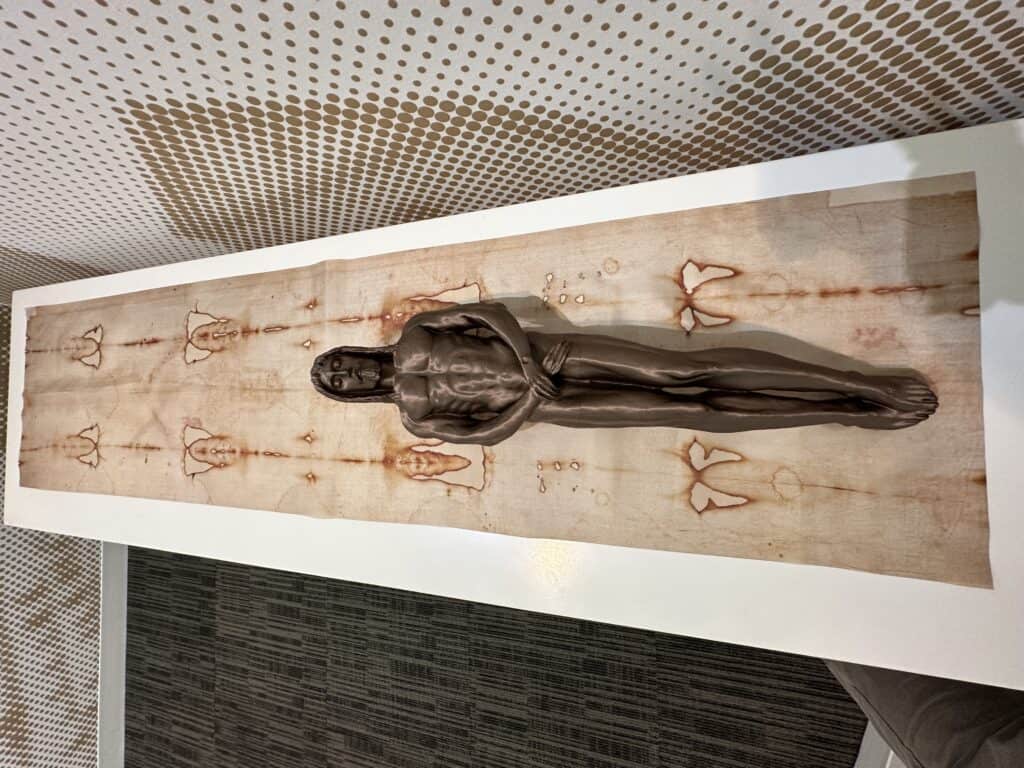
One of the exhibition’s most memorable features is a full-sized reproduction of the Shroud. Seeing the image at its actual scale offers a completely different perspective than looking at photographs in books or online.
The exhibition also includes sculptures and modern interpretations that explore how the figure on the cloth might have appeared. Among them is an AI-assisted artistic depiction linked to analysis of the Shroud image. View such reconstructions as interpretations rather than verified portraits of Jesus.
Regardless of your personal views about the Shroud’s authenticity, the exhibition offers an unusual combination of religious art, historical storytelling, and scientific discussion.
Our verdict: We recommend adding the Shroud of Turin Immersive Experience to your itinerary if you’re interested in the subject. Allow sufficient time for both the theater presentations and the museum galleries rather than treating it as a quick stop.
Shroud of Turin Exhibition Tickets, Prices and Hours
As of October 2026, the exhibition lists the following standard admission prices:
| Ticket category | Admission |
|---|---|
| Adults, ages 15–64 | $20 |
| Youth, ages 10–14 | $10 |
| Seniors and other eligible honored guests | $15 |
| Parking | Free |
The exhibition is generally open Tuesday through Sunday, from 10 AM to 5 PM, with timed admission. It is normally closed on Mondays except on certain holidays.
Visitors should plan to arrive at least 15 minutes before their scheduled presentation.
The organizers recommend allowing approximately 90 minutes for the complete experience, including the immersive theaters and museum exhibits.
The exhibition is intended primarily for visitors ages 10 and older.
Tickets and current information: The Shroud of Turin: An Immersive Experience.
How to Plan Your Visit to Christ Cathedral
Where Is Christ Cathedral Located?
Christ Cathedral is located at:
13280 Chapman Avenue, Garden Grove, California 92840
The cathedral sits in northern Orange County, close to Anaheim and other Southern California destinations. For travelers visiting Disneyland or staying near the Anaheim Resort area, Christ Cathedral is a convenient addition to an itinerary.
Christ Cathedral map via Google Maps
Where to Stay Near Christ Cathedral
If you’re visiting Christ Cathedral as part of a Southern California vacation, consider staying in nearby Anaheim or Garden Grove. Both areas offer convenient access to the cathedral, Disneyland, and other Orange County attractions.
Use the interactive hotel map below to compare accommodations and find a place that fits your budget and travel plans.
Do You Need a Rental Car to Visit Christ Cathedral?
If you’re staying in Anaheim or Garden Grove, Christ Cathedral may be just a short drive from your accommodations. If you’re flying into Southern California and plan to visit multiple Orange County attractions, renting a car can add flexibility.
You can compare rental car prices through Discover Cars at John Wayne Airport (SNA) or Los Angeles International Airport (LAX) before your trip.
Couples Travel Tip ❤️
Make your visit to Christ Cathedral a relaxed outing, not a quick sightseeing stop. Take time to explore the beautiful grounds together, admire the artwork in St. Callistus Chapel, and enjoy a quiet moment near the Peace Be Still reflecting pool.
If you attend the Shroud of Turin Immersive Experience, allow time afterward to share your impressions. Whether you’re religious or simply appreciate history and architecture, it’s a wonderful destination for conversation, reflection, and discovering something new together.
Is Christ Cathedral Free to Visit?
You can visit the cathedral campus without purchasing a general sightseeing ticket. Guided tours are also free, although donations are appreciated. However, some special programs and attractions, including the Shroud of Turin Immersive Experience, require separate paid admission. Certain religious and private events may temporarily restrict visitor access to portions of the property.
Can You Take a Guided Tour of Christ Cathedral?
Yes, and we think this is a worthwhile option for visitors who want to understand the building’s history and artwork more deeply.
The cathedral publishes the following regular guided tour schedule:
| Day | Scheduled tours |
|---|---|
| Monday–Thursday | 1 PM and 2 PM |
| Friday | 10 AM and 1 PM |
Tours generally last between 60 and 90 minutes. Tours begin at the Tower of Hope, and visitors should park in lots P5 or P7.
The cathedral recommends reservations for groups. Tours in several languages may be available by advance arrangement. Schedules can change, particularly around major religious holidays or special events. Check the official Christ Cathedral tour page before your visit.
How Long Should You Spend at Christ Cathedral?
We recommend allowing at least 90 minutes to two hours for the main cathedral, St. Callistus Chapel, and outdoor grounds. Visitors particularly interested in architecture, sacred artwork, or photography may appreciate more time.
If you plan to attend the Shroud of Turin Immersive Experience, allow an additional 90 minutes or more. A combined visit could easily occupy three to four hours.
Suggested Self-Guided Visiting Route
Based on our experience, here’s an itinerary that covers the major highlights:
- Begin with photographs of the cathedral exterior and bell tower.
- Visit the Our Lady of La Vang Shrine.
- Enter the cathedral and examine the baptismal area and sacred oils.
- Explore the main sanctuary, including the Hazel Wright Organ and religious artwork.
- Head downstairs to St. Callistus Chapel and the crypts, where accessible.
- Return outside and enjoy the sculpture gardens and Peace Be Still fountain.
- Stop at the cathedral gift shop if time permits.
- Finish with your reserved Shroud of Turin Immersive Experience.
If you purchase timed tickets for the Shroud exhibition, adjust your itinerary so that you arrive before your scheduled entry.
Tips for Visiting Christ Cathedral
A few recommendations to help you get the most from your visit:
1. Check the church schedule before arriving. Christ Cathedral is an active place of worship. Masses, funerals, weddings, and special events can affect sightseeing access.
2. Consider a guided tour. The architecture and religious artwork are filled with symbolism that isn’t always obvious without interpretation.
3. Make time for St. Callistus Chapel. Don’t assume everything worth seeing is in the main sanctuary.
4. Look beyond the cathedral building. The Our Lady of La Vang Shrine, landscaped areas, and outdoor sculptures are significant attractions in their own right.
5. Reserve Shroud tickets ahead of time. Its immersive theater operates on scheduled showings with limited capacity.
6. Plan around the weather. Southern California can be hot, particularly during summer, and part of the visit involves walking outside.
7. Respect the religious setting. Keep conversations quiet in worship areas, avoid disturbing people who are praying, and observe posted photography restrictions.
8. Check the music calendar. If hearing the Hazel Wright Organ is important to you, a concert or special musical event could make your visit even more memorable.
Who Should Visit Christ Cathedral?
Although Christ Cathedral is primarily a place of Catholic worship, we think its appeal extends to a broad range of travelers.
Catholic Pilgrims and Religious Travelers
For Catholics, Christ Cathedral is an important spiritual destination and the mother church of the Diocese of Orange.
Visitors can participate in Mass, spend time in prayer, visit the Marian shrine, and appreciate the many artistic expressions of Catholic tradition.
Architecture Enthusiasts
The former Crystal Cathedral is one of Southern California’s most recognizable examples of modern religious architecture.
Its history of adaptation from a Protestant church to a Catholic cathedral makes it particularly interesting.
Music Lovers
The Hazel Wright Organ is an extraordinary instrument with a fascinating history. The smaller Schoenstein pipe organ in St. Callistus Chapel provides another point of interest.
History and Art Enthusiasts
Visitors interested in religious history, mosaic artwork, decorative craftsmanship, and cultural heritage will discover plenty worth exploring.
Visitors Curious About the Shroud of Turin
The immersive exhibition offers an additional reason to visit the property, particularly for travelers interested in the intersection of Christianity, science, and historical mysteries.
You don’t have to approach the subject with a particular religious belief to find its history intriguing.
Christ Cathedral Frequently Asked Questions
Is Christ Cathedral the Same as the Crystal Cathedral?
Yes. Christ Cathedral occupies the building formerly known as the Crystal Cathedral, which opened in 1980 and became famous through Reverend Robert Schuller’s Hour of Power television ministry. The Catholic Diocese of Orange acquired the property in 2012, and the renovated building was dedicated as Christ Cathedral in July 2019.
Can Non-Catholics Visit Christ Cathedral?
Yes. Visitors of different faiths, as well as those primarily interested in history or architecture, are welcome to explore the cathedral during appropriate visitor hours. Christ Cathedral remains an active place of worship, so visitors should respect religious services and posted restrictions.
Is It Free to Enter Christ Cathedral?
General campus visitation and regular guided tours do not require an admission fee. Donations are appreciated for guided tours. Special attractions, including the Shroud of Turin Immersive Experience, have separate ticket prices.
How Long Does a Christ Cathedral Tour Take?
The cathedral’s scheduled guided tours generally last 60–90 minutes. For a self-guided visit covering the sanctuary, St. Callistus Chapel, and outdoor highlights, we recommend allowing approximately 1.5–2 hours.
Can Visitors See St. Callistus Chapel?
Yes. St. Callistus Chapel is located beneath the main cathedral and is used for regular Masses. Public access may vary with liturgies and scheduled activities, so visitors should confirm availability before arriving.
What Is Special About the Hazel Wright Organ?
The Hazel Wright Organ is one of the world’s largest pipe organs, containing more than 17,000 pipes. Originally installed for the Crystal Cathedral, it underwent an extensive restoration in Italy and remains a major feature of the cathedral’s musical heritage.
Is the Original Shroud of Turin on Display at Christ Cathedral?
No. The original cloth is preserved in Turin, Italy. The Shroud of Turin Immersive Experience in Garden Grove displays detailed replicas and other exhibits exploring the artifact’s religious and scientific significance.
Is the Shroud of Turin Exhibition Included in a Cathedral Tour?
No. The Shroud of Turin Immersive Experience operates as a separate, ticketed attraction in the Richard H. Pickup Cultural Center. Visitors can attend the exhibition independently of a cathedral tour.
Is Christ Cathedral Worth Visiting if You’re Not Religious?
We think so. The building’s dramatic architecture, famous pipe organ, artwork, unusual history, and beautiful grounds offer plenty of interest for visitors who enjoy architecture and cultural landmarks, regardless of religious background.
Is Christ Cathedral a Catholic Church?
Yes, Christ Cathedral is a Roman Catholic cathedral serving the Diocese of Orange in Garden Grove, California. Formerly known as the Crystal Cathedral, it was originally a Protestant church founded by Reverend Robert Schuller. The Catholic Diocese of Orange acquired the property in 2012, and the diocese formally dedicated the renovated cathedral in July 2019.
What is the Largest Church in Orange County?
Saddleback Church in Lake Forest is generally considered Orange County’s largest church by congregation size. However, Christ Cathedral in Garden Grove is one of the county’s largest church buildings, encompassing approximately 78,400 square feet. Formerly known as the Crystal Cathedral, it now serves as the spiritual home of the Roman Catholic Diocese of Orange.
More California Churches and Sacred Places to Explore
If you enjoy visiting places like Christ Cathedral, California has many other historic churches, missions, and religious landmarks worth discovering.
We’ve made religious and pilgrimage travel a recurring part of our own journeys, particularly through our experiences walking California’s historic mission routes.
Here are a few related articles from our travels:
- 6 Catholic Churches in Ventura County Worth Encountering — Discover several beautiful churches, chapels, and sacred destinations in Ventura County.
- Saint Junipero Serra Pilgrimage: How We Survived 35 Miles — Follow our two-day walking pilgrimage from Mission Santa Barbara to Mission Basilica San Buenaventura.
- Best Pilgrimage Walks in the USA — Explore religious and spiritual walking routes across the United States.
- The American Pilgrimage: Why It Still Has Meaning — Discover how meaningful journeys can connect history, reflection, culture, and personal experience.
These destinations illustrate that you don’t need to travel to Europe to discover remarkable places of faith, beauty, and history.
More Things to Do Near Christ Cathedral
Christ Cathedral is a rewarding destination on its own, but you can easily combine your visit with other Southern California experiences.
If you’re spending several days in Orange County, consider exploring Anaheim attractions, guided sightseeing tours, or other cultural experiences in the region.
Browse Anaheim and Orange County tours and attractions to discover additional activities for your itinerary.
Get More Travel Inspiration from The Places Where We Go
We love exploring destinations that offer more than just a photograph. Historic buildings, cultural landmarks, national parks, sacred places, and unusual attractions often have fascinating stories waiting to be discovered.
If you enjoy this kind of travel, join our free weekly travel newsletter. We share travel inspiration, helpful planning advice, and interesting destinations worth adding to your future itineraries.
Join Our Free Weekly Travel Newsletter
Our Final Thoughts: Is Christ Cathedral Worth the Trip?
Our first visit to Christ Cathedral reminded us how much can be hidden behind a familiar landmark.
From the outside, many people still recognize the building as the Crystal Cathedral. But step inside, and you’ll discover a fascinating combination of contemporary architecture and Catholic religious tradition. Then venture downstairs, and the richly decorated St. Callistus Chapel introduces an entirely different atmosphere.
The impressive pipe organs, mosaics, sculptures, and sacred artwork add depth to the experience. And for those interested in religious history and scientific mysteries, the Shroud of Turin exhibition provides another compelling reason to visit.
Would we recommend Christ Cathedral? Absolutely.
Whether you’re planning a Catholic pilgrimage, exploring Orange County attractions, or simply looking for a destination with an interesting story, Christ Cathedral offers a memorable experience.
And that, for us, is one of the most rewarding things about travel: discovering the stories and unexpected experiences waiting inside the places we visit.
Happy travels!
The Places Where We Go
