
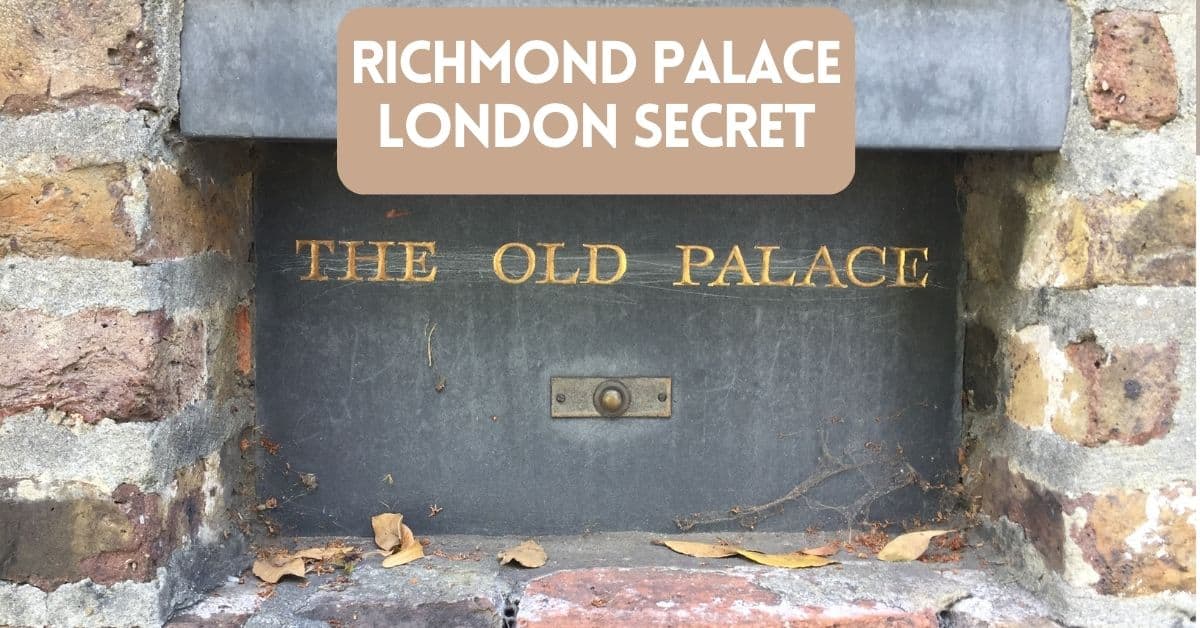
Richmond Palace London – What Remains and How to Visit This Hidden Gem
Last updated: September 2026
Richmond Palace was once one of England’s great Tudor royal residences, but most visitors to London have no idea where to find it—or that parts of it still survive. Today, you won’t find a ticketed palace like Hampton Court. Instead, you can see surviving Tudor fabric around the southwest edge of Richmond Green, including the original palace gateway and Gate House, sections of the old palace wall, and remnants incorporated into later buildings around Old Palace Yard.
Henry VII rebuilt the palace after a devastating fire at the earlier palace of Shene and renamed it Richmond in 1501. Both Henry VII and Queen Elizabeth I died here. We came looking for Richmond Palace for an unusually personal reason: the site also connects to our own family history during World War II. In this guide, we’ll show you where Richmond Palace was, what remains today, what visitors can actually see, and whether it is worth seeking out during a visit to Richmond.
Historic England identifies the original palace gateway and surviving Gate House/Old Palace fabric, while Richmond Council identifies the Gate House, boundary walls, and Wardrobe as incorporating standing Tudor remains.
The Places Where We Go contains affiliate links and is a member of the Amazon Services LLC Associates Program. As an Amazon Associate, we earn from qualifying purchases at no extra cost to you when you purchase using one of these Amazon links. Read our disclaimer and privacy policy for more information.
Richmond Palace At-A-Glance
| Location | Richmond upon Thames, southwest London |
|---|---|
| What is it? | The surviving remains of a former Tudor royal palace |
| Built | Rebuilt by Henry VII around 1501 |
| What remains? | Tudor gateway, Gate House, sections of palace wall, Old Palace Yard, and other surviving Tudor fabric |
| Can you go inside? | No. Most surviving buildings are private residences |
| Admission | Free to view from public streets and paths |
| Nearest station | Richmond Station |
| Walk from station | About 10 minutes |
| Best for | Tudor history, royal history, architecture, and hidden London attractions |
| Allow | 30–60 minutes for the palace remains and Richmond Green |
| Nearby | Museum of Richmond, Richmond Green, and the River Thames |
Can You Visit Richmond Palace Today?
Yes—but visiting Richmond Palace today is very different from touring a royal attraction such as Hampton Court Palace or Windsor Castle. Most of the Tudor palace disappeared centuries ago, and there is no ticket office, visitor center, or restored royal interior to explore.
Instead, a visit to Richmond Palace is about discovering the surviving pieces of the former royal residence around Richmond Green and Old Palace Yard. Several remnants of Henry VII’s palace remain incorporated into later buildings. Still, this is where Tudor monarchs once lived, entertained their court, and governed.
For travelers interested in Tudor history, Richmond Palace is especially intriguing because the surviving remains sit quietly within a modern residential neighborhood. You may walk past them without realizing their significance unless you know what to look for.
What You Can See
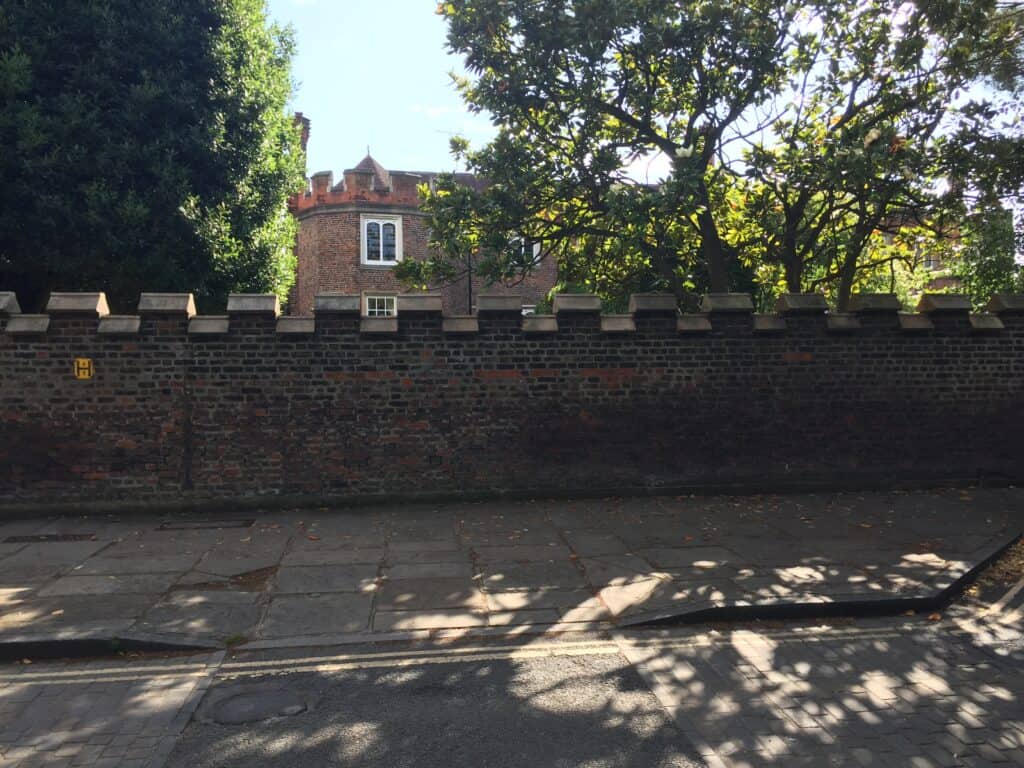
Surrounded by an extensive brick wall, getting a good view of Richmond Palace can be challenging. An informative panel outside the property recaps its history as far back as the 1200s. At one time, Richmond Palace pioneered garden spaces with knot garden and Renaissance-style garden styles.
The most recognizable surviving feature is the original palace gateway facing Richmond Green. This entrance once led into the palace complex and today opens toward Old Palace Yard. Look above the archway for the royal arms associated with Henry VII.
Adjoining the gateway is the historic Gate House, which incorporates surviving fabric from the Tudor palace. The combination of brickwork, gateway, and adjoining buildings provides perhaps the clearest impression of what remains from the former royal residence.
Visitors may also be able to walk through and around Old Palace Yard, which occupies part of the former palace site. Although the buildings surrounding the yard largely date from later periods, portions of the Tudor complex survive within them. Note, during our visit, we weren’t sure if we could enter through the Gate House so we did most of our viewing from the perimeter of Richmond Palace.
Elsewhere around the former palace grounds, sections of the old palace wall and surviving Tudor material associated with buildings traditionally known as the Wardrobe offer additional clues to the scale and layout of Richmond Palace.
One of the pleasures of visiting is simply exploring slowly. Street names such as Old Palace Lane and Old Palace Yard help reveal the history hidden within the modern neighborhood.
Allow some time to walk around Richmond Green, examine the surviving gateway and brickwork, and continue toward the Thames. Although only fragments of Richmond Palace remain, knowing their history makes it much easier to imagine the enormous royal complex that once occupied this part of Richmond.
What Is Private
It is important to remember that the surviving Richmond Palace buildings are not a museum or publicly accessible palace attraction. Many of the historic structures around Old Palace Yard are now private residences.
Visitors should therefore enjoy the palace remains from public streets, paths, and accessible areas without entering private courtyards, gardens, doorways, or residences. You can photograph the exterior of the Tudor gateway and other visible architectural remains from public areas, but this is also a residential neighborhood, so a respectful visit is appropriate.
You should not plan to tour furnished rooms or walk through the surviving houses. Think of Richmond Palace as an historic site to discover rather than a palace to tour.
That distinction is worth knowing before making a special trip. If your goal is to walk through grand Tudor chambers and see recreated royal interiors, nearby Hampton Court Palace will provide a more traditional palace experience. But if you enjoy finding traces of lost London, Tudor history, or places that most visitors overlook, Richmond Palace is a fascinating stop—and one that feels remarkably removed from London’s busiest tourist attractions.
Get Free Weekly Travel Planning Guide
Destination Ideas – Practical Tips – Timely Travel News

Where Is Richmond Palace in London?
Richmond Palace was located in Richmond upon Thames in southwest London, between Richmond Green and the River Thames. Although most of the enormous Tudor palace has disappeared, several surviving remains can still be found along the southwest side of Richmond Green and around Old Palace Yard.
If you are using a map or navigation app, don’t expect to find a large attraction labeled “Richmond Palace.” A better landmark is the Richmond Palace Gate House on Richmond Green. The original palace gateway still leads from the Green into Old Palace Yard, where portions of Henry VII’s palace survive within later buildings.
The location makes Richmond Palace particularly easy to combine with other attractions in Richmond. After seeing the palace remains, you can explore Richmond Green, walk down Old Palace Lane toward the Thames, visit the nearby Museum of Richmond, or continue along the riverside.
Getting to Richmond Palace by Train or Tube
For most visitors, public transportation is the easiest way to reach Richmond Palace.
Richmond Station is served by several forms of London transportation:
- London Underground: Take the District line to Richmond, which is the western terminus of this branch of the line.
- London Overground: Richmond is also served by the Mildmay line, providing connections through areas of west and north London.
- National Rail: South Western Railway operates trains between Richmond and London Waterloo, making this a convenient option when traveling from central London.
If you’re staying near Waterloo or another station with convenient South Western Railway connections, the National Rail option can be particularly useful. If your London accommodations are near a District line station, taking the Underground may be more convenient even if the journey takes a little longer.
Because engineering work and service changes occasionally affect London’s rail network, we recommend checking Transport for London or National Rail before setting out.
Travel tip: You do not need a car to visit Richmond Palace. Richmond’s historic center, Richmond Green, the palace remains, and the riverside are all easily explored on foot after arriving at Richmond Station.
Flying into London and prefer a door-to-door transfer? Welcome Pickups offers pre-booked airport transfers from Heathrow, Gatwick, and other London airports directly to your hotel or accommodation.
Walking from Richmond Station
The walk from Richmond Station to the remains of Richmond Palace is short and provides a pleasant introduction to historic Richmond. Allow roughly 10 minutes to reach the palace gateway, depending on your pace and how often you stop along the way.
From the main exit at Richmond Station:
- Cross the road outside the station and make your way into Old Station Passage, the pedestrian passage opposite the station.
- At the end of the passage, turn left toward Little Green.
- Continue past Richmond Theatre, with Little Green alongside you.
- You’ll soon arrive at the larger Richmond Green.
- Cross Richmond Green toward its southwest side, where you’ll find the surviving Richmond Palace buildings.
- Look for the distinctive red-brick Tudor gateway leading into Old Palace Yard. Above the arch are the restored arms of Henry VII.
The gateway is the feature that makes the former palace site easiest to identify. It was once the principal landward entrance to Henry VII’s palace and led into the palace’s Great Court.
Don’t rush across Richmond Green. Part of the appeal of visiting Richmond Palace is approaching it on foot and gradually spotting the clues that a royal residence once occupied this quiet corner of London. Historical information boards around the Green can also help you picture the scale and layout of the long-lost palace.
After seeing the gateway and Old Palace Yard, consider continuing along Old Palace Lane toward the River Thames. It turns a visit to the palace remains into an easy walking excursion through one of the most attractive parts of Richmond.
Where To Stay Near Richmond Palace
Use our interactive map below to find lodging options near Richmond Palace.
What Remains of Richmond Palace?
Most of Richmond Palace disappeared centuries ago, but the palace has not vanished completely. Several important pieces of the former royal complex still survive around Richmond Green and Old Palace Yard, some incorporated into buildings that were altered or rebuilt long after the Tudor period.
That is part of what makes searching for Richmond Palace so interesting. Rather than arriving at a single preserved monument, you have to look for clues—the original palace gateway, Tudor brickwork, portions of old walls, historic buildings, and even street names such as Old Palace Yard and Old Palace Lane.
Knowing what to look for makes a visit much more rewarding.
The Tudor Gateway and Gate House
The easiest surviving feature to identify is the original Richmond Palace gateway facing Richmond Green. This was once the principal landward entrance to Henry VII’s palace and led directly into the Great Court.
Walk up to the gateway and look above the arch. You’ll see the arms of Henry VII, which were restored during the 20th century. Even after so much of the palace disappeared, visitors can still pass through essentially the same entrance used to access this important Tudor royal residence centuries ago.
Beside the gateway stands the Gate House, one of the most significant surviving pieces of Richmond Palace. Although it has been altered over the centuries, much of its Tudor structure remains. Look closely at the dark red brickwork, including decorative patterns created with darker bricks. This style of patterned brickwork, known as diapering, is one of the architectural details to watch for as you explore the site.
The neighboring building known as The Old Palace also incorporates some remains of Henry VII’s palace, although much of its present appearance dates from later rebuilding.
This was one of our favorite parts of searching for Richmond Palace. When you first approach Richmond Green, it is easy to see a collection of attractive historic buildings without realizing that portions of a Tudor royal palace are still standing in front of you. Once you identify the gateway and Tudor brickwork, the history becomes much easier to visualize.
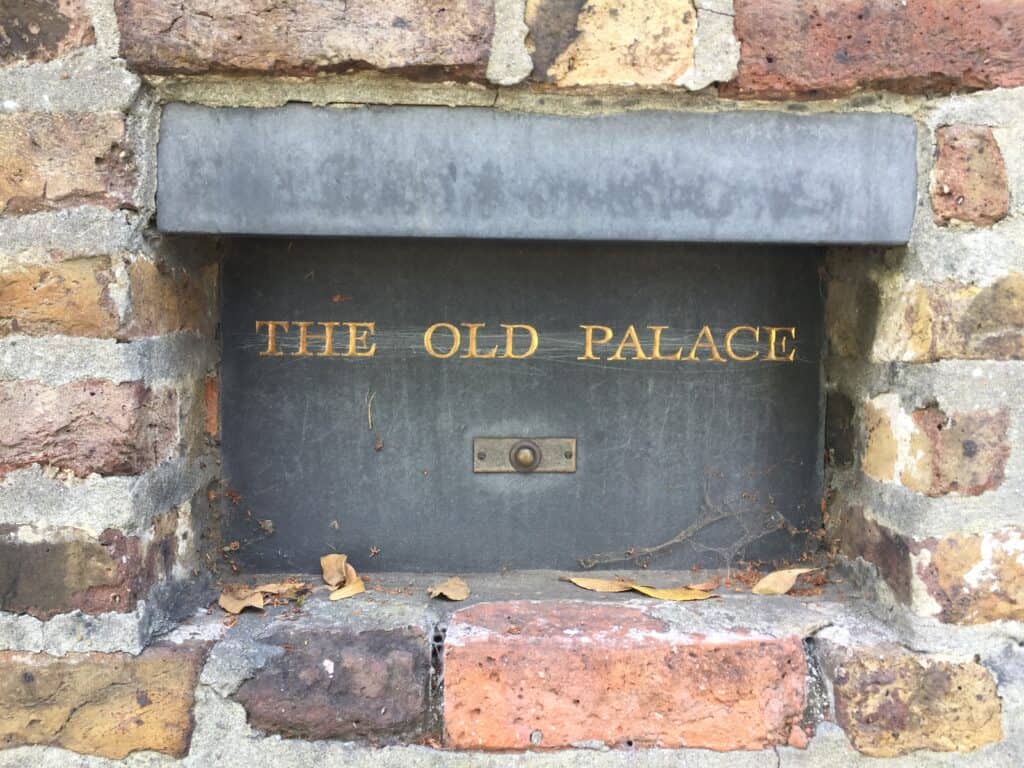
Old Palace Yard
Walk through the Tudor gateway and you enter Old Palace Yard, one of the best places to imagine the scale of Richmond Palace.
The present yard corresponds approximately with the palace’s former Great Court. During the Tudor period, buildings surrounded this large courtyard, including accommodations for members of the royal household and court as well as the palace Wardrobe.
Today the scene is much quieter. The buildings surrounding Old Palace Yard are largely private residences, and many date from periods after the palace’s royal heyday. Above ground, much of the Tudor palace that once enclosed the courtyard has disappeared.
Still, standing in Old Palace Yard gives you something that looking at a historic drawing cannot: a sense of place. You can walk through the original palace entrance and stand approximately within one of the principal courtyards of a residence used by monarchs including Henry VII, Henry VIII, and Elizabeth I.
As we explored the area, names such as Old Palace Yard and nearby Old Palace Lane became important clues that we were walking across the former palace grounds. This is one of those places where knowing the history transforms what might otherwise appear to be a quiet residential corner of Richmond.
Remember that Old Palace Yard is a residential area rather than a tourist attraction. Enjoy the architecture and history from public areas and respect the privacy of the people who live in the surviving historic buildings.
The Palace Wall and Wardrobe
Some of the most intriguing Richmond Palace remains require a closer look.
Along the former palace site are surviving sections of historic palace wall, further evidence of the boundaries and buildings that once defined the royal complex. Although these remnants do not immediately convey the grandeur of the palace shown in old illustrations, they are genuine pieces of the historic site and help reveal just how extensive Richmond Palace once was.
Another important survivor is the building known as The Wardrobe, located along Old Palace Yard.
During the palace era, the Wardrobe occupied the eastern side of the Great Court. Its name refers to an important part of the royal household responsible for storing furnishings and other materials used by the court. Surviving Tudor-era fabric can still be seen within the present building.
Look for the distinctive 16th-century diapered brickwork, created using darker brick headers to form patterns across the wall. Although the Wardrobe was substantially altered in later centuries—including changes to its windows and garden-facing side—the surviving Tudor brickwork provides another tangible connection to Henry VII’s palace.
The Wardrobe is particularly interesting because Richmond Palace was not simply a collection of grand rooms for kings and queens. A royal palace also needed an enormous supporting operation: servants, officials, kitchens, storage areas, furnishings, gardens, courtyards, and accommodations for members of the court. Buildings such as the Wardrobe help tell that broader story of daily life within a Tudor palace.
Together, the gateway, Gate House, Old Palace Yard, surviving walls, and Wardrobe are enough to make Richmond Palace more than simply the site of a lost building. You will not see anything comparable to the intact Tudor grandeur of Hampton Court Palace, but the fragments that remain allow you to stand within the footprint of a palace that played an important role in English royal history.
For us, that was part of the appeal. Richmond Palace isn’t a place where everything has been reconstructed and explained for you. Instead, you discover the palace piece by piece—and once you know what survives, it becomes much easier to picture the royal residence that once stretched from Richmond Green toward the River Thames.
A Brief History of London’s Richmond Palace
Long before it was known as Richmond Palace, a royal residence stood here under the name Shene, or Sheen. Over several centuries, kings and queens rebuilt, enlarged, abandoned, and returned to the site before Henry VII transformed it into one of the great palaces of the Tudor court.
Richmond Palace eventually became associated with some of the most famous names in English history, including Henry VII, Henry VIII, Catherine of Aragon, Anne of Cleves, Mary I, and Elizabeth I. Royal births, deaths, political decisions, court celebrations, and theatrical performances all took place here.
Its story, however, began long before the Tudors.
From the Medieval Palace of Shene to Henry VII
Royal connections with Shene stretch back at least to the 12th century. Henry I stayed at the manor, and later medieval kings continued to use the site.
During the reign of Edward III, extensive work transformed Shene into an important royal residence. Edward III died there in 1377, after which the palace passed to his grandson, Richard II.
Richard and his wife, Anne of Bohemia, made Shene one of their principal residences. Their time there ended tragically when Anne died at Shene in 1394. Grief-stricken, Richard ordered the manor to be demolished the following year.
The royal residence did not remain abandoned for long. Henry V ordered Shene rebuilt in 1414, and additional work was carried out during the reign of Henry VI. By the late 15th century, it had once again become an important royal property.
The most dramatic transformation came after Henry VII, the first Tudor monarch, reclaimed Shene following his victory in the Wars of the Roses.
On December 23, 1497, while the royal family was staying there, a major fire destroyed much of the palace. Rather than abandon the site, Henry VII rebuilt it on a grand scale.
The resulting palace included royal apartments, a great hall, chapel, kitchens, courtyards, gardens, galleries, and other buildings necessary to accommodate the monarch and the enormous royal household. Its towers overlooking the Thames must have created a striking sight for anyone approaching by river.
In 1501, Henry VII renamed the palace Richmond, drawing on his association with the title Earl of Richmond. The surrounding settlement eventually adopted the same name—which is why this part of southwest London is known as Richmond today.
Richmond became one of Henry VII’s favored residences and an important setting for Tudor court life. In 1502, his daughter Margaret Tudor was formally betrothed here to James IV of Scotland, a marriage that would eventually have enormous consequences for the English succession.
Henry VII spent his final days at Richmond Palace and died here on April 21, 1509.
His son Henry VIII then inherited both the throne and the magnificent palace his father had created.

Henry VIII and Richmond Palace
Richmond Palace continued to play an important role during the reign of Henry VIII, although Henry never seems to have been quite as attached to Richmond as his father had been.
Shortly after becoming king in 1509, Henry celebrated Christmas at Richmond with his new queen, Catherine of Aragon.
In January 1511, Catherine gave birth at Richmond to a son, Henry, Duke of Cornwall. The arrival of a male heir was celebrated throughout the kingdom, but the joy was short-lived. The infant prince died only weeks later.
As Henry’s reign continued, another royal palace began competing for his attention: Hampton Court Palace.
Cardinal Thomas Wolsey had developed Hampton Court into an extraordinarily lavish residence. As Wolsey fell from royal favor, Henry acquired Hampton Court, while Wolsey was required to accept Richmond in exchange in 1530.
Hampton Court subsequently became one of the palaces most closely associated with Henry VIII, but Richmond remained part of the royal story.
After Henry’s marriage to Catherine of Aragon ended, Richmond became associated with members of his former family. Catherine and her daughter Mary spent time there, and later another of Henry’s queens would make Richmond her home.
Following the annulment of Henry’s marriage to Anne of Cleves in 1540, Richmond Palace was included among the properties granted to Anne as part of the settlement. Unlike several of Henry’s other marriages, the relationship between Henry and Anne remained comparatively cordial. Anne entertained the king and his daughters at Richmond on several occasions.
Richmond therefore became linked not only with Henry VIII himself but also with several of the women whose lives became entwined with the Tudor dynasty.
After Henry’s death, the palace continued to pass among members of the royal family. Edward VI used it, Mary I spent time there, and Princess Elizabeth was even held at Richmond for a period during Mary’s reign.
But it was under Elizabeth I that Richmond Palace once again became a favorite royal residence.
Elizabeth I at Richmond Palace
Of all the monarchs associated with Richmond Palace, Queen Elizabeth I had one of the strongest connections to it.
Beginning soon after her accession in 1558, Elizabeth spent increasingly long periods at Richmond. The palace became particularly favored as a winter residence, when its relatively compact royal apartments were easier to keep warm than some of the Crown’s larger palaces.
Richmond was not simply a place for Elizabeth to retreat from London. It became an active center of court life and government.
Important political business was conducted here. In 1586, Elizabeth wrote from Richmond concerning the sentence passed against Mary, Queen of Scots. Two years later, as England faced the threat of the Spanish Armada, Elizabeth and her advisers made preparations at Richmond and ordered warning beacons to be readied.
The palace was also a place of entertainment.
Theatrical companies regularly performed before the queen and her court at Richmond. Among them was the Lord Chamberlain’s Men, the acting company associated with William Shakespeare. Imagine standing today near Old Palace Yard knowing that Shakespeare’s company once traveled to this same royal complex to entertain Elizabeth and her courtiers.
Elizabeth also enjoyed hunting in the surrounding countryside, and Richmond provided easier access to royal hunting grounds away from increasingly crowded central London.
As Elizabeth grew older, Richmond remained one of her preferred residences. It ultimately became the place where the final chapter of the Tudor dynasty unfolded.
Queen Elizabeth I died at Richmond Palace on March 24, 1603, ending a reign of more than 44 years.
With her death, the Tudor dynasty came to an end. The palace passed to the Stuarts, but Richmond would never again enjoy quite the same position at the center of royal life.
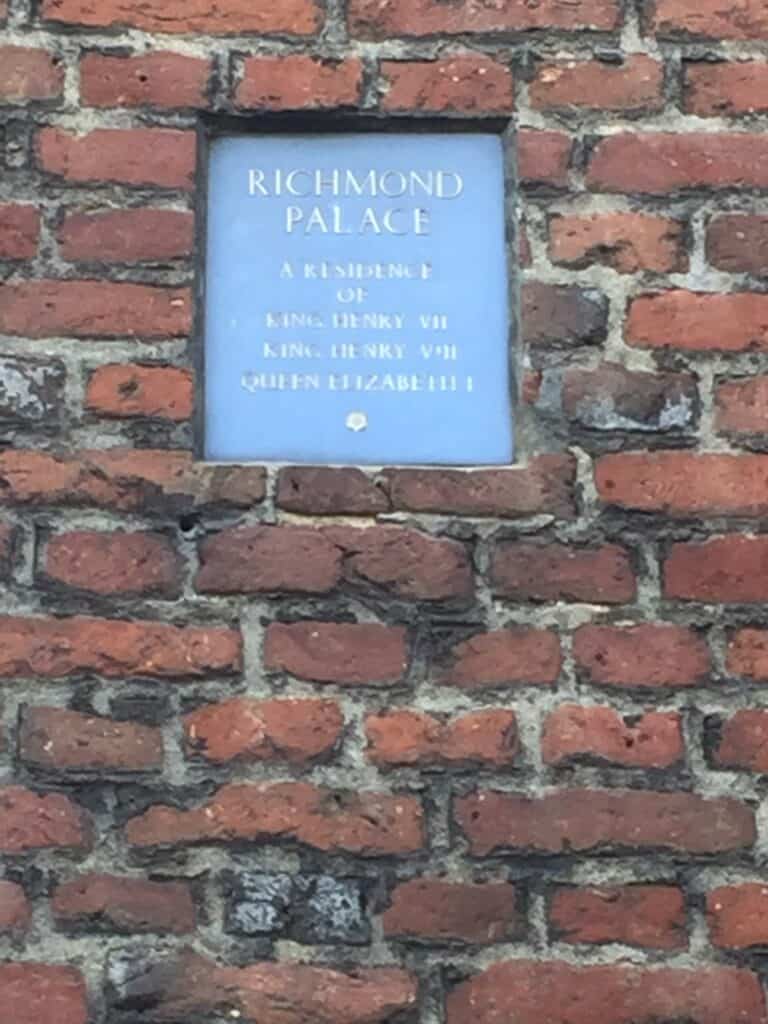
A blue plaque on a wall identifies the property as the former residence of King Henry VII (formerly known as the Earl of Richmond) and Queen Elizabeth I. Both of these monarchs also died at Richmond Palace.

Why Richmond Palace Was Demolished
Richmond Palace did not disappear because of a single fire or one dramatic act of destruction. Instead, its decline and demolition occurred gradually, particularly following the turmoil of the English Civil War.
The palace remained in royal use after Elizabeth’s death. Henry, Prince of Wales, the eldest son of James I, lived at Richmond and made improvements there before his death in 1612. Charles I also used Richmond Palace and expanded the royal art collection housed there.
But the struggle between Charles I and Parliament changed the palace’s future.
Following the defeat and execution of Charles I in January 1649, Parliament took control of royal properties across England. Richmond Palace was no exception.
Later that year, the palace and manor were sold to private purchasers. Once the enormous royal complex was divided among different owners, there was little incentive to preserve it as a palace.
Buildings were dismantled, and valuable materials such as stone, brick, timber, and architectural fittings could be removed and sold or reused elsewhere. Records from 1651 already refer to carts carrying stone away from the “Great House,” evidence that the demolition of Richmond Palace was underway.
When the monarchy was restored under Charles II in 1660, the palace was returned to royal hands, but by then much of the damage had been done. Richmond was already described as being close to ruin, and it never regained its former importance as a royal residence.
Over the following decades and into the 18th century, houses and other buildings gradually occupied portions of the former palace grounds. Parts of the old royal buildings were incorporated into later structures while other sections disappeared entirely.
That explains why Richmond Palace can be slightly confusing for first-time visitors today. There was no single event in which the entire palace vanished. Instead, a once-vast royal residence was sold, divided, dismantled, altered, and gradually built over.
Fortunately, a few tangible reminders survived.
The Tudor gateway, Gate House, Old Palace Yard, portions of historic wall, and Tudor fabric within buildings such as the Wardrobe still provide clues to the palace that once stretched between Richmond Green and the River Thames.
Considering that Richmond was once one of England’s great royal residences—and the place where both Henry VII and Elizabeth I died—it is remarkable how easily visitors to London can overlook it today.
In Search of Richmond Palace in London
We added Richmond Palace on our London itinerary as we were exploring areas that connected me to my dad’s history when he was in London. Our visit to the Trenchard Museum at RAF Halton in Wendover was the starting point for this family-history tour.
Our Family Connection to Richmond Palace
Our search for Richmond Palace also had a deeply personal connection. My father, Bolesław Dobrucki, spent time in Richmond during World War II, which inspired us to retrace parts of his story in our article Walking in the Footsteps of Bolesław Dobrucki.
During WWII, my dad visited here on holiday from the Royal Air Force in Halton. Along with other young Polish boys serving in the RAF, he was brought to the residence as a guest of Virginia Cherrill, known then as Lady Jersey. We confirmed this bit of family history through photos and depictions in the book “Survivors of War” by Dan Dobrucki.
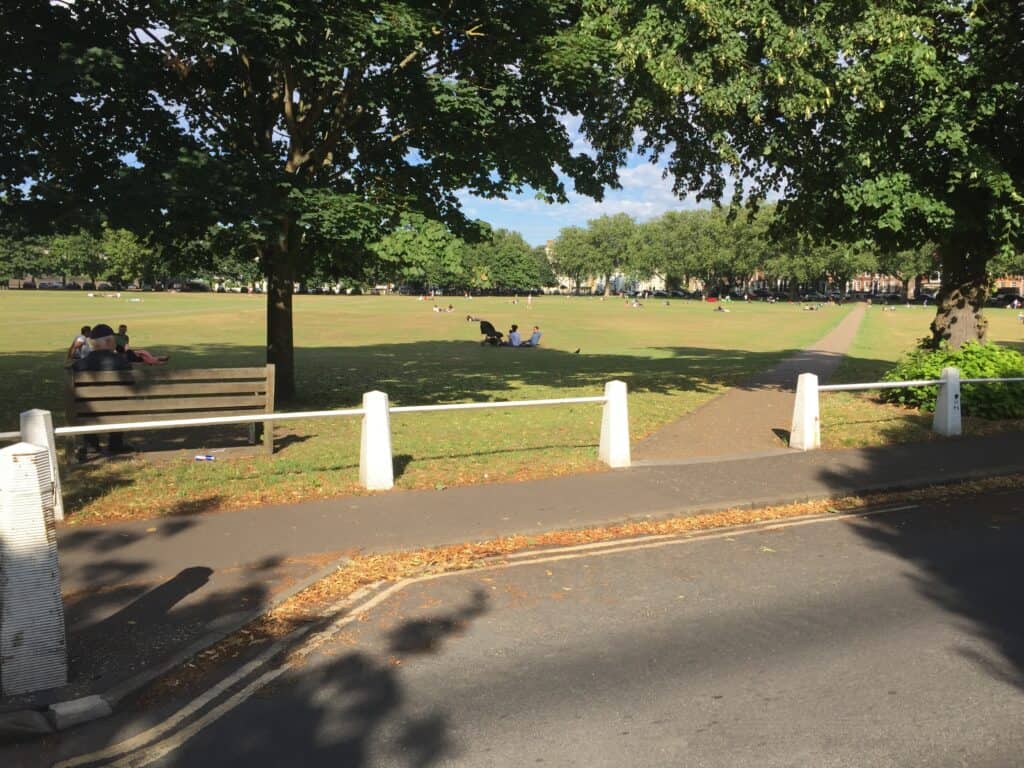
Our Journey to Richmond Palace through Richmond Green
We traveled to the Richmond district to find the grounds of Richmond Palace. Stepping out of Richmond Station, we entered the bustling main avenue lined with storefronts for block after block.

We thought this was a strange place for a palace residence. We turned a corner and walked towards Richmond Green – a vast open-air park for the public.
Richmond Green is a beautiful and historic open space in Richmond, London. It covers over 12 acres and is surrounded by stunning architecture, including Georgian townhouses, the Church of St Mary Magdalene, and our destination: the iconic Tudor gatehouse of Richmond Palace.
The green is known for its peaceful atmosphere, where locals and visitors can relax on the grass or take a leisurely walk around the perimeter. It also serves as a popular spot for picnics, outdoor events, and even cricket matches during the summer months. The park is well-maintained, with colorful flower beds, tree-lined paths, and benches for people to sit and enjoy the surroundings.
Richmond Green is an integral part of the local community. It provides a place to relax for anyone looking to escape the hustle and bustle of central London.
REQUEST TO READERS: If a property resident someday stumbles upon this article, we are a flight away from a trip back to London should the opportunity to tour the grounds ever arise.
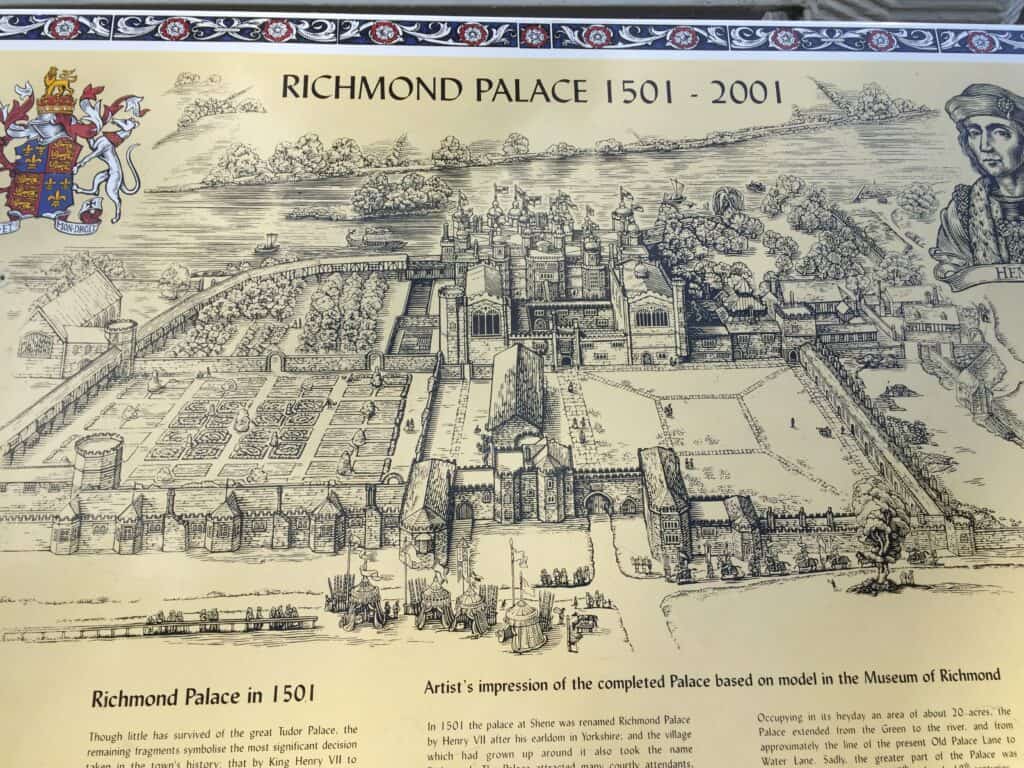
Is Richmond Palace Worth Visiting?
Richmond Palace is worth visiting if you enjoy Tudor history, royal history, hidden London sites, or places where you have to use a little imagination to reconstruct the past. It is less suitable for travelers expecting a fully preserved palace with grand interiors, exhibitions, or guided tours.
What survives today is relatively modest: the Tudor gateway, Gate House, Old Palace Yard, portions of historic walls, and Tudor fabric incorporated into later buildings. You can see the principal remains fairly quickly, so we would not necessarily travel across London solely for Richmond Palace unless the history is a particular interest.
However, the experience becomes much more worthwhile when combined with Richmond Green, the Museum of Richmond, and a walk along the River Thames. Together, these stops can easily create a pleasant half-day in Richmond.
For us, the appeal was also personal. We came searching for Richmond Palace because of our family connection to the area, but even without that connection, there is something fascinating about standing at the gateway of a palace once used by Henry VII, Henry VIII, and Elizabeth I and realizing how little of this important royal site survives today.
Richmond Palace also offers something increasingly rare in London: the chance to encounter significant history without crowds, entrance fees, or the feeling of visiting a heavily managed tourist attraction.
Who Will Enjoy Richmond Palace Most?
Richmond Palace is especially worth seeking out if you:
- Enjoy Tudor and British royal history
- Like discovering lesser-known London attractions
- Are interested in historic architecture and archaeology
- Enjoy photographing old buildings and unusual historical details
- Are already planning to visit Richmond or Richmond upon Thames
- Prefer quieter historic sites away from central London’s busiest attractions
If your priority is seeing impressive Tudor interiors, royal apartments, tapestries, kitchens, and extensive palace grounds, Hampton Court Palace is the stronger choice.
But if the idea of finding the surviving traces of a largely lost Tudor palace sounds intriguing, Richmond Palace is well worth adding to your Richmond itinerary.
Our verdict: Richmond Palace is not a must-see attraction for every first-time visitor to London, but for history lovers and travelers who enjoy uncovering places most tourists overlook, it is a rewarding and memorable stop.
Love Discovering London’s Hidden Royal History?
Richmond Palace is only one of several fascinating royal sites that many London visitors overlook. We’ve created a free Hidden Royal London guide featuring 7 overlooked palaces and royal sites, including lost Tudor palaces, medieval survivors, and lesser-known royal residences you can still discover today.
Download our FREE Hidden Royal London guide →
See More of Richmond’s Tudor History
A visit to Richmond Palace does not need to end at the surviving gateway. Two nearby stops can add useful context and help you better understand how the palace shaped the town around it.
Museum of Richmond
The Museum of Richmond is an excellent companion stop after exploring the palace remains. Located in the Old Town Hall near the Thames, the museum tells the story of Richmond from its early history through its years as an important royal residence and beyond.
Its collection includes material connected with Richmond Palace, including Tudor objects and archaeology, helping visitors picture the royal complex that once stood nearby. Because so little of the palace survives above ground, seeing artifacts associated with the site can make the history considerably easier to visualize.
Admission is currently free, making the museum an especially worthwhile addition if you have time after visiting Old Palace Yard. Check the museum’s website for current opening days and hours before your visit.
Richmond Green and the Thames
Richmond Palace once stood between Richmond Green and the River Thames, so spending a little time exploring both helps put the surviving remains into context.
Richmond Green was closely connected with palace life and was used for activities including jousting and archery during the royal period. Many of the historic buildings around the Green also reflect Richmond’s long association with the palace and the people who served or visited the royal court.
From the palace site, continue toward the River Thames for one of the most pleasant parts of a visit to Richmond. The river was an important transportation route for the royal household, providing convenient access between Richmond and other royal residences closer to central London.
Today, the combination of the Tudor remains, Richmond Green, and the riverside makes it much easier to appreciate why this location was so attractive to English monarchs—and turns a quick stop at Richmond Palace into a more complete exploration of historic Richmond.
Frequently Asked Questions – FAQ
Not as a complete palace. Most of Richmond Palace was dismantled and built over after the English Civil War, but several important remnants still survive around Richmond Green and Old Palace Yard. Visitors can see the original Tudor gateway, the Gate House, sections of historic palace wall, Old Palace Yard, and Tudor fabric incorporated into buildings such as the Wardrobe. So while you cannot tour Richmond Palace as an intact royal residence, you can still visit the site and see genuine remains of Henry VII’s Tudor palace.
Yes. Henry VIII inherited Richmond Palace from his father, Henry VII, and used it during the early years of his reign. He celebrated Christmas there with Catherine of Aragon in 1509, and their son Henry, Duke of Cornwall, was born at Richmond in January 1511. Although Henry later became more closely associated with Hampton Court Palace, Richmond remained an important royal residence and was also used by members of his family, including Catherine of Aragon and Anne of Cleves.
Yes. After Henry VIII’s marriage to Anne of Cleves was annulled in 1540, Richmond Palace was among the properties granted to her as part of the settlement. Anne used Richmond as one of her residences and remained on relatively good terms with Henry after the annulment. She even entertained the king and members of the royal family there on occasion. Her association with Richmond adds another Tudor chapter to the palace’s history beyond the reigns of Henry VII, Henry VIII, and Elizabeth I.
Yes. Richmond became one of Elizabeth I’s favored residences, particularly in winter. Court entertainments were regularly staged there, including performances by the company of which William Shakespeare was a member. Elizabeth died at Richmond Palace in 1603.
Richmond Palace no longer exists as it was largely demolished in the 17th century by order of the Parliament of England. The main entrance and gatehouse still stand and are occupied as private residences today.
Richmond Palace is not open to the public as a conventional tourist attraction. The surviving buildings are largely private residences, so visitors come to see the exterior remains and historic palace site.
After Charles I was executed in 1649, the Commonwealth sold Richmond Palace to private purchasers. Its buildings were divided and significant sections were dismantled, with materials sold off. Later development gradually replaced much of the former palace.
Listen to our Richmond Palace Podcast episode
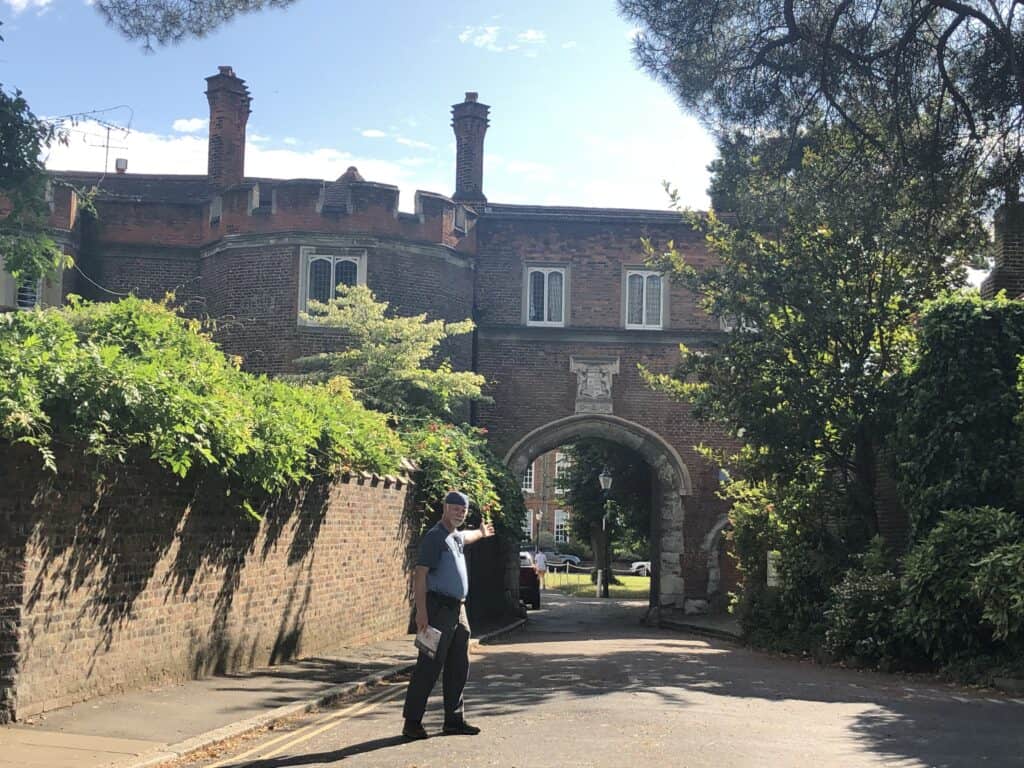
Concluding Our Search For Richmond Palace in London
This destination won’t land on the itineraries of many tourists in London. It is a fascinating hidden gem for those interested in the history of the monarchy and architecture. For us, it checked off a bucket list stop as we continued seeking historic destinations connected to our family history.
What destinations are part of your genealogical pilgrimage?
Thanks for reading our article. Happy travels, and we hope to see you at the places where we go!
Julie & Art
#richmondpalace
Richmond Palace London
Sources
Sources consulted include, but are not limited to, the following:
History of English Gardens
Historic England
London Museum
Museum of Richmond
Planning more royal history stops in London? Download our free Hidden Royal London: 7 Overlooked Palaces & Royal Sites guide and discover six more historic places to pair with Richmond Palace.
More London History & Travel Guides
A Day Trip to Osterley House
Best Catholic Churches in London for Mass – 5 Worth Visiting
Discover London Food – Exploring the City’s Vibrant Food Scene
Fun Things To Do in London For Couples
Top 10 Polish History Sites to Explore in London
Two Days in London – A Perfect Itinerary For Your Visit
More family roots travel adventures
Tracing Welsh ancestry in Raglan, Wales
Walking in the footsteps of Boleslaw Dobrucki
Exploring family roots in East Los Angeles

4 Comments
Comments are closed.